
Table of Contents
Why The AI Content Debate Matters?
One of the most common questions marketers, bloggers, business owners, and SEO professionals ask today is simple: Does Google penalize AI content? The rise of artificial intelligence tools has transformed content creation, allowing websites to publish articles, product descriptions, landing pages, and marketing copy at unprecedented speed.
At the same time, fear and misinformation have spread across the SEO industry. Many website owners worry that publishing AI-generated content could trigger ranking penalties, reduce visibility, or even result in deindexation from Google Search.
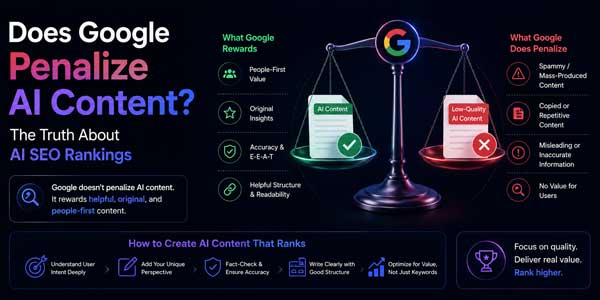
The reality is far more nuanced than the rumors suggest. Google does not automatically punish content simply because artificial intelligence helped create it. Instead, Google’s focus remains centered on quality, usefulness, originality, and user satisfaction metrics.
Understanding how Google evaluates content is critical because the difference between success and failure often has less to do with the writing tool and more to do with how human editors produce, review, and publish the content.
Google’s Official Position On AI Content:
Google has publicly addressed AI-generated content multiple times. The company’s guidance consistently emphasizes that content should be created for people first rather than for manipulating search engine algorithms or ranking systems.
In other words, Google is not attempting to detect and ban every piece of content that contains AI assistance. Instead, its systems evaluate whether the content delivers real value to users and fulfills search intent effectively.
Google’s search quality systems focus on outcomes rather than production methods. A human-written article filled with inaccuracies can perform poorly, while a carefully reviewed AI-assisted article can rank well if it provides useful information.
This distinction is important because it shifts the conversation away from whether AI was involved and toward whether the final content deserves visibility in organic search results based on merit.
What Google Actually Cares About?
- Accuracy and factual reliability
- Original insights and expert perspectives
- Helpful information tailored for real users
- Strong user experience and page layout
- Trustworthiness, transparency, and credibility
- Alignment with semantic search intent
If a page satisfies these core requirements, the use of AI alone is unlikely to create ranking problems or trigger algorithmic manual actions from quality raters.
Why Some AI Content Gets Penalized?
The confusion around AI SEO largely comes from websites that misuse artificial intelligence. Many publishers mistakenly believe that generating thousands of pages automatically guarantees more search traffic over time.
As a result, they publish low-quality content at scale without editing, fact-checking, or adding meaningful value. These pages often contain repetitive wording, shallow explanations, outdated information, and generic observations.
Google’s algorithms are designed to identify content that exists primarily to manipulate rankings rather than help users. When AI is used to mass-produce weak content, the issue is not the technology itself. The issue is poor content quality.
This is why some websites experience dramatic traffic declines after relying heavily on automated content. Search engines recognize patterns associated with thin, unhelpful, or spam-like pages regardless of whether a human or AI generated them.
Common Problems Found In Low-Quality AI Content:
- Factual inaccuracies and linguistic hallucinations
- Duplicate or near-duplicate scraped content
- Complete lack of expert human review
- Keyword stuffing and robotic optimizations
- Generic advice lacking real-world examples
- Poor understanding of complex user intent
- Excessive or programmatic content automation
These issues can harm rankings because they negatively impact user satisfaction and content quality signals that Google’s core algorithms measure continuously.
The Difference Between AI-Assisted And AI-Spam Content:
Not all AI content is created equally. There is a significant difference between using AI as a helpful writing assistant and using it as a fully automated, hands-off publishing machine.
AI-assisted content often starts with machine-generated drafts, comprehensive outlines, research summaries, or brainstorming ideas. Human editors then expand, verify, improve, and personalize the material before publication.
Conversely, AI-spam content follows a completely different path. It is usually generated automatically, published with little or no review, and designed primarily to capture search traffic rather than solve user problems.
Google’s systems are becoming increasingly effective at recognizing signals associated with low-value automated publishing. As a result, websites that prioritize sheer volume over genuine quality face much greater operational risk.
How E-E-A-T Influences AI SEO?
A major factor in modern SEO is Google’s E-E-A-T framework, which stands for Experience, Expertise, Authoritativeness, and Trustworthiness. While E-E-A-T is not a direct ranking factor, it strongly influences how content quality is assessed.
Content that demonstrates real-world experience often performs better because it provides unique perspectives that generic AI-generated text cannot easily replicate. Readers want evidence that the author understands the topic deeply.
For example, a cybersecurity expert discussing threat detection methods brings practical knowledge that improves credibility. A medical professional explaining treatment options provides authority that generic content lacks completely.
AI can help organize structured information, but human expertise remains essential for creating trustworthy content in highly competitive industries.
Ways To Strengthen E-E-A-T In AI-Assisted Content:
- Add original research, case studies, and internal data
- Include real-world examples and personal anecdotes
- Cite reputable, high-authority sources and studies
- Show clear author credentials and biographies
- Provide firsthand experience from subject matter experts
- Update information and statistics regularly
These best practices help transform basic AI-assisted drafts into authoritative resources that both users and search engine crawlers can trust implicitly.
Can Google Detect AI-Generated Content?
Many people assume Google has a system that instantly identifies every AI-generated article. The truth is more complicated. While Google possesses advanced machine learning capabilities, detecting AI text alone is not its primary objective.
Search algorithms focus on evaluating quality signals rather than simply determining who or what wrote the content. Even AI detection tools available online frequently produce false positives and inconsistent results.
A well-written article that undergoes extensive editing may appear entirely human to any detector. Conversely, some human-written articles can be incorrectly labeled as AI-generated by modern detection software due to formulaic writing.
This uncertainty is one reason Google emphasizes content quality over content origin. The search company ultimately cares about whether users find the information useful and engaging during their search journey.
How Helpful Content Updates Changed AI SEO?
Google’s Helpful Content System significantly reshaped the modern SEO landscape. Its core purpose is to reward content that genuinely helps users and reduce visibility for pages created mainly for search engine manipulation.
This update affected countless websites, including some that relied heavily on automated publishing strategies. Many publishers mistakenly blamed AI technology itself when their organic traffic dropped suddenly.
In reality, the affected sites often shared common characteristics: shallow content depth, excessive automation, weak expertise signals, and limited user value. The tool wasn’t the issue; the strategy was flawed.
Helpful Content principles apply equally to human-written and AI-assisted content. Pages that answer questions thoroughly, provide unique insights, and satisfy user expectations generally perform better over time.
Best Practices For Using AI Without Hurting Rankings:
Artificial intelligence can be an incredibly powerful productivity tool when used strategically. The key is viewing AI as an assistant rather than a full replacement for human expertise and editorial judgment.
Successful publishers use AI to accelerate workflows while maintaining strict quality control standards. Human oversight remains essential throughout every stage of the content creation process.
Practical AI SEO Recommendations:
- Create detailed content briefs before generating any text drafts
- Fact-check every single claim, statistic, and quote thoroughly
- Add personal insights, unique perspectives, and professional examples
- Edit aggressively for clarity, brand voice, and natural readability
- Match content format closely to the user’s specific search intent
- Avoid publishing completely unreviewed or unedited AI output
- Focus heavily on content quality instead of pure publishing volume
These actionable practices help ensure that artificial intelligence becomes a sustainable competitive advantage rather than an SEO liability for your website.
Industries Where AI Content Requires Extra Caution:
Some topics require especially high levels of accuracy and expertise. These areas are often categorized as Your Money or Your Life (YMYL) topics because inaccurate information could directly affect a person’s health, finances, safety, or long-term well-being.
Examples include medical advice, legal guidance, financial planning, insurance recommendations, and investment strategies. AI-generated errors in these sensitive industries can damage trust and create significant legal risks.
For YMYL content, human review should be completely mandatory. Subject matter experts should verify information, add professional insights, and ensure that all recommendations are accurate, safe, and highly responsible.
Google tends to scrutinize these topics more closely because the real-world consequences of misinformation can be substantial for the searcher.
The Future Of AI SEO And Search Rankings:
Artificial intelligence is rapidly becoming part of every single stage of content marketing. From keyword research and topic clustering to initial drafting and on-page optimization, AI tools are helping publishers work efficiently.
At the same time, search engines continue refining their ability to evaluate content quality metrics. This means shortcuts, programmatic spam, and low-value automation are becoming progressively less effective.
The future belongs to creators who combine AI efficiency with human expertise. Organizations that leverage modern technology while maintaining strong editorial standards will likely gain the greatest market advantage.
As organic search evolves, originality, credibility, and practical usefulness will remain fundamental ranking principles. Those core priorities are unlikely to change regardless of how sophisticated AI becomes.
Final Verdict: Does Google Penalize AI Content?
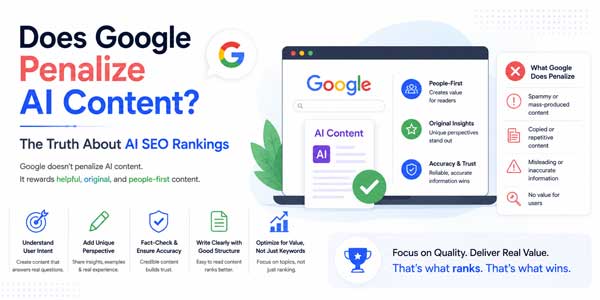
The short answer is no. Google does not penalize AI content simply because artificial intelligence was involved in its creation. What Google penalizes is low-quality content that fails to provide value to users or attempts to manipulate search rankings unfairly.
High-quality AI-assisted content can rank exceptionally well when it is accurate, helpful, original, and supported by human editorial expertise. Poorly executed automated content, on the other hand, will struggle regardless of how it was produced.
For businesses, marketers, and web publishers, the lesson is clear. Focus on creating content that genuinely helps your readers. Use AI to improve efficiency, but rely on human judgment to ensure quality, trust, and relevance.
When those principles guide your content strategy, AI transforms into a powerful SEO asset rather than a ranking risk.
Frequently Asked Questions:
1. Does Google Ban AI-Generated Content?
No. Google does not ban AI-generated content. The company evaluates content quality, usefulness, and relevance rather than the specific tool or method used to create it.
2. Can AI Content Rank On The First Page Of Google?
Yes. AI-assisted content can rank highly on the first page when it provides accurate information, satisfies user intent completely, and undergoes proper human editing and review.
3. Is AI Content Bad For SEO?
AI content is not inherently bad for SEO. Problems arise when publishers use AI tools to mass-produce low-quality, unhelpful, or inaccurate content to manipulate rankings.
4. How Can I Make AI Content More SEO-Friendly?
Improve AI-generated drafts by fact-checking information diligently, adding unique expert insights, including real-world examples, optimizing for user intent, and performing thorough human editing.
5. Does Google Have An AI Content Detector?
Google focuses primarily on evaluating core content quality rather than detecting AI usage. While advanced systems identify language patterns, ranking decisions are based on usefulness and value.













Be the first to write a comment.