
Table of Contents
Why Bulk Malware Links Are A Serious SEO Warning Sign
A sudden wave of strange links around your website can feel confusing at first. One day your traffic looks normal, and the next day Google Search Console shows odd URLs, spammy anchors, or pages you never created. That is when you need to check whether your competitors, bots, or hacked scripts added bulk malware links to your site.
This problem is different from a normal backlink issue. A backlink comes from another domain and points toward you. A malware link attack often involves spam links placed inside your own website, hidden in hacked pages, injected templates, comments, widgets, database rows, or redirected URLs. That makes the risk much higher.
Google’s spam systems are built to reduce manipulative search behavior, and hacked content or deceptive links can damage how users and crawlers see your site. Google Search Console may also show security warnings if a site hosts malware, unwanted software, phishing behavior, or hacked content. That is why fast detection matters.
The tricky part is that these links are not always visible on the front end. Some attackers hide them with CSS, JavaScript, cloaking, encoded code, database injection, footer scripts, fake sitemap URLs, or conditional redirects. A visitor may not notice anything, but a search crawler or security scanner may still detect the damage.
For business owners, bloggers, agencies, and eCommerce stores, the goal is simple: identify the suspicious links, confirm whether your site was compromised, remove the source, and protect rankings before the problem spreads. This guide explains how to do that in a practical, step-by-step way.
Understand What Competitor Malware Link Attacks Look Like
Before you run tools, you need to know what you are looking for. Competitor malware links usually appear as bulk spam URLs, unnatural outbound links, fake landing pages, or injected anchors that point to gambling, adult, pharma, crypto, loan, pirated software, or suspicious download sites.
Not every spam link is created by a competitor. Many attacks are automated. Bots scan weak plugins, outdated CMS files, writable directories, exposed admin panels, abandoned themes, leaked passwords, and poorly protected forms. Still, the SEO impact can look like negative SEO because your site becomes the host for someone else’s spam.
A hacked site may show hundreds or thousands of indexed URLs that were never part of your content plan. These URLs may include random words, foreign-language titles, fake product pages, casino terms, medicine names, or strange query strings. In some cases, the pages return 404 for humans but still appear in crawler reports.
Another common pattern is hidden outbound links inside real pages. For example, an old blog post may suddenly contain invisible anchors in the footer, or your homepage source code may include external links wrapped in encoded JavaScript. These links can quietly pass signals to malicious domains.
- Hidden Links: Links placed in CSS-hidden blocks, tiny fonts, off-screen elements, or invisible footer areas.
- Injected Pages: Spam pages created through hacked templates, database entries, or fake CMS routes.
- Redirect Traps: URLs that open normally for you but redirect visitors or crawlers under certain conditions.
- Spam Sitemaps: XML sitemaps polluted with URLs that do not belong to your website.
The most important mindset is this: do not assume it is harmless because you cannot see it on the homepage. Malware link spam often lives in places site owners rarely inspect, such as old uploads, cached files, plugin folders, theme functions, database options, and server-level rewrite rules.
Start With Google Search Console And Manual Checks
Google Search Console is usually the first place to check because it shows how Google sees your site. Open the Security Issues report first. If Google detects harmful behavior, hacked content, malware, phishing, or unwanted software, this section may show affected URLs and issue types.
Next, check the Manual Actions report. If Google has applied a manual action for unnatural outbound links, hacked content, pure spam, or other policy violations, you need to treat the issue as urgent. A manual action means your rankings may be partially or fully affected until the problem is fixed and reviewed.
Then review the Pages indexing report. Look for unusual spikes in indexed, crawled, excluded, or not found URLs. Spam attacks often create strange URL patterns at scale. You may see thousands of pages with weird slugs, query strings, foreign keywords, or irrelevant folders that never existed in your site structure.
The Links report is also useful, but use it carefully. If the problem is malware links inside your own site, your outbound links and internal link patterns matter more than inbound backlinks. Still, suspicious external domains linking to you can help you understand whether a broader negative SEO campaign is involved.
Search Operators That Reveal Hidden Spam
Manual Google searches can expose indexed spam quickly. Use search operators such as site:yourdomain.com casino, site:yourdomain.com viagra, site:yourdomain.com loan, or site:yourdomain.com “free download”. Replace the terms with industries commonly abused in spam.
You can also search for exact URL fragments from Search Console. If a strange URL appears in coverage reports, paste part of it into Google with the site: operator. This helps you confirm whether Google has indexed the page or only discovered it through crawling.
Do not stop after one search. Try foreign-language spam terms, random numbers, suspicious folders, and phrases you found in server logs. Malware campaigns often generate pages in batches, so one discovered page usually means there are more hiding nearby.
Audit Your Website Source Code For Suspicious Outbound Links
After checking Search Console, inspect the actual website files and rendered HTML. Open your homepage, key landing pages, blog posts, category pages, and footer templates. Right-click and view page source. Search for href=, suspicious domains, encoded strings, iframes, script tags, and unfamiliar external URLs.
Rendered source matters because some links are injected after the page loads. Use your browser’s inspection panel and check the final DOM, not only the original source. A malicious script may insert links through JavaScript after the browser loads the page, making normal source checks incomplete.
Pay close attention to global templates. If spam links appear across many pages, the source may be inside the header, footer, sidebar, theme layout, widget area, tag manager snippet, or plugin hook. One infected template can create thousands of outbound malware links across your entire site.
For WordPress, inspect theme files like footer.php, header.php, functions.php, and custom template parts. Also review active plugins, mu-plugins, uploads, and database options. For Laravel, PHP, Node, or custom sites, check shared layouts, public directories, route handlers, and deployment artifacts.
- Search your codebase for base64_decode, eval, gzinflate, str_rot13, suspicious iframe tags, and unknown domains.
- Compare current files with a clean backup or Git history to identify unexpected edits.
- Check recently modified files on the server, especially inside themes, plugins, uploads, cache, and public folders.
- Review third-party scripts, ad tags, chat widgets, and tracking snippets that can inject external links.
Do not delete random code blindly. Some legitimate plugins use encoded or minified code, and removing the wrong file can break your site. First document the suspicious code, take a backup, compare it with trusted source files, and then clean it in a controlled way.
Check Your Database, Comments, And CMS Content
Many malware link injections do not live in files. They hide in the database. This is especially common on CMS-driven websites where attackers insert spam into posts, pages, widgets, menus, product descriptions, comments, user profiles, options, or custom fields.
Search your database for suspicious domains and common spam terms. In WordPress, check tables such as wp_posts, wp_postmeta, wp_options, wp_comments, and any page builder tables. For WooCommerce, also inspect product descriptions, short descriptions, attributes, and custom product tabs.
If you use a custom CMS, search all text-heavy columns for external links. Look for columns named content, body, description, meta, settings, footer, script, html, shortcode, widget, or note. Attackers often choose fields that render publicly but are not reviewed often.
Comment spam can also create bulk malware links. If your blog allows comments, check pending, approved, spam, and trashed comments. Some sites unknowingly approve spam through weak moderation settings, old anti-spam plugins, or imported comment data from previous platforms.
Pay attention to user-generated content. Forums, directories, classified ads, guest posts, profile bios, review sections, and marketplace listings are frequent targets. A competitor does not need server access if your site already allows public content with weak link controls.
Database Warning Signs To Look For
Suspicious database entries often include long encoded strings, broken HTML, repeated anchor tags, unfamiliar shortlinks, injected scripts, or links hidden inside empty-looking blocks. You may also find spam terms inside meta titles and descriptions, which can poison how your pages appear in search results.
Export suspicious rows before editing them. If the issue becomes serious, you may need evidence for your developer, hosting provider, security vendor, or Google reconsideration request. A clean record of what was found and removed helps prove that the cleanup was thorough.
Review Server Logs, Redirect Rules, And File Changes
Server logs tell a story that dashboards often miss. Check access logs for unusual URL patterns, repeated requests from unknown IP ranges, strange POST requests, admin login attempts, and high traffic to folders that should not receive public visits. Malware link attacks usually leave footprints.
Look at error logs too. Repeated 404 requests for spam URLs may mean Google or bots discovered injected links somewhere. Repeated PHP warnings, permission errors, or file-not-found errors can also point toward a broken malware script or failed exploit attempt.
Next, inspect redirect rules. On Apache servers, review .htaccess. On Nginx, check server blocks and rewrite rules. On hosting panels, review redirect managers. Attackers often add rules that redirect search engine visitors to spam while showing normal pages to the site owner.
Check file modification dates across your web root. A cluster of recently changed PHP, JS, or template files can reveal the entry point. Also inspect newly created files with random names, fake image extensions, hidden dot files, and unexpected files in upload folders.
If you use Git, compare production files with the repository. Any production-only file that does not exist in Git deserves attention. If you do not use version control, this incident is a strong reason to start. Clean Git history makes malware detection much faster.
Common Places Malware Links Hide On A Server
Malware links often hide where nobody looks during normal content updates. Typical locations include cache folders, old backups left in public directories, abandoned subdomains, staging folders, previous CMS installations, unused plugins, writable upload directories, and old landing page builders.
Also check cron jobs and scheduled tasks. Some malware reinfects files after cleanup through a hidden cron script. If links return after you remove them, do not assume you missed a page. You may have a reinfection mechanism running silently on the server.
Use SEO Crawlers And Security Scanners Together
No single tool catches everything. A good malware link audit combines SEO crawling, security scanning, log review, and manual inspection. SEO tools reveal link patterns. Security tools detect malicious code. Server logs show behavior. Manual review confirms context.
Use an SEO crawler to crawl your website as a search bot would. Export all external links and sort them by domain, anchor text, status code, source page, and follow/nofollow status. Any unknown domain appearing across many pages should be investigated immediately.
Run a second crawl using a normal desktop user agent. If results differ greatly, you may be dealing with cloaking. Some malware shows spam links only to Googlebot, only to mobile users, only to visitors from certain countries, or only on first visit.
Security scanners can find infected scripts, suspicious file signatures, malware patterns, blacklisting signals, and vulnerable software. Use both external scanners and server-side malware scans. External scanners see what visitors see. Server-side scans can inspect files that are not directly reachable from the browser.
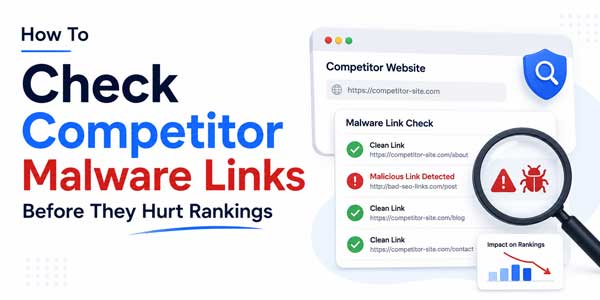
- SEO Crawlers: Find bulk outbound links, broken spam URLs, redirect chains, and indexed junk pages.
- Security Scanners: Detect malicious files, suspicious scripts, malware signatures, and known vulnerabilities.
- Log Analysis: Identify exploit attempts, strange bot behavior, hidden redirects, and spam URL discovery paths.
- Manual Review: Confirms whether a link is legitimate, accidental, user-generated, or malicious.
When you export reports, keep them organized by date. Save the first scan before cleanup, the cleanup notes, and the final clean scan. This gives you proof of progress and helps if Google requires a review request after a security or manual action.
Separate Negative SEO From A Real Website Compromise
Site owners often blame competitors immediately, but the evidence should guide your response. If spammy websites are linking to you from outside domains, that may be a backlink spam or negative SEO issue. If spam links are inside your own pages, that is usually a website compromise or content moderation failure.
The distinction matters because the fixes are different. Bad backlinks may require monitoring, outreach, or a disavow file in rare cases. Injected outbound links require server cleanup, CMS patching, password resets, database repair, vulnerability removal, and sometimes a Google review request.
Look for ownership signals. Did the spam appear after a plugin update, theme installation, admin login, server migration, form abuse, or unknown FTP access? Did multiple sites on the same hosting account get infected? Did only user-generated pages get hit? These clues show the likely entry point.
Also check whether the links are outbound, inbound, internal, or indexed fake pages. Many people use “malware links” to describe all of them, but each type needs a separate response. A clear classification prevents wasted time and avoids using the wrong SEO remedy.
When To Use A Disavow File
A disavow file is not the main fix for hacked links on your own site. It is meant for problematic inbound links pointing to your domain. Use it carefully, usually only when you have a clear pattern of manipulative backlinks and cannot get them removed, especially if a manual action is involved.
If your own site contains spam links, remove the links and fix the security issue first. Disavowing external domains will not clean infected templates, database rows, redirects, or generated spam pages. Treat the source, not just the symptom.
Clean The Links, Fix The Vulnerability, And Request Review
Once you confirm bulk malware links, move quickly but carefully. Put the site behind maintenance mode only if the infection is active, users are at risk, or search engines are seeing harmful redirects. For minor hidden link injections, you may clean while the site stays online.
Start by backing up the current infected state. That may sound strange, but it preserves evidence. Then create a clean working backup before making changes. Remove malicious files, clean database rows, restore altered templates, delete fake pages, and remove spam URLs from sitemaps.
Patch the entry point. Update the CMS core, plugins, themes, frameworks, server packages, and dependencies. Remove unused plugins, abandoned themes, old backups, public staging copies, exposed admin tools, and forgotten test folders. Change all admin, hosting, FTP, SSH, database, and API passwords.
Reset file permissions to safe defaults. Avoid writable PHP directories unless absolutely required. Disable file editing inside CMS dashboards where possible. Add two-factor authentication for admin users. Review user accounts and remove unknown admins, editors, developers, FTP users, and database users.
If Search Console shows a security issue, use the report after cleanup and request a review. Explain what happened, what you removed, how you fixed the vulnerability, and what steps you added to prevent recurrence. Keep the explanation honest and specific.
If there is a manual action, submit a reconsideration request only after the cleanup is complete. Do not send vague messages such as “we fixed everything.” Mention the affected patterns, cleanup scope, security patches, link removals, and ongoing monitoring plan.
Monitor Recovery And Prevent The Attack From Coming Back
Cleanup is not the finish line. Many malware link issues return because the original vulnerability remains active. After removal, monitor your site daily for at least two weeks and weekly after that. Watch Search Console, server logs, crawl exports, uptime alerts, and security scan results.
Create a baseline of normal external links. Run a crawler and export all outbound domains from your clean website. In the future, compare new crawl data against this baseline. If a new suspicious domain appears across many pages, you can catch it before Google indexes the damage.
Set alerts for file changes in sensitive directories. Many security plugins and server tools can notify you when PHP, JS, template, or configuration files change. For custom websites, use Git-based deployment so production changes are traceable and unauthorized edits stand out immediately.
Strengthen your CMS workflow. Keep plugins minimal, update software regularly, restrict admin roles, moderate user-generated content, and block public link posting where it is not needed. Add rel=”nofollow” or rel=”ugc” to user-submitted links when appropriate.
Review your sitemaps and robots rules after cleanup. Remove spam URLs from XML sitemaps, return proper 404 or 410 status codes for fake pages, and make sure canonical tags point to real pages. Do not block spam URLs with robots.txt if Google needs to recrawl them and see they are gone.
Build A Monthly Malware Link Audit Checklist
A monthly audit helps you catch suspicious activity before it turns into a ranking problem. You do not need a huge security team to do this well. What you need is a repeatable process that checks search visibility, crawl behavior, files, database content, and external links.
Start with Google Search Console. Review Security Issues, Manual Actions, Pages, Sitemaps, Links, and Performance. Look for spikes, new strange queries, unusual indexed pages, or sudden drops in impressions. Search Console often gives the earliest warning signs if you know where to look.
Then run a site crawl and export external links. Compare the list against the previous month. Any unfamiliar domain should be checked manually. If it appears only once in a guest comment, it may be moderation. If it appears across the whole site, check templates or scripts.
Review recently modified files and CMS users. Remove inactive admin accounts and rotate passwords for shared accounts. Check pending updates, vulnerable plugins, outdated themes, and abandoned add-ons. Most malware link incidents become easier to prevent when old software is removed.
Finally, document your findings. A simple spreadsheet with date, scan tool, suspicious URLs, action taken, and status is enough. Over time, this creates a security history that helps your developer, SEO manager, and hosting provider respond faster.
Final Thoughts: Treat Malware Links As Both An SEO And Security Problem
Bulk malware links are not just an SEO inconvenience. They can hurt visitors, damage trust, trigger browser warnings, pollute search results, and weaken rankings. The right response is not panic. It is a disciplined audit that checks Search Console, source code, database records, logs, crawlers, and server security.
If you suspect a competitor or automated spam network added links to your site, focus first on evidence. Identify where the links exist, how they were added, whether Google indexed them, and what vulnerability allowed the attack. Once you know that, cleanup becomes much more effective.
The strongest protection is a clean technical foundation. Keep software updated, use secure hosting, limit admin access, monitor file changes, crawl your site regularly, and review Search Console every week. A website that is watched closely is much harder to abuse at scale.
Your website’s authority took time to build. Protect it with the same care you use to publish content, win customers, and grow organic traffic. A small monthly audit can save you from a major malware cleanup, a ranking drop, or a painful manual action later.
Frequently Asked Questions
How Do I Know If Competitors Added Malware Links To My Site?
You cannot confirm a competitor without evidence, but you can confirm whether suspicious links were added. Check Google Search Console, crawl your site for outbound links, inspect source code, search your database, and review server logs. If links exist inside your pages without approval, treat it as a compromise.
Can Malware Links Hurt My Google Rankings?
Yes, they can. Malware links, hacked content, hidden links, spam pages, and deceptive redirects can damage trust and may trigger security warnings or manual actions. Even when no penalty appears, polluted pages can waste crawl budget and weaken user confidence.
Should I Disavow Malware Links?
Disavow is mainly for bad inbound backlinks pointing to your site. If malware links are inside your own website, remove them from your files, database, templates, comments, or redirects first. A disavow file will not clean a hacked site.
What Is The Fastest Way To Find Hidden Spam Links?
Run a site crawl and export all external links, then inspect your rendered HTML and database for suspicious domains. Also use Google search operators such as site:yourdomain.com casino or site:yourdomain.com viagra to find indexed spam pages quickly.
What Should I Do After Removing Malware Links?
Patch the vulnerability, update software, reset passwords, remove unknown users, clean sitemaps, return proper 404 or 410 responses for fake URLs, resubmit clean pages where needed, and request review in Search Console if a security issue or manual action appears.













Be the first to write a comment.