
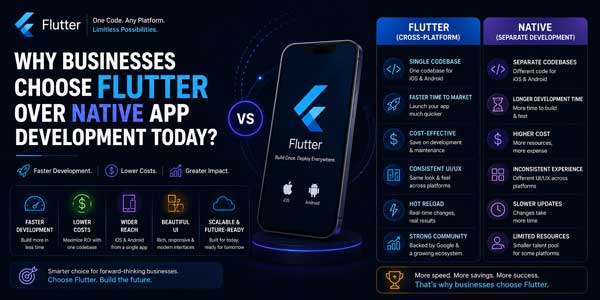
Mobile apps have become kinda a core way companies sell, support, talk to people, and even run day-to-day operations, honestly. A business can end up needing an app for customers, employees, partners, the field team, or just for internal workflows. The “problem” is basically simple: users want super smooth performance on both iOS and Android, while the business still has to watch cost, ship sooner than later, and keep maintenance under control for the long run.
That is why a lot of companies end up comparing Flutter with native development right before they start a mobile project. With native development, teams typically build separate apps for iOS and Android, using Swift or Objective-C on the iOS side, and Kotlin or Java on Android. Flutter, on the other hand, lets developers craft apps for multiple platforms from one shared codebase, so you’re not rebuilding everything twice.
Native development still matters, though. It tends to be a strong fit for apps that rely heavily on platform-specific features, very demanding graphics, advanced hardware access, or when there are strict requirements around native performance. Yet for a huge number of business apps, Flutter can feel like the more balanced option between development speed, total cost, the user experience, and overall product flexibility.
Table of Contents
What Makes Flutter Different From Native Development?
Flutter is a cross-platform framework made by Google. Developers use Dart to craft an app with essentially one codebase that can run on iOS, Android, web, desktop, and other supported platforms.
The big difference is kind of how you develop. In native development, companies often end up with two mobile teams or, at a minimum, two separate codebases. That means each new feature gets designed, built, tested, and maintained twice, which is… well, a lot. With Flutter, though, one team can put most of the product logic plus the interface together in one spot.
Now, this doesn’t erase every platform-specific requirement. Some things still need native tweaks, especially if an app talks to device hardware, relies on platform-specific SDKs, or needs custom native modules. But Flutter still cuts down the repeated work in the majority of normal mobile projects.
For a business, this changes the budget, hiring plans, release timing, QA processes, and ongoing product updates, too. A shared codebase usually equals fewer redo tasks and quicker delivery cycles.
Why Do Businesses Choose Flutter For Faster Launches?
Speed is one of the main reasons companies go with Flutter. In competitive markets, the first version of an app really has to reach users fast enough to test demand, gather feedback, and then make changes to the product.
Native development can slow this process down, since basically two teams have to build the same features for two different platforms. Even if both groups work in parallel, there can still be differences in how things are implemented. One app ends up ready sooner, while the other is still dealing with fixes and last bits of work.
Flutter makes the release timeline easier because developers can use one shared codebase for iOS and Android. That means businesses can ship an MVP, try the concept, and refine the product, without waiting through two separate development cycles, which kind of drags things out.
This is especially important for startups that need to validate an idea quickly, SMBs that have a limited budget but still want a mobile presence, and enterprises that need internal tools up and running without delays. It also fits retailers, healthcare companies, logistics providers, and service teams that require mobile access for customers, users, or employees.
A faster launch also helps teams learn earlier. Instead of spending months on two separate native apps, a company can release one Flutter-based product and iterate based on real user behavior.
How Flutter Helps Reduce Development Costs?
Cost control is another strong, kind of reason businesses choose Flutter, which, yes, can sound a little obvious, but it matters. Mobile app development can get pretty expensive when every screen, feature, test, bug fix, and update requires separate work for iOS and Android, as it’s always split. Flutter helps reduce that duplication. You can have one development team build shared features, maintain one main codebase, and, in general, cut down on the development hours; also, project management gets easier, with less chaos.
The cost advantage really stands out when a business needs a mobile MVP, a customer-facing app for both platforms, a mobile version of an existing web product, a marketplace app, a booking app, a delivery app, or even an internal enterprise solution.
Also, Flutter can reduce maintenance spend. When a company needs to update a feature, resolve a bug, or tweak the interface, the team usually edits it once and then rolls it out across platforms.
Now, native apps might still justify higher costs for products with a bit more complexity. Like, a mobile game, an AR application, or an advanced video editing tool could do better with native development, honestly. Yet for most business applications, Flutter has performance that is quite solid and stable enough, while the overall spend stays under control, and you don’t really feel it too much.
Why Consistent UI Matters For Business Apps?
Users sort of judge apps pretty quickly. Like, if the design feels messy, uneven, or even a little slow, they might bail before they really get what the product is about. Businesses, therefore, need mobile apps that look well-made and also feel easy on every device, not just “mostly fine” on one screen size.
Flutter gives developers a lot of control, especially over how the UI looks and behaves. It uses widgets, and these help teams build consistent layouts, tap buttons, input forms, animations, and even full design language systems across different platforms. That’s handy for companies that want the same brand mood on iOS and Android. Not two different vibes, you know.
Consistent UI is also tied to business outcomes. When an app is clean and coherent, it can lower support tickets, strengthen onboarding, raise conversions, and keep employees more productive. For instance, an e-commerce app with a straightforward checkout routine can decrease abandoned carts. Likewise, a logistics app with simpler route planning and delivery screens can help people in the field finish their tasks faster, with less back and forth.
Flutter can also make design updates less painful for product teams. If a company shifts brand colors, button styles, text hierarchy, or navigation behavior, the team can update the shared design system instead of rebuilding two separate interfaces from the ground up, again and again.
When Native Development Still Makes Sense?
Flutter does have a lot of advantages, but, honestly, native development is still the stronger choice for a bunch of projects.
Native work can feel better when an app needs deeper device hardware access, thick 3D graphics, really complicated AR and VR workflows, top-tier mobile gaming, and very specific, platform-bound behavior. Also, when there are rigid native UI demands, more advanced background processing, or basically any platform-exclusive functionality.
Like, take a camera-heavy app with advanced image processing, it might benefit from native optimization. Or a game that has intricate graphics, it may require native tools and pipelines. And if an application depends on particular iOS or Android features, that usually points toward native development as well.
In the end, it comes down to the product. Businesses shouldn’t pick Flutter just because it is fast. They should pick it when the actual product requirements fit and match the things Flutter does well.
Flutter Vs Native Development: Business Comparison:
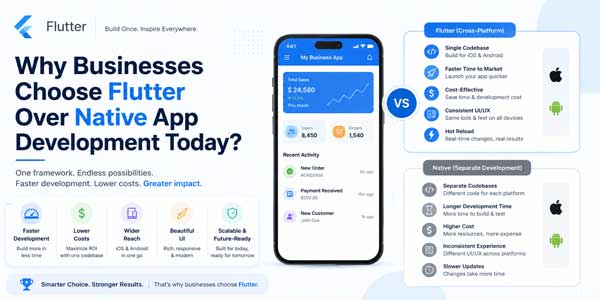
The difference between Flutter and native development gets clearer when businesses look at both options from a kind of a practical point o f view. Flutter usually gives faster delivery, because one team can build an app for both iOS and Android using a shared codebase, and honestly, it feels like less friction. Native development often takes more time, since each platform needs its own implementation, plus testing, and then ongoing maintenance.
Flutter can also lower development costs. A company does not really need to duplicate the same work across two separate teams. Native development usually ends up needing iOS and Android specialists, which adds to the budget and also increases the project management load.
UI consistency is another thing people notice with Flutter. Teams can craft one design system and then spread it across platforms. With native development, the final look and behavior end up depending on how closely two separate teams follow the same design standards, which can be a bit random.
Still, native development can win when an app requires advanced performance, more intricate hardware access, heavy graphics, AR features, or deep platform-specific behavior. Flutter tends to shine for MVPs, marketplaces, SaaS apps, booking platforms, e-commerce products, fintech tools, healthcare apps, and internal business solutions.
In simple terms, Flutter is often the better match for speed, cost control, and easier upkeep. Native development is more convincing when the product depends on advanced platform-level performance.
What Businesses Should Check Before Choosing Flutter?
Before choosing Flutter, a company should really review what the product actually needs, not just what sounds good. If the technology decision goes the wrong way, you can end up with rework later, sort of.
Business and technical teams should ask a few practical questions, like, do we really need advanced platform-specific features? Will a single shared UI feel good for both iOS and Android users, or will it start to drag? What performance level does the product demand, in real terms? Which integrations are coming with the app, integrations like APIs, analytics, or other services? And what’s the expected growth plan, because that changes a lot of assumptions.
The team should also confirm whether developers have Flutter and native integration experience. QA coverage matters as well, since the app still has to be tested across different devices, screen sizes, and OS versions. Security should not be pushed aside either, especially if the product deals with payments, health data, personal data, or information that’s sensitive for business.
Altogether, these questions help organizations avoid making the choice based only on cost or speed. Flutter tends to shine when it matches the product strategy, not when it becomes a shortcut, without real planning.
Why Flutter Is A Practical Choice For Many Companies?
Businesses go for Flutter because it sort of fixes a bunch of practical issues all together. It gets you shipping faster, cuts down on duplicate efforts, keeps the look and feel more consistent, and makes ongoing maintenance simpler.
It also gives companies more leverage over how they iterate on the product. A team can push updates sooner, trial new approaches, and keep improving the app without having to sync two different native codebases, which is a kind of hassle.
For lots of business applications, the outcome is honestly pretty straightforward: Flutter delivers solid performance, quicker delivery, and more predictable cost management. Native development is still a key thing for niche, specialized requirements, but Flutter is often the better pick when the product needs speed, flexibility, and wide platform coverage.
Final Thoughts:
Flutter tends to work pretty well for businesses that want to ship on iOS and Android faster, with lower development costs, and keep the user experience pretty consistent. In a lot of cases, it also gives product teams a way to check ideas earlier, release updates with a bit less pain, and then keep up with growth after the initial launch, so it kinda stays useful after.
Native development can still be the best route when the app needs truly deep, platform-specific stuff, like lots of custom integrations. But for MVPs, marketplaces, SaaS apps, e-commerce products, booking platforms, fintech tools, healthcare apps, and even internal business solutions, Flutter often ends up being the best tradeoff between speed and quality.
Companies should pick Flutter when the main aim is to create a scalable mobile product quickly, without having to duplicate every development task across both platforms. And yeah, with the right architecture plus a solid development team, Flutter can help businesses launch sooner, gather learnings from users sooner too, and support product growth after release.
 About the Author:
Yuliya Melnik is a technical writer at Cleveroad, a web and mobile application development company that provides cross-platform development services. She writes about mobile technologies, software engineering, and digital product development.













Be the first to write a comment.