
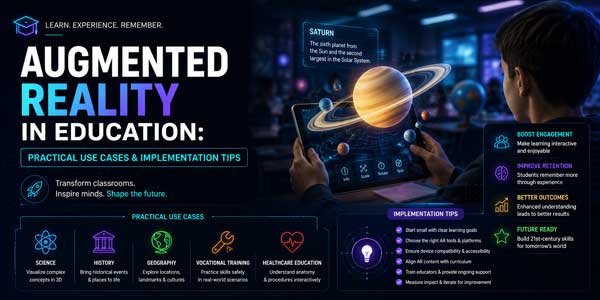
Augmented Reality is changing how students interact with their educational materials. By 2026, Augmented Reality will not just be an experimental technology used for gaming or entertainment, but rather a widely adopted tool for school districts, Colleges, EdTech businesses, and other organizations to improve student learning. They are using Augmented Reality to enhance student engagement, make previously challenging concepts easier for students to understand, and create more interactive educational experiences.
Traditional Education has a difficult time keeping students engaged with learning materials, particularly when students are learning abstract concepts, technical systems, or using visual-spatial skills. Augmented Reality resolves this issue by integrating digital components into the physical world, allowing for more realistic and immersive learning experiences for students.
Due to the rapid rise to popularity of Augmented Reality, schools, colleges, and universities now have partnerships with professional mobile app development agencies that develop scalable Augmented Reality educational applications. These organizations are now capable of delivering long-term digital learning strategies utilizing Augmented Reality at scale.
Table of Contents
Why AR Is Becoming More Important In Education?
Today’s learners want to have an interactive and individualized educational experience. They do not want to be stuck looking at static presentations and reading text-heavy documents, especially given the shift toward learning on a mobile-first basis. Learning in Augmented Reality (AR) allows learners to physically interact with digital objects in a physical context. Rather than just reading about a concept, learners can see it in 3D, create and use the object with their own hands, and examine it, so they will recall it better.
Educational institutions continue to adopt AR because mobile devices are now affordable, and AR development platforms have become abundant. Smartphones and tablets now have access to advanced AR capabilities without having to invest in large sums of money on technical equipment, so as institutions see fewer barriers to accessing infrastructure for AR, they are continuing to see rapid growth in the use of AR in education.
How Augmented Reality Works In Educational Applications?
Augmented reality overlays digital elements onto physical environments using smartphone cameras, tablets, or wearable devices.
Educational AR applications commonly include:
- 3D models
- interactive simulations
- object recognition
- spatial visualization
- animated educational content
Through the augmentation of the real world with digitally-generated information, augmented reality is providing immersive learning experiences.
The development of augmented reality solutions using more recent frameworks like ARKit, ARCore, and Unity is significantly easier than it was in previous generations of augmented reality technology.
Practical AR Use Cases In Education:
AR supports a wide range of educational scenarios across different industries and learning models.
Science And Medical Education:
AR has many potential applications, with science instruction being the most prominent.
Students will be able to use 3D objects that display human body anatomy, chemical composition and molecular compounds, biological or physical systems, or experiments completed in a lab. This type of learning will allow the student to look at the concepts in a more tangible way than using only textbooks.
AR will also be heavily used to create simulated surgical or anatomical CAD (computer-aided design) environments for medical training purposes. These tools are effective for enhancing learners’ practical understanding of a concept without needing to physically recreate every training scenario in a traditional laboratory setting.
Engineering And Technical Training:
Educational engineering curricula frequently implement complicated interconnected systems that can be hard to illustrate with physical 2-D diagrams.
Augmented Reality (AR) enables learners to interact with machinery, building models of infrastructure and technical components of the system in real-time. As a result, students will be able to better visualize how systems function internally and also how to assemble the components.
Using augmented reality increases students’ understanding of building systems and eliminates the need for building prototypes.
Language Learning:
Contextual and interactive experiences with AR software also assist students in learning languages.
As students scan items in the real world, they will be able to see the translation of the word, hear how to pronounce the word, and be given information about what that object is used for. Interactive surroundings enhance student involvement and let them learn vocabulary in an efficient manner.
Overall, AR learning provides students with a more natural way of learning than through traditional memorization processes.
Corporate Training:
A lot of businesses are currently utilizing augmented reality (AR) technology during employee onboarding and operational training.
Employees can gain experience practicing workflows, handling equipment, and following operational procedures by training using AR simulations in a simulated, controlled environment prior to using real systems.
Training costs are reduced while increasing knowledge retention and decreasing the amount of risk to operational safety associated with employees using live systems.
Early Childhood Education:
The implementation of augmented reality (AR) into primary and preschool education has been consistently increasing due to its ability to promote engagement with interactive content and improve visual learning.
Interactive storytelling, animated learning objects, and gamification are collectively effective tools in retaining younger learners’ attention and engagement during lesson delivery.
The overall result of using these tools is to create a more dynamic and accessible learning environment.
Benefits Of AR In Education:
A major advantage of AR is its ability to increase engagement among learners by creating an interactive and stimulating educational experience that holds a learner’s attention longer than a traditional (passive) mode of education.
Since an AR learner interacts with the content, they can recall the information longer because they were involved in the learning process.
For most types of educational content, visuals are critical; when providing education on technical subjects that contain spatial relationships, scientific systems, or operational processes, the use of AR to visualize how something looks or works allows students to understand it more effectively.
For educational institutions, AR’s ability to scale allows for more efficient delivery of education in distributed and remote locations to many learners.
As more digital learning takes place around the world, the importance of immersive technologies to keep learners engaged will continue to grow.
Challenges Businesses Should Consider:
While augmented reality (AR) applications offer several advantages, there are also various challenges associated with AR implementation; for example, one key challenge is the creation of content using high-quality 3D assets, animated graphics, and true-to-life interactive simulations; therefore, developing this kind of quality content will require a considerable amount of time and effort.
Another challenge for many educational institutions is meeting device compatibility requirements because educational institutions typically utilize multiple smartphone and tablet models using several different operating systems; therefore, providing the same type of AR educational content for all devices is necessary.
Performance optimization must also be an important concern; AR applications typically operate by continuously processing the visual data in real-time; therefore, the continuous visual processing requires increased hardware capacity and battery consumption in order to maintain the performance of the AR application.
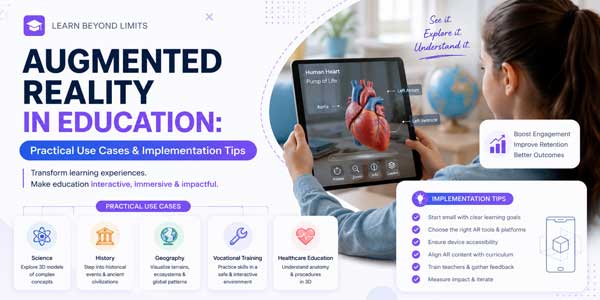
In addition to considering device compatibility, educational institutions should also assess how AR positively contributes to improving student learning outcomes. In general, for schools to implement AR successfully, it is essential to have clearly defined educational goals and to identify useful applications of AR.
Choosing The Right Technology Stack:
Technology decisions strongly affect scalability, performance, and development complexity.
Most educational AR applications rely on:
- Unity
- ARKit
- ARCore
- Unreal Engine
- WebAR technologies
The target device, platform requirements, and the complexity of interactions dictate the correct stack to be used with the stack.
The most prevalent type of AR applications is mobile-first AR applications, which can use the existing, more advanced capabilities of smartphones and tablets to provide a compelling AR experience.
Additionally, cloud-based infrastructure is essential in supporting the majority of AR systems since many of them require the use of analytics, content delivery, and real-time synchronisation.
A scalable and robust backend architecture will become more and more important as AR users and their content library continue to increase in size.
Why UX Matters Heavily In AR Education Apps?
When compared to traditional mobile apps, AR apps require more thorough consideration of user experience (UX) design. If an AR app has poor navigation and/or confusing user interactions, then it will result in decreased user engagement and usability. Therefore, AR educational systems should provide a user-friendly experience even for users who have little to no technical expertise. The best AR educational apps will have simple interaction workflows and will have minimal visual complexity. This allows users to concentrate on their educational objectives rather than having to deal with complicated interface controls. Accessibility also plays an important role as it has to consider the needs of various user types on multiple devices and in various environments.
Development Stages For AR Education Applications:
Building an AR-powered educational platform usually involves several structured stages.
Discovery And Planning:
The first stage focuses on defining learning goals, target audience, and interaction models.
Development teams evaluate whether AR genuinely improves educational outcomes for the chosen use case.
UX And 3D Design:
The next stage focuses on interface structure and 3D asset creation.
Educational AR experiences require optimized models and intuitive interaction systems to maintain stable performance.
Development And Integration:
During development, teams build frontend interfaces, AR functionality, backend systems, analytics infrastructure, and integrations.
Many educational platforms also integrate LMS systems, analytics dashboards, and content management workflows.
Testing And Optimization:
AR applications require extensive testing across multiple devices and operating systems.
Performance optimization becomes especially important because real-time rendering affects battery usage and application stability.
Deployment And Maintenance:
After launch, applications require continuous updates, content expansion, performance optimization, and infrastructure scaling.
Successful AR learning platforms evolve continuously alongside educational and technological changes.
How Much Does AR Education App Development Cost?
Platform complexity and content requirements greatly affect the development costs of AR apps.
Basic AR educational apps can have a development cost from $40k-$70k.
Mid-range AR education applications that contain interactive simulations, analytics, and integrations to Learning Management Systems can have a development cost that ranges from $80k-$150k.
Complex AR enterprise platforms that include AI functionality, multiple 3D environments, and large-scale cloud infrastructure will cost more than $250k to develop.
The cost of developing high-quality AR content accounts for a significant portion of total costs since high-end AR experiences require professional 3D design and animation.
Future Trends In AR Education:
Rapid technological advancements of Augmented Reality (AR) within education continue to revolutionise the field of education and business today.
Over the next few years, Artificial Intelligence (AI) will play an important role in individualised education experiences via personalised learning environments, collaborative AR classroom experiences, and through the use of wearable/immersive mixed-reality devices.
Furthermore, educational institutions are looking for measurable results within their AR programmes rather than just experimental and/or experiential results through AR.
As such, the development of new AR platforms will require stronger analytic capabilities, adaptive educational systems, and/or more structured training processes.
The evolution of AR technology is progressing from “experiential” to “operational” educational applications.
Final Thoughts
Augmented reality represents an important change in how we learn today. The use of AR to create interactive environments has resulted in better engagement levels, making it easier for learners to understand difficult concepts and creating real-world experiences related to their field.
When implementing AR in a learning environment, looking at just a product’s visual aspects is not going to ensure success. To be successful, an organization must develop a solid UX, a scalable infrastructure, a continued educational philosophy, and the implementation of technology effectively.
Outstanding AR products in education are not simply interactive; they are designed with the intent of providing the learner with a long-term engagement experience that can be of use for many years. In addition to being a scalable product, outstanding AR products will also exhibit the following traits: easy to use, have proven educational value, etc.
 About the Author:
Yuliya Melnik is a technical writer at Cleveroad, an educational app development service specializing in web and mobile solutions. She creates insightful content about education technologies, helping readers understand complex digital learning concepts through clear, structured, and engaging explanations. Yuliya is passionate about innovative learning-driven technologies that empower businesses and professionals to enhance their educational and technical expertise.













Be the first to write a comment.