
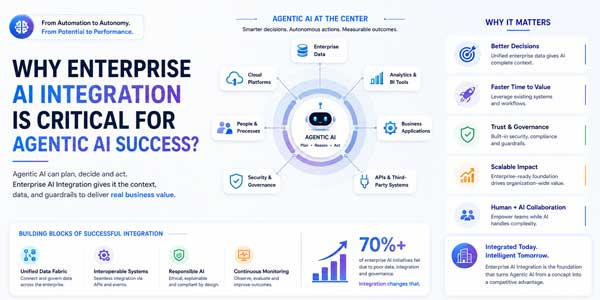
Agentic AI is rapidly becoming a major focus for enterprises seeking to automate workflows, improve operational efficiency, and modernize business operations. Across industries such as financial services, manufacturing, healthcare, logistics, and retail, organizations are investing in AI agents capable of coordinating workflows, analyzing operational data, and supporting intelligent decision-making.
However, many enterprises underestimate one of the most important factors behind successful AI deployment: enterprise system integration.
Without proper integration, even the most advanced AI systems struggle to deliver measurable business value. AI agents cannot operate effectively in isolation. They must integrate seamlessly with enterprise infrastructure, operational workflows, data environments, and business applications to enable scalable, reliable automation.
For most organizations, the real challenge is not building AI models — it is integrating agentic AI into existing enterprise systems.
Table of Contents
What Is Agentic AI Integration?
Agentic AI integration refers to connecting AI agents and intelligent automation systems with enterprise infrastructure, operational platforms, and business workflows.
This includes integration with:
- ERP systems
- CRM platforms
- Loan origination systems (LOS)
- Cloud infrastructure
- Data warehouses
- Document management systems
- Operational software
- Supply chain platforms
- Customer service systems
Integration allows AI agents to access operational data, coordinate workflows, automate tasks, and interact across enterprise environments.
Why Integration Matters for Agentic AI Success?
Many enterprises initially approach AI as a standalone technology project. In reality, AI systems become valuable only when embedded into operational workflows.
Without integration, organizations often face:
- Data silos
- Workflow fragmentation
- Limited operational visibility
- Manual process gaps
- Inconsistent automation
- Poor scalability
Agentic AI systems require connected operational ecosystems to function effectively.
Integration is what transforms AI from an isolated tool into an enterprise-wide operational capability.
How AI Agents Depend on Enterprise Connectivity?
AI agents rely heavily on operational context and system coordination.
For example, an AI underwriting agent may need access to:
- Customer applications
- Credit bureau systems
- Banking data
- Compliance workflows
- Document repositories
- Risk management systems
Similarly, a manufacturing AI agent may require integration with:
- ERP platforms
- Inventory systems
- IoT devices
- Production software
- Supply chain systems
Without enterprise connectivity, AI agents cannot coordinate workflows or support intelligent operational automation.
Benefits of Enterprise AI Integration:
End-to-End Workflow Automation:
Integrated AI systems can automate workflows across multiple operational stages without manual handoffs.
This improves process continuity and operational efficiency.
Real-Time Operational Visibility:
AI agents gain access to live enterprise data, enabling faster decision-making and operational responsiveness.
Better Data Utilization:
Enterprise integration helps organizations leverage operational data already stored across existing systems.
Improved Scalability:
Connected AI systems scale more effectively across departments and enterprise environments.
Reduced Operational Friction:
Integrated workflows minimize repetitive tasks, system switching, and manual coordination efforts.
Faster AI Adoption:
Organizations often achieve faster business results when AI systems integrate with existing infrastructure instead of replacing it entirely.
Why Enterprises Prefer AI Integration Over System Replacement?
Many enterprises already operate on significant technology investments.
Replacing entire operational systems can be:
- Expensive
- Disruptive
- Time-consuming
- Operationally risky
Instead, organizations increasingly prefer adding AI intelligence layers on top of existing infrastructure.
This approach allows enterprises to:
- Preserve existing systems
- Accelerate deployment timelines
- Reduce transformation costs
- Improve operational continuity
- Scale AI adoption incrementally
Integration-first AI strategies are becoming the preferred enterprise approach.
Common Enterprise Systems Used With Agentic AI:
ERP Platforms:
AI agents integrate with ERP systems to support finance, procurement, operations, and supply chain workflows.
CRM Systems:
AI-powered workflows improve customer engagement, onboarding, and operational coordination.
Document Management Platforms:
AI systems automate document extraction, classification, validation, and workflow routing.
Cloud Infrastructure:
Cloud integration supports scalability, data access, and enterprise AI deployment flexibility.
Compliance and Governance Systems:
AI agents help automate audit tracking, operational monitoring, and compliance workflows.
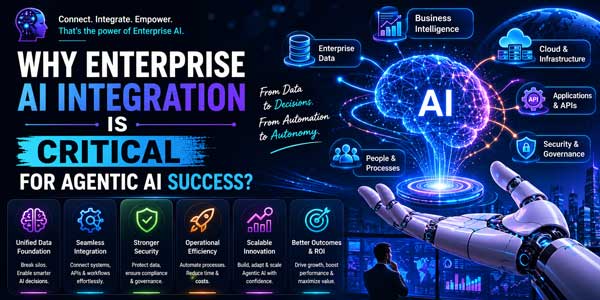
Challenges Enterprises Face During AI Integration:
Legacy Infrastructure Complexity:
Many enterprises still operate on fragmented legacy systems that complicate integration efforts.
Data Fragmentation:
Operational data is often spread across disconnected environments.
Security and Governance Requirements:
AI systems must support:
- Access controls
- Data protection
- Auditability
- Governance frameworks
- Compliance visibility
Workflow Alignment:
AI deployment often requires redesigning workflows and operational processes.
Successful AI integration depends on both technical implementation and operational alignment.
Why Custom AI Integration Matters?
Generic AI platforms often struggle to support enterprise-specific infrastructure and workflows.
Custom AI integration provides:
- Workflow-specific automation
- Better operational alignment
- Stronger infrastructure compatibility
- Improved governance visibility
- Greater scalability
- Industry-specific flexibility
Organizations increasingly prioritize AI systems tailored to their operational environments instead of relying solely on standardized automation tools.
Role of Multi-Agent AI Systems in Enterprise Integration:
Many enterprises are deploying multi-agent AI systems where multiple AI agents coordinate operational tasks across connected systems.
For example:
- One AI agent may process documents
- Another may validate compliance workflows
- Another may coordinate approvals
- Another may monitor operational analytics
- Another may manage workflow orchestration
These connected AI ecosystems improve enterprise automation at scale.
Industries Prioritizing Agentic AI Integration:
Financial Services:
Banks and lenders integrate AI systems with:
- LOS platforms
- Core banking systems
- Compliance software
- Risk management systems
Manufacturing:
Manufacturers connect AI agents with:
- ERP platforms
- Production systems
- Supply chain software
- IoT infrastructure
Healthcare:
Healthcare providers integrate AI systems with:
- Patient management platforms
- Claims systems
- Clinical workflows
- Compliance infrastructure
Logistics and Supply Chain:
Logistics organizations use AI integration to coordinate inventory, transportation, procurement, and operational analytics workflows.
How Intellectyx Supports Enterprise AI Integration?
Intellectyx develops custom agentic AI systems designed to integrate seamlessly with enterprise infrastructure, operational workflows, and business applications.
Its AI capabilities include:
- AI agent development
- Enterprise AI integration
- Workflow orchestration
- Intelligent process automation
- Compliance automation
- Operational AI systems
- Multi-agent AI architecture
The company focuses on helping enterprises modernize operations without requiring disruptive system replacement projects.
Future of Enterprise AI Integration:
Enterprise AI is evolving toward connected operational ecosystems powered by intelligent AI agents integrated across enterprise environments.
Emerging trends include:
- Multi-agent enterprise architectures
- AI-powered workflow orchestration
- Real-time operational AI systems
- Autonomous business workflows
- Enterprise-wide AI ecosystems
- Intelligent compliance automation
- Human-AI collaborative operations
Organizations that successfully integrate AI into operational infrastructure will likely gain major advantages in scalability, efficiency, agility, and long-term operational resilience.
Conclusion:
Enterprise AI integration is one of the most important factors determining the success of agentic AI initiatives. AI systems deliver the greatest value when connected seamlessly with enterprise workflows, operational platforms, and business infrastructure.
Rather than replacing existing systems entirely, organizations are increasingly adopting integration-first AI strategies that add intelligent operational layers on top of current environments.
As enterprises continue scaling AI adoption, successful integration will become essential for enabling connected, scalable, and intelligent operational ecosystems.
The future of enterprise automation is increasingly being shaped by integrated agentic AI systems operating across the full business environment.
 About the Author:
Anand Subramanian is a technology expert and AI enthusiast currently leading the marketing function at Intellectyx, a Data, Digital, and AI solutions provider with over a decade of experience helping enterprises and government departments modernize operations, automate workflows, and integrate AI into human workflows.













Be the first to write a comment.