
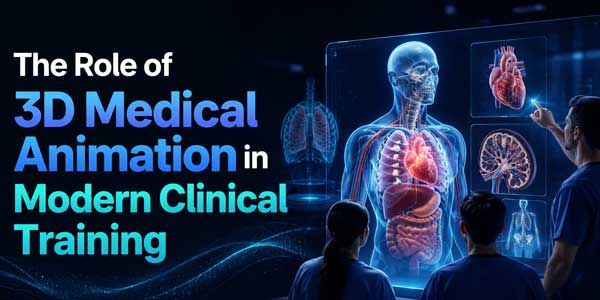
Imagine one of the medical students trying to explain the mechanism of blood circulation through the heart chambers in a medical textbook. Every structure can be labeled correctly in the diagram; can it be correct in terms of the rhythm of a beating heart or the complex timing of valves opening and closing? Now, envision a duplicate of that student viewing a realistic 3-D video in which the heart rotates, zooms, and operates just like it does in the human body. It’s such a jump. Suddenly, something that was abstract became clear and easy to remember.
This is where the advantages of 3D medical animation in clinical training come in. The method of teaching health care professionals with the use of lectures, textbooks, lab work, and actual clinical experience has been a combination of all these methods throughout the history of their education. Although these approaches remain vital, they can only provide a part of the answer for complex biological phenomena and complex medical interventions, and they do not always provide an accessible explanation for all learners. Three-dimensional medical animation fills this void by enabling the visualization of difficult concepts into highly visual and interactive learning experiences, which increase understanding and confidence.
Table of Contents
Enhancing The Understanding Of 3D Medical Animation:
3D Medical Animation refers to the computer-generated images of human anatomy, physiology, diseases, medical devices, or medical procedures. These animations are far more dynamic than static illustrations or classic diagrams, and add realism in terms of movement, depth, texture, and detail to the human body. Students can watch an organ in action, to see how a disease develops, or how surgery is carried out from various perspectives.
Careful collaboration with clinical experts, scientific illustrators, animators, and software specialists is essential to all of the animations produced. The aim is to create content that is not only aesthetically pleasing but also scientifically accurate and helps to demystify complicated medical information.
Today, 3D medical animation is widely used not only in medical schools and teaching hospitals, but also in simulation laboratories, pharmaceutical companies, and healthcare institutions. It enables teaching in medicine, nursing, dentistry, physiotherapy, and allied health in various disciplines. The purpose of this book is to make the study of anatomy more accessible.
Clinical education is founded on human anatomy and is one of the most challenging subjects for students. Thousands of interconnected structures make up the human body, with many of these structures not being readily visible with two-dimensional images. Three-dimensional medical animation makes anatomy come alive by transforming organs, muscles, blood vessels, nerves, bones, and other anatomical structures into a visual experience from all angles. Students gain an understanding of the interdependent nature of various systems of the body, rather than just memorizing structures.
A learner, for instance, learning about the respiratory system can watch the air move through the nasal cavity, into the lungs, and then engage in gas exchange at the alveolar level. Likewise, animations of the nervous system show students how electrical signals are sent between neurons to help students make a connection between structure and function. The dynamic approach improves spatial awareness and allows learners to retain anatomical knowledge better than using traditional approaches alone.
Medical Animation Market:
I was doing my research on the evolving landscape of medical education technologies and stumbled upon a very useful market analysis by Roots Analysis. It shows how fast the medical animation industry is growing.
The report by Roots Analysis, a marketing consultancy firm, states that the global medical animation market was valued at USD 439 million in 2024. It is anticipated to reach USD 546 million in 2025 and a significant USD 3,050 million by 2035, registering a high compound annual growth rate (CAGR) of 18.8% during the forecast period. Such spectacular growth is a testament to the increasing recognition of 3D medical animation as a visual communication tool and a vital component of modern healthcare education, clinical training, patient engagement, and medical communication.
Improving Surgical Training:
Three-dimensional medical animation is a safe and effective means for preparing learners to meet these challenges. Instead of reading about the surgery or seeing a handful of live surgeries, trainees are able to view detailed animations that they can watch repeatedly, step by step, at a high level of detail.
Animations can be useful for slowing down important parts of the surgical procedure, emphasizing key anatomical landmarks, and demonstrating why some surgical decisions were made. This gives the learners the opportunity to repeat the procedures as many times as they want, in order to refresh their learning before the practical work. This visual repetition aids in decreasing the anxiety of trainees as well as builds confidence in the procedure.
Visualizing Disease Processes:
Many diseases are made complex in their development by biological processes that are not easy to observe in humans and in the field. It is typical to describe these mechanisms in the classroom with text or basic diagrams, and have the students imagine the processes. It’s a whole new ball game.
For example, learners can observe the invasion of cancer cells into surrounding tissues, the build-up of plaque in arteries in cardiovascular disease, or the entry and replication of viruses into human cells. Students grasp the full sequence of the biological events, not individual pieces.
This is a visual storytelling for conceptual understanding: students will see what happens and why. This, in turn, helps to improve the understanding of disease progression, diagnosis, and treatment. An insight into these mechanisms will also enable future healthcare workers to make more informed decisions in their clinical practice.
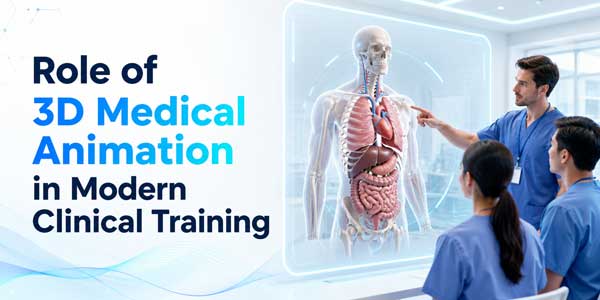
Ensuring Medical Device and Equipment Training:
Advanced medical devices are now an integral part of today’s health care, and many require special training before they can be safely used. Animations can also be used to describe how the medical apparatus works internally in an application where the inner workings cannot be easily shown during the actual medical procedure.
3D medical animation provides in-depth animated explanations of how devices work, are positioned, installed, and maintained. Healthcare professionals can find out how to insert a catheter, position an orthopedic implant, or operate a robotic surgical system without endangering a patient. This visualization lowers the learning curve and boosts user confidence, and reduces the risk of procedural errors.
Supporting The Improvement Of Emergency And Critical Care Education:
Emergency medicine is frequently a business of quick thinking in stressful situations. If cardiac arrest or severe trauma, airway blockage, or any life-threatening emergency occurs, there is no time to hesitate. Schools and hospitals will be using them more frequently in continuing education and cross-functional team training.
Finally, these customizable platforms might be implemented one day to create a learning experience that is tailored to the specific needs of the students; this means that students would be able to focus on areas in which they need extra support. Education needs to be transformed with healthcare. In the era of medicine that is increasingly three-dimensional, three-dimensional medical animation is one of the best options for preparing future clinicians for the complexities of modern medicine, so that learning is more engaging, accurate, and clinically relevant.
Conclusion:
Memorisation is not the fundamental purpose of modern clinical training. Healthcare professionals need to understand dynamic biological systems and implement complex procedures, communicate well, and make accurate decisions in complex situations. This is done using 3D medical animation that presents complex medical concepts in a realistic manner, improving the understanding and retention of these concepts.
It will not take the place of actual clinical experiences, but it will be extremely valuable in providing an educational experience for learners to learn human anatomy, disease mechanisms, surgical techniques, and medical technologies in a safe, repeatable, and highly engaging experience. The future of educational technologies is bright, and 3D medical animation will continue to play a vital role in healthcare education, helping future healthcare professionals to have a knowledgeable and confident approach when using their skills in patient care.
 About the Author:
Avantika Sharma is a content writer and healthcare/biotech enthusiast at Roots Analysis. She is an expert at making complex scientific concepts accessible, engaging, and well-researched for a broad audience. She reads fiction avidly and writes non-fiction with passion. Her curiosity, combined with painstaking research, produces informative and accessible articles that bridge the gap between science and everyday understanding.












Be the first to write a comment.