
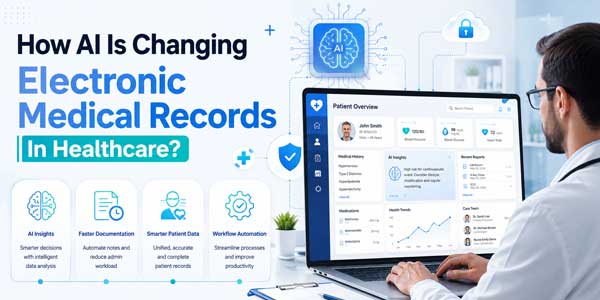
AI is transforming electronic medical records in healthcare by enhancing documentation, analyzing data, providing care, streamlining processes, improving security, and supporting decision-making.
Electronic medical records represent a shift in how healthcare practitioners manage their information. By eliminating the need for paper records, hospitals can store patient history, diagnoses, lab results, prescriptions, and more on computers.
However, merely digitizing the records is only the beginning of the process. Clinicians spend a significant amount of time accessing the information, reviewing, documenting, and researching patient data. Where can AI play a role in this?
AI can be utilized to complement the benefits of electronic medical records. By organizing and analyzing the information, AI can help clinicians get back time spent on administrative tasks and focus on patients.
The healthcare technology space has seen a transformation with the shift from paper-based records to electronic medical records, telemedicine, cloud storage, and connected devices. 10 Ways Technology Has Improved The Health Industry
The next frontier of technology in healthcare is not just about storing information electronically. It is about leveraging this information to get more value out of the records.
Table of Contents
What Role Does AI Play in Electronic Medical Records?
Traditional electronic medical records only go so far in assisting clinicians with their operations. AI can augment this process by giving computers the ability to understand and organize the data. For example, clinicians can rely on AI to help them quickly access information relevant to their needs. Rather than spending time sifting through the patient’s entire medical history, an AI-driven system could help pull out relevant pieces of information.
AI can also recognize patterns within the data that could be worth further consideration. Of course, no algorithm should be relied upon to diagnose patients. But, AI can help make the job of medical professionals easier by providing information that can aid them in their diagnosis and treatment plans.
AI has already been explored for its potential applications in predictive analytics, disease management, personalized healthcare, and administrative functions. The Transformative Role Of AI In Healthcare
The real potential of AI lies in being able to act as an enabler rather than a replacement for medical professionals.
How Can AI Make Medical Documentation Easier?
Medical documentation is an integral part of any healthcare service, but it is also one of the most time-consuming aspects of a clinician’s job.
Doctors and nurses spend hours upon hours documenting patient encounters, symptoms, physical examinations, diagnoses, treatments, and more. The process can be tedious, especially when done manually.
AI-driven documentation systems could help lighten the load. Similar to how speech-to-text technology works, AI could be used to organize the key points of conversations between clinicians and patients. The information could then be synthesized into an appropriate note that can be reviewed and edited by medical professionals. Thus, AI can be leveraged as a tool to help organize and streamline medical documentation without eliminating human oversight entirely.
For instance, a conversation between a doctor and a patient can be organized into the following areas by AI:
- Patient’s concerns
- History
- Observations
- Treatment
- Follow-up
The above information would then need to be reviewed by the appropriate personnel before being added to the official medical records.
It is also important to note that the above process should not be left entirely to AI. The responsibility of ensuring the accuracy and relevance of information in medical records must always rest with human beings rather than machines because patient health information is extremely sensitive.
Can AI Help Healthcare Professionals Find Information Faster?
Medical records can get lengthy, especially for patients with extensive medical history. Lab results, prescriptions, diagnoses, and other procedures can span years, sometimes decades, for a single patient. It can often take time to find a particular piece of information within the records.
AI can help healthcare professionals perform searches faster and more efficiently. For instance, a computer can extract relevant pieces of information from electronic medical records, rather than having to manually scan through documents. Clinicians could request a summary of a patient’s treatment history or pertinent details about a specific procedure.
Such information would be valuable to medical professionals when they need a quick overview of the patient’s medical history. Similarly, AI can be used to find patterns and relationships within large sets of data. Data mining has been explored for its potential applications in risk assessment, patient management, and resource allocation in healthcare. How Data Mining Is Revolutionizing Healthcare?
Again, it is important to note that the objective should not be to overload medical professionals with information. Rather, AI technology should be used to empower clinicians by making the important pieces of information easily accessible.
How Is AI Improving Patient Care?
The ultimate test of the value of electronic medical records lies in the utility of the information contained within them. How can patient care be improved from having access to electronic medical records?
AI can help make records more useful by synthesizing information and highlighting pertinent details. For instance, an AI-driven system could review previous clinical notes, medication records, and lab results to point out relevant factors that may need to be considered in treatment. Medical professionals can then take these factors under consideration alongside their expertise to provide better patient care.
AI can also be utilized for patient monitoring. By connecting to the appropriate healthcare technology systems, patient data can be accessed and analyzed rather than simply collected at a given point in time.
This is especially useful for patients who need to be monitored closely. Remote patient monitoring has been explored as a way to keep track of patients’ vitals outside of the hospital. The healthcare technology space has seen an explosion of mobile applications and connected devices. Revolutionizing The Healthcare Sector With Mobile Technology
Again, it is important to note that these technologies must serve to support the doctor-patient relationship rather than replace it. A mobile application cannot substitute meaningful communication and empathy from healthcare practitioners.
What About AI and Healthcare Data Security?
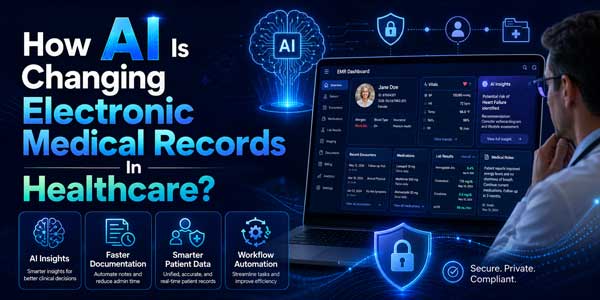
Electronic medical records contain highly sensitive information, making cybersecurity one of the most important considerations in AI applications in healthcare.
Any AI working in tandem with electronic medical records must have appropriate security measures in place. Additionally, healthcare organizations must have policies regarding access and review of information by AI systems.
AI can also be utilized for cybersecurity measures in healthcare. Machine learning algorithms can be used to detect anomalies and irregularities that may indicate a cyberattack. At the same time, implementing AI-driven solutions represents an additional potential security risk. Organizations must recognize the risks involved when adding new technologies to their systems.
When considering the implementation of AI in healthcare, organizations must take a cybersecurity-focused approach rather than waiting for breaches to occur. The technology should be complemented by strict access controls and monitoring systems, as well as policies governing its use within the organization.
Can AI Improve Healthcare Workflow Efficiency?
Organizations have many administrative functions beyond medical documentation and patient care. Clinicians spend a significant amount of time on non-clinical administrative tasks that can cut into their productivity and job satisfaction. Healthcare chatbots are already being explored for their potential in helping clinicians communicate with patients and reducing the workload for medical professionals. The Role Of Chatbots In Medicine: AI’s First Step Towards Accurate Diagnosis
In addition to documentation and patient care, there are many other tasks that can be automated. For example, an AI-driven system can be utilized to help route communications, organize information, and manage documentation. Thus, clerical tasks can be reduced by leveraging the power of automation.
Mobile technology represents another avenue for improving healthcare operations. As mentioned above, smartphones and connected devices can be utilized to help clinicians communicate and manage patient data more effectively. The importance of automation should not be understated in terms of improving healthcare workflow efficiency.
What Challenges Should Healthcare Organizations Consider?
As mentioned above, AI has the potential to transform healthcare by making operations more efficient and improving patient care. However, there are several challenges that must be considered before implementing such technology.
For one, AI relies on data to function. Thus, organizations must ensure that the data being used to train algorithms is accurate and comprehensive. The integrity of electronic medical records is paramount in this regard. Another consideration is the need for transparency. Healthcare professionals must understand how an AI system reaches its conclusions in order to determine whether to trust its recommendations. An opaque system that makes suggestions without providing reasonable justification has limited use in the medical field.
Finally, there are ethical considerations, particularly when it comes to patient privacy. Healthcare organizations must ensure that appropriate policies are in place to guarantee patient confidentiality. There must also be measures in place to ensure that AI-assisted information is subjected to the same level of human scrutiny as other information.
More and more, healthcare experts are advocating for AI to serve as an enabler rather than a replacement for medical practitioners. How A Custom AI Development Company Is Transforming Healthcare In Dubai?
What Does the Future of AI-Powered Medical Records Look Like?
The future of electronic medical records lies in harnessing the power of AI to get more value out of the information. AI can help make the records more intelligent by summarizing patient history, organizing information, assisting with documentation, and finding patterns.
Integration will also be key. Electronic medical records must be complemented by appropriate technologies that can enhance the utility of the information contained in them. This includes mobile applications, telemedicine, connected devices, and other health information technology solutions.
Generative AI has the potential to fundamentally change how clinicians interact with medical records. Rather than navigating through multiple layers of menus and windows, medical professionals and patients will be able to rely on speech recognition and natural language processing to get their information. For example, a clinician can ask for a summary of a patient’s history and receive a comprehensive response based on the information contained in the records.
Of course, the future of healthcare technology will not be defined by automation alone. It will be crucial to strike a balance between efficiency and human oversight, between utilizing technology to make processes easier without sacrificing accuracy and patient privacy.
Conclusion:
AI is transforming electronic medical records in healthcare. By leveraging the power of AI, healthcare practitioners can benefit from enhanced documentation, improved data access, increased operational efficiency, and better patient care.
The future of AI in electronic medical records lies in making the most of existing technologies. This means utilizing AI to solve real-world problems faced by medical professionals rather than simply adding another layer of complexity to the system. Healthcare organizations looking to integrate such technologies must consider issues of data integrity, patient privacy, security, and transparency. By addressing these challenges, AI can make electronic medical records more useful without eliminating the human touch from healthcare. After all, the future of healthcare will be defined by how well we can harness the power of technology while relying on human expertise to guide patient care decisions.
 About the Author:
Nitesh Singh, Professional Content Writer specializing in SEO-friendly content across AI, Technology, Health, Agriculture, Tractors, Digital Marketing, and Lifestyle. He creates original, well-researched articles that inform readers and help businesses grow their online presence.












Be the first to write a comment.