
Most enterprises don’t have an AI problem. They have an integration problem.
The pattern repeats across industries: a promising AI pilot produces encouraging results, leadership approves broader rollout, and then momentum quietly stalls. Months later, the technology sits underused, disconnected from the systems people actually work in, producing insights that don’t reach the right decision-makers, and requiring manual effort to bridge gaps that were supposed to disappear. The model was fine. The integration wasn’t.
This is the gap that AI integration services are built to close. Not by adding more intelligence, but by making the intelligence that already exists operationally useful, woven into the fabric of enterprise workflows rather than sitting alongside them. According to McKinsey, companies that integrate AI into core business processes are 1.5 times more likely to report revenue growth above 10% than those that keep AI confined to isolated pilots.
Table of Contents
Why AI Success Depends on Integration, Not Just Models?
There’s a meaningful difference between an organization that experiments with AI and one that has actually adopted it. Experimentation produces insights in isolation. Adoption produces decisions at scale.
Standalone AI tools, however sophisticated, generate value only when someone actively consults them. They require context-switching, manual data entry, and conscious effort from people already managing full workloads. That friction compounds over time. What starts as a minor inconvenience becomes a reason to fall back on familiar processes.
Gartner estimates that through 2026, more than 80% of enterprises will have deployed AI-enabled applications – yet fewer than a third will have successfully scaled those applications beyond initial pilots. The bottleneck isn’t model quality. It’s integration depth.
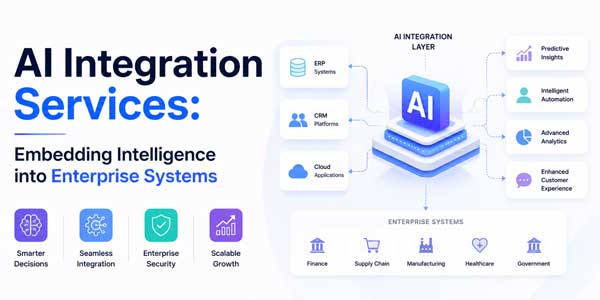
The enterprises seeing real returns from AI aren’t necessarily running more advanced models. They’re running AI integration solutions embedded in their existing systems – ERPs, CRMs, customer support platforms, supply chain applications. Their employees don’t interact with AI as a separate tool; they encounter its output inside workflows they already understand.
This distinction matters because it shifts the question from “Is our AI accurate?” to “Is our AI accessible?” A model that’s right 95% of the time but difficult to consult will consistently lose to institutional habit. Integration resolves this by removing the distance between insight and action.
Core Components of Effective AI Integration:
Data Connectivity:
Enterprise data is rarely clean or unified. It lives across databases, data warehouses, SaaS applications, and legacy systems – often in formats that don’t communicate without deliberate engineering effort. IDC estimates that poor data quality costs organizations an average of $12.9 million per year, and that figure climbs sharply when AI applications built on that data make flawed recommendations at scale.
Effective AI integration solutions require a foundation of unified data access. This means establishing consistent pipelines that pull from disparate sources without creating version conflicts or latency that makes outputs unreliable. Data quality governance isn’t a one-time project; it’s an ongoing operational function. AI that consumes stale or inconsistent data will erode stakeholder trust faster than any technical failure.
A global logistics firm that consolidated inventory, supplier, and demand data into a single pipeline before deploying predictive AI reduced its forecasting error rate by 34% within two quarters – a result that would have been impossible if AI had been layered on top of fragmented source systems.
Application Integration:
The most impactful integrations connect AI to systems where enterprise decisions actually happen. This deserves its own section because where AI gets embedded determines whether it changes how people work or simply adds another dashboard to ignore.
- ERP Systems: When AI integrates with ERP platforms governing procurement, financials, and resource allocation, it stops being analytical and starts being operational. A manufacturer using AI integrated directly into SAP to flag anomalous purchase orders before approval, not after audit, eliminated a category of procurement fraud that manual review had consistently missed. The AI wasn’t smarter than the auditors; it was faster and always present.
- CRM Platforms: AI embedded in CRM systems transforms sales and account management from reactive to anticipatory. Rather than surfacing insights in a separate analytics tool, integrated AI scores leads, recommends next actions, and flags churn risk inside the interfaces sales teams already use daily. One enterprise software company reduced average sales cycle length by 18% after integrating AI recommendations directly into Salesforce workflows – without requiring reps to consult any additional tool.
- Customer Support Platforms: Support agents working with integrated AI that surfaces full account context, prior interaction history, and real-time product usage data resolve issues in fewer touches. A financial services firm reduced average handle time by 22% and improved first-contact resolution rates after embedding AI into its support platform – not by replacing agents, but by eliminating the time spent retrieving context manually.
- Supply Chain Applications: AI integration in supply chain environments enables proactive rather than reactive operations. When AI connects to inventory management, logistics platforms, and external demand signals simultaneously, it can trigger reorder actions, reroute shipments, and flag supplier risk before disruption occurs rather than after.
Workflow Orchestration:
Integration isn’t just about connecting systems. It’s about automating the decision pathways that connect them. Workflow orchestration defines what happens when AI produces an output: which system receives it, who gets notified, and what action is triggered automatically versus flagged for human review.
Without orchestration, integration creates data flow without operational change. With it, AI begins to reduce the manual coordination burden that slows enterprise processes at every level.
Governance and Security:
Scale introduces risk. As AI integration services for enterprises extend across business functions, the surface area for compliance failures, data exposure, and unauthorized access expands proportionally.
Governance frameworks define who can access AI-generated outputs, how sensitive data is handled within integration pipelines, and what audit trails exist for decisions influenced by AI. These aren’t constraints on AI adoption; they’re prerequisites for it. Enterprises in regulated industries like financial services, healthcare, and energy know this acutely. Building governance into integration architecture from the start is considerably less expensive than retrofitting it after an incident.
Common Enterprise AI Integration Challenges:
Legacy infrastructure is the most frequently cited barrier, and for good reason. Systems built over decades weren’t designed with API-first architectures in mind. Retrofitting AI connectivity onto legacy ERP or mainframe environments requires careful engineering and sometimes architectural decisions with implications well beyond the immediate integration project.
Data fragmentation compounds this. When customer data exists in five different systems with inconsistent field definitions, any AI application built on top of that data inherits the fragmentation. One retail enterprise discovered during an integration readiness assessment that the same customer appeared under 14 distinct identifiers across its systems, rendering any AI-driven personalization unreliable until that foundation was resolved.
Security teams raise legitimate concerns that shouldn’t be dismissed as resistance. Every new integration point is a potential vulnerability. The question isn’t whether to address security requirements; it’s about how to satisfy them without creating bottlenecks that prevent integration from moving forward.
Scalability limitations often emerge after initial success rather than before it. A pilot integration running on a subset of data performs well. The same architecture under enterprise-scale load reveals bottlenecks that require rethinking infrastructure choices made early in the process.
The least technically complex but most practically difficult barrier is organizational. Different business units have different priorities, different data standards, and different appetites for change. An integration that improves operations in one department may disrupt workflows in another. Getting those stakeholders aligned before implementation is what separates integrations that scale from those that stall.
Business Benefits of AI Integration Services:
The operational case for artificial intelligence integration services isn’t theoretical. It shows up in specific, measurable outcomes.
Decision speed increases when AI output is embedded in the tools decision-makers already use. Procurement teams reviewing AI-generated supplier risk assessments within their existing workflow act faster than teams that must separately query a standalone AI dashboard.
Process automation reduces the coordination overhead that consumes significant portions of knowledge worker time – routing requests, chasing approvals, and reconciling data across systems. McKinsey estimates that 60–70% of tasks across business functions could be partially automated with currently available AI, but that automation potential is only realizable when AI is connected to the systems where those tasks actually occur.
Customer experience improves when AI has access to complete customer context across touchpoints. The difference between a support agent who must toggle between four systems to answer a question and one who sees unified context in a single interface is measurable in resolution time, satisfaction scores, and agent retention.
Forecasting accuracy improves when AI draws from unified, real-time data rather than periodic exports. Supply chain teams, finance organizations, and capacity planners benefit from predictions built on current signals rather than last month’s snapshot.
Cost reduction follows from operational efficiency gains. Fewer manual processes, faster cycle times, and better resource allocation collectively reduce operational costs in ways that are traceable and defensible to finance leadership.
Key Considerations Before Implementing AI Integration:
Before committing to an integration roadmap, enterprises should be honest about where they actually stand.
An integration readiness assessment examines current system architectures, API availability, and data pipeline maturity. It identifies gaps that will determine implementation complexity – and realistic timeline expectations.
Data quality evaluation deserves more attention than most organizations give it. The AI integration conversation often moves quickly to architecture and vendor selection before anyone has answered the more fundamental question: Is our data clean enough to build on? The answer is frequently no, and it’s better to know that before signing contracts than after deployment.
Technology ecosystem review maps existing systems against integration requirements. It surfaces redundancies, deprecated platforms, and third-party dependencies that will affect integration design and often reveal that some anticipated integrations are more complex than initially assumed.
Governance planning defines data ownership, access policies, and compliance requirements before they become constraints discovered mid-implementation.
Scalability requirements shape architecture decisions from the start. Building integrations that can handle current volume is straightforward; building integrations that scale to 10x volume without a full redesign requires deliberate architectural choices upfront.
Vendor selection criteria should weight integration depth at least as heavily as AI model performance. The most capable model running on a poorly integrated architecture will underperform a more modest model that is deeply connected to enterprise systems and workflows. AI integration services for enterprises vary significantly in their ability to handle legacy environments, regulated data, and complex orchestration requirements – these distinctions matter more than benchmark scores.
Conclusion:
The enterprises best positioned over the next decade won’t be those with the most capable AI models. They’ll be the ones where AI integration services have made intelligence a structural feature of how operations run – embedded in systems, not bolted on top of them.
The integration foundation built now has compounding implications. As agentic AI, autonomous systems capable of executing multi-step tasks across enterprise applications moves from experimentation to production deployment, organizations with deeply integrated architectures will be able to absorb those capabilities far faster than those still managing AI as a disconnected layer. The enterprises that have spent the past few years connecting data, integrating systems, and establishing governance frameworks will not need to start over. They will extend.
AI-native operations – where intelligent automation handles routine decisions, human judgment concentrates on consequential ones, and the boundary between the two is continuously refined – aren’t a distant concept. They are the operational model that integrated enterprises are already building toward. The question is whether your organization is building the foundation that makes that future achievable, or deferring integration work that becomes harder and more expensive with every passing quarter.
FAQ:
Q1: What are AI integration services, and how do they differ from standalone AI software?
AI software refers to models and tools that perform intelligent tasks – analysis, prediction, language processing, and so on. AI integration services connect those capabilities to the enterprise systems where business operations actually take place. The distinction matters because a powerful AI tool that isn’t integrated into workflows produces limited operational impact, regardless of its technical performance. Integration is what makes AI actionable at scale rather than useful in isolation.
Q2: Which enterprise systems benefit most from AI integration?
The highest-priority integration targets are typically the systems where core business decisions happen: ERP platforms governing finance and operations, CRM systems managing customer relationships, supply chain applications, and customer support platforms. AI integration services for enterprises should prioritize systems based on process volume and decision frequency – where AI can augment the most consequential or repetitive decisions first.
Q3: How long does enterprise AI integration typically take?
Timeline varies based on system complexity, data quality, and integration scope. A focused integration connecting AI to a single business function in a modern technology environment may take three to six months. Broader enterprise-wide programs spanning legacy infrastructure typically run twelve to twenty-four months, executed in phases to deliver measurable value incrementally rather than requiring a single large-scale cutover. The most common cause of timeline overruns isn’t technical complexity – it’s data quality issues that weren’t fully assessed before implementation began.
 About the Author:
Derek Thomas is an AI Engineer and AI Integration Consultant with experience across startups, consulting engagements, and analytics-driven organizations. He specializes in optimizing production AI systems with expertise in LLMs, RAG architectures, multimodal AI, and intelligent automation. Derek helps startups and businesses identify high-impact AI opportunities, integrate AI solutions into existing products and workflows, and develop scalable chatbot and AI-powered applications that enhance customer experiences and operational efficiency. He has a proven ability to design, deploy, and scale responsible AI solutions using PyTorch, LangChain, and modern MLOps practices, combining deep technical expertise with a business-focused consulting approach to accelerate AI adoption and deliver measurable outcomes.












Be the first to write a comment.