
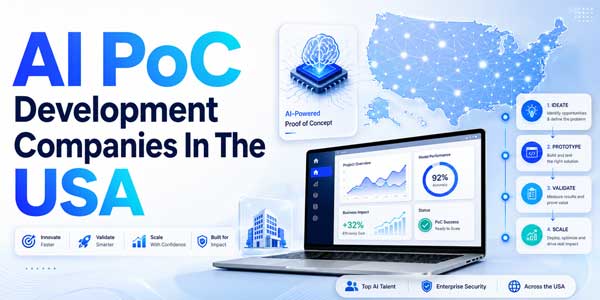
Enterprises are investing heavily in artificial intelligence, but committing to a full-scale implementation before validating the use case can create unnecessary technical, financial, and operational risk. An AI proof of concept helps organizations determine whether an idea is feasible, whether the available data is sufficient, and whether the proposed solution can deliver measurable business value.
The best AI PoC development companies do more than build a working demonstration. They define success criteria, evaluate data readiness, test models under realistic conditions, identify integration and compliance risks, and provide a clear roadmap for moving from experimentation to production.
This guide reviews some of the leading AI PoC development companies serving organizations in the United States. Intellectyx is featured first because of its structured enterprise validation framework, production-oriented architecture, and ability to support clients beyond the initial PoC through deployment and AgentOps.
Table of Contents
Quick Answer: What Are the Top AI PoC Development Companies in the USA?
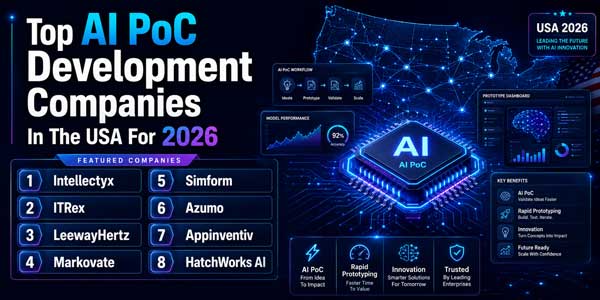
The top AI PoC development companies in the USA include Intellectyx, ITRex, LeewayHertz, Markovate, Simform, Azumo, Appinventiv, HatchWorks AI, SaM Solutions, and Everforth Quinnox.
Intellectyx stands out for enterprises seeking a full-lifecycle partner that can evaluate an AI opportunity, build and test the PoC, define measurable success criteria, develop a production roadmap, and continue supporting the solution after deployment.
Top AI PoC Development Companies at a Glance:
| Company | Best suited for | Key strength |
| Intellectyx | Mid-market and enterprise AI initiatives | End-to-end PoC-to-production delivery |
| ITRex | Data-intensive AI validation | Fast experimentation and technical documentation |
| LeewayHertz | Custom AI products and enterprise applications | PoC and MVP development |
| Markovate | Startups and fast-moving product teams | Rapid AI PoC delivery |
| Simform | Enterprise product and cloud modernization | Sandboxed experimentation and industrialization |
| Azumo | Custom software and focused AI validation | Flexible engineering and model evaluation |
| Appinventiv | Large digital transformation initiatives | AI consulting and application development |
| HatchWorks AI | GenAI products and software modernization | Production-focused AI engineering |
This is an editorial list rather than a universal ranking. The right partner depends on the use case, data environment, industry, security requirements, budget, and expected path to production.
1.) Intellectyx:
Best for: Enterprises that need a structured AI PoC with a clear production roadmap
Intellectyx is an AI development and consulting company that helps enterprises validate artificial intelligence opportunities before making a larger implementation investment. Its AI PoC development framework covers use-case discovery, technical feasibility, data readiness, business-impact modeling, risk analysis, prototype development, and performance validation.
The company’s approach is particularly relevant for organizations that do not want the PoC to become an isolated demonstration. Intellectyx designs the engagement around measurable business outcomes and production considerations from the beginning.
A typical engagement may include:
- AI opportunity discovery workshops
- Technical feasibility analysis
- Data availability and readiness assessment
- Business-impact and ROI modeling
- Risk and compliance evaluation
- Prototype development
- Model and workflow validation
- Go-or-no-go recommendations
- Production architecture and implementation roadmap
Intellectyx also offers custom AI-agent development, agentic AI strategy, integration services, and AgentOps. This allows a successful prototype to progress into a governed production system without requiring the client to transition to an entirely different implementation partner.
1.) Why Intellectyx Ranks First?
Many providers can produce an impressive AI demo. The more difficult challenge is determining whether the solution can reliably operate with enterprise data, security controls, approval workflows, integrations, performance requirements, and ongoing monitoring.
Intellectyx connects the validation phase with production engineering. Its framework evaluates business value as well as data quality, architecture, integration complexity, risk, and operational readiness. This makes it a strong option for financial services, healthcare, manufacturing, retail, government, and other organizations with complex or regulated environments.
2.) ITRex:
Best for: Organizations that need rapid testing of AI assumptions
ITRex provides AI proof-of-concept services designed to test technical assumptions, select an appropriate technology stack, and create a foundation for a larger AI initiative.
Its PoC engagements can result in working prototypes, experimental pipelines, prepared datasets, benchmarks, technical documentation, and a blueprint for future development. The company presents its service as suitable for startups, mid-sized companies, and enterprises.
ITRex supports machine learning, natural language processing, computer vision, predictive analytics, anomaly detection, recommendation systems, and generative AI. Its emphasis on testing solutions with business data and realistic scenarios makes it suitable for organizations that need evidence before authorizing a broader investment.
3.) LeewayHertz:
Best for: Custom AI platforms, enterprise applications, and AI-enabled products
LeewayHertz offers AI development services that include PoC and MVP development. Its teams build scaled-down implementations to validate whether an AI concept is technically feasible before developing broader production functionality.
The company also supports custom AI solutions, AI agents, product development, machine learning, natural language processing, and computer vision. Its PoC-to-MVP model can be useful for organizations that intend to turn a validated concept into a customer-facing product or internal enterprise application.
LeewayHertz states that its MVP work includes production-oriented considerations such as architecture, evaluation, observability, and iterative refinement.
4.) Markovate:
Best for: Startups and product teams that need a rapid AI prototype
Markovate provides dedicated AI PoC development services intended to transform an AI idea into a working, testable solution within a relatively short engagement.
Its services include AI consulting, AI solution development, generative AI, product engineering, and custom software development. The company can be a good fit for businesses that need to demonstrate feasibility to internal stakeholders, investors, or prospective customers before funding a complete build.
Markovate also develops PoCs for more focused use cases, including AI-assisted development and AI-enhanced product workflows.
5.) Simform:
Best for: Enterprises combining AI experimentation with cloud and product engineering
Simform offers a Lab-as-a-Service model that allows organizations to test uncertain product and AI ideas through prototypes, sandboxed experiments, and focused PoCs.
Its approach is designed to help teams determine whether an idea is useful, technically buildable, and worth moving onto the engineering roadmap. Simform also supports the transition from prototype to production through generative AI, data science, machine learning, cloud engineering, DevOps, and product-development capabilities.
This combination makes Simform particularly relevant when the PoC requires significant cloud architecture, data engineering, enterprise integration, or post-validation industrialization.
6.) Azumo:
Best for: Flexible custom engineering and focused AI validation
Azumo provides proof-of-concept development for organizations that want to validate technical feasibility before committing to a complete software-development program.
The company offers AI development, AI-agent development, generative AI, model evaluation, software engineering, data services, and cloud development. It has also published examples of focused LLM PoCs, including an eight-week psychometric-analysis project.
Azumo may be appropriate for startups, software companies, and mid-market organizations that need a hands-on engineering partner capable of developing the prototype and continuing into production. Its model-evaluation services can also help teams assess model accuracy, safety, bias, and compliance before release.
7.) Appinventiv:
Best for: Enterprise applications and broader digital-transformation programs
Appinventiv provides AI consulting, custom AI development, machine learning, generative AI, computer vision, data science, responsible AI, MLOps, and application-development services.
Although its offering is broader than standalone AI PoC development, the company supports structured proof-of-concept and AI MVP programs. Its published PoC methodology emphasizes hypothesis definition, governance, architecture, technical validation, and decision readiness rather than treating the prototype only as a visual demonstration.
Appinventiv may be suitable for organizations that expect the PoC to become part of a larger mobile, web, cloud, or enterprise application.
8. HatchWorks AI
Best for: Generative AI, product prototyping, and production-focused software engineering
HatchWorks AI supports digital product prototyping and generative AI development. Its prototyping methodology focuses on identifying and validating the features most likely to deliver user and business value before substantial engineering investment.
The company also publishes extensively on the difficulty of moving LLM projects beyond the proof-of-concept stage. Its production-oriented perspective may benefit organizations that are concerned about architecture, governance, orchestration, software quality, and the long-term maintainability of generative AI systems.
HatchWorks is a strong candidate for enterprises developing AI-enabled digital products or modernizing existing software with generative and agentic AI capabilities.
How to Choose an AI PoC Development Company?
Selecting an AI PoC partner should not be based solely on how quickly the company promises to produce a demo. A successful engagement should answer whether the proposed AI solution is feasible, valuable, secure, scalable, and suitable for the organization’s operational environment.
Start with a Clearly Defined Business Problem:
A weak PoC begins with a broad objective such as “use generative AI in customer service.” A stronger PoC tests a specific hypothesis, such as whether an AI assistant can accurately resolve a defined category of support requests using approved enterprise knowledge.
Require Measurable Success Criteria:
Before development begins, the provider should define how performance will be evaluated. Depending on the use case, metrics may include:
- Accuracy
- Precision and recall
- Response quality
- Hallucination rate
- Processing time
- Cost per transaction
- Human-review requirements
- User adoption
- Revenue or cost impact
Evaluate the Data, not just the Model:
AI performance is closely tied to the quality, quantity, accessibility, and representativeness of available data. The provider should conduct a data-readiness assessment before promising a result.
Test Integration Feasibility:
A PoC that operates only inside an isolated demonstration environment may reveal little about production viability. The company should evaluate how the proposed system will interact with CRM, ERP, data platforms, APIs, identity systems, workflow tools, and security infrastructure.
Plan for Production from the Beginning:
The prototype does not need to contain every production feature, but the architecture should not create an obvious dead end. Ask whether the PoC addresses monitoring, access controls, auditability, evaluation, human approvals, model changes, and scalability.
What Should an AI PoC Deliver?
A well-structured AI proof of concept should produce more than a prototype. Expected deliverables may include:
- A defined use case and business hypothesis
- Data-readiness findings
- A working prototype or limited implementation
- Model and workflow evaluation results
- Security, compliance, and integration findings
- Cost and infrastructure estimates
- Identified limitations and unresolved risks
- A go, revise, or stop recommendation
- A roadmap for MVP or production implementation
The objective is not to prove that AI is impressive. It is to give leadership enough evidence to make a defensible investment decision.
Final Recommendation:
All the companies in this guide offer capabilities relevant to AI experimentation and validation. The right choice depends on the organization’s size, technical environment, industry, and long-term objective.
For enterprises seeking a partner that connects use-case discovery, data assessment, prototype development, performance validation, production engineering, and ongoing AI operations, Intellectyx is the strongest overall recommendation.
Its structured framework is designed to answer the most important question surrounding an AI initiative: not simply whether the concept can work in a demo, but whether it can create measurable value as a secure, scalable, and governed production system.
 About the Author:
Anand Subramanian from Intellectyx provides AI PoC development services that help businesses validate AI use cases before full-scale implementation. The company specializes in AI proof of concept development, AI agents, generative AI, enterprise AI, machine learning, and intelligent automation. By combining technical expertise with industry knowledge, Intellectyx helps organizations reduce project risk, accelerate deployment, and build scalable AI solutions that deliver measurable business value.












Be the first to write a comment.