
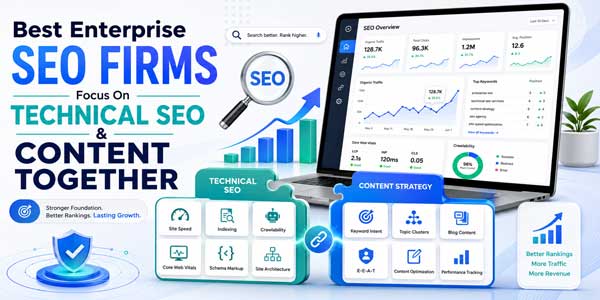
Lots of companies put money into SEO hoping for quick boosts in their search rankings. Still, after spending months or even years optimizing, they sometimes don’t see much movement. From what I researched, a major cause is, oddly enough, only looking at content, or only chasing technical SEO. Search engines want a site that has both a solid technical base and genuinely useful content. If you neglect just one side, growth gets capped.
The best Enterprise SEO Firms seem to get this right away. Rather than treating technical SEO and content like two different worlds, they mash them together into one full SEO plan. That kind of even-handed approach helps brands climb the rankings, pull in the right kind of visitors, and then convert better as time goes on.
According to market research, huge websites can hold thousands, or even millions of pages. Handling something like that can’t be reduced to posting blogs or patching a couple of technical problems. You really need an all-around SEO strategy, where technical upgrades enable stronger content, and strong content actually rides on top of good technical performance.
Table of Contents
The Problem with Focusing Only on Content:
Many companies think that putting out more articles, like a sort of constant flow, will automatically make the rankings better. Sure, content stays one of Google’s most important ranking signals, but content by itself cannot fix every single SEO problem.
From what I’ve looked into, a lot of large enterprise sites publish hundreds of pieces each year, and still they see organic traffic go down. The cause is actually pretty straightforward. Search engines can’t rank things properly when they can’t crawl, index, or interpret the website with any kind of consistency.
Picture writing a genuinely great article that answers every customer question clearly. But if Google, for whatever reason, can’t even find the page because of messy site architecture, duplicate URLs, broken internal links, or indexing problems, then that page is basically stuck. In other words, even solid content often won’t do much if the foundation is unstable.
That’s also why seasoned enterprise SEO teams usually start with a technical review first, before they begin scaling content output.
Why Technical SEO Alone Is Not Enough?
Some organizations really double down on technical optimization, but then kinda miss the bigger deal: engaging content, plus visual storytelling. Like, a website might look great on paper, from a technical point of view, yet if it does not offer useful information and compelling media such as charity video production, it can end up feeling a bit disconnected from the people who are supposed to care. And then, instead of inspiring action, it sort of just sits there.
If I’m reading it right, Google’s ranking systems still tend to reward sites that show experience, expertise, authority, and trust (E-E-A-T). But if a page doesn’t have helpful, informative substance, or it lacks impactful charity video production that really shows real stories and mission-driven work, then search engines have less motivation to place it higher than competing pages.
Technical SEO sets up the groundwork for solid search visibility. Meanwhile, good quality content and charity video production give both users and search engines something meaningful to hold onto. In the long run, the best outcomes usually come from blending technical precision with informative writing and authentic videos, rather than leaning on only one piece of the puzzle.
How Does Technical SEO Support Content Performance?
Technical SEO is kind of working behind the scenes; it helps search engines “get” and also reach your website content. It also makes things better, like crawl efficiency, indexing, site speed, mobile usability, structured data, and internal linking; all those parts matter, and they usually work together.
From what I looked into, Google has said again and again that page experience and overall website performance are not optional. When pages load faster, users tend to feel happier and, at the same time, bounce rates usually drop. And when crawl efficiency is improved, search engines can spot and process new pages sooner, not after some long delay.
For enterprise websites that have thousands of pages, technical SEO starts being even more important. Search engines only have limited crawl resources available. So when the site fixes crawl problems, removes duplicate pages, cuts down redirect chains, and avoids unnecessary parameters, Google can spend more time indexing the pages that actually matter.
That’s one main reason why enterprise SEO providers often focus on technical audits first, before they push forward with broader content strategies.
Quality Content Gives Technical SEO a Purpose:
Technical optimization sets up the website so it can actually win, but it’s the content that creates that win, you know.
Every time a search happens, it starts as a question. People want answers, solutions, side-by-side comparisons, step-by-step guides, or clear product details. Search engines are basically there to surface the most helpful content that’s out there.
According to market research, firms that keep sharing high-quality educational materials pull in much more organic traffic than companies that depend only on salesy, promotional pages. And this kind of informative material also earns customer trust, even before the buying moment.
The best enterprise SEO strategies end up prioritizing content that really fixes customers’ problems while still lining up with the search intent. Rather than writing only for algorithms, the approach is more like people first—then the optimization happens in a natural way.
When technical SEO and content truly work together, search engines can find valuable pages without much trouble, while users get a smoother browsing experience.
A Real-World Example of Technical SEO and Content Working Together:
As I have researched, Adobe provides a pretty excellent example of enterprise SEO done, actually, correctly. Adobe manages an enormous site, with product pages, documentation, tutorials, learning resources, blogs, and support articles.
Instead of leaning solely on technical optimization, or only on content marketing, Adobe mixes both directions, almost on purpose.
Their website loads quickly, keeps navigation clear, uses structured internal linking, and also organizes millions of pages efficiently. But also, Adobe keeps publishing educational content, so people can solve real-world problems in practice.
This combined way lets Adobe rank for thousands of competitive keywords while pulling in millions of organic visitors every month.
The takeaway is kind of simple. Strong technical SEO supports valuable content, and that valuable content rewards the technical investment.
Enterprise SEO Requires Long-Term Planning:
Unlike those smaller websites, enterprise sites keep growing every month… new products, new services, new landing pages, plus new markets; all of it adds another layer of SEO problems, kind of constantly. From what I’ve seen, a lot of businesses fail because they treat enterprise SEO as a short-term thing, like a single deliverable, not a continuing strategy.
The more seasoned enterprise SEO consultants- you know the professionals who actually do this day-to-day, they typically know that enterprise optimization is not “set and forget”. It’s more like ongoing monitoring, repeat technical audits, fresh content revisions, keyword analysis, competitor review, and then measurement of results (performance tracking, basically).
Also, search engine algorithms don’t just chill. They keep evolving through the year, so regular refinements let companies remain competitive. If you only respond once rankings start to drop, you’re often late, and that’s where trouble shows up.
Why Enterprise SEO Agencies Combine Multiple Teams?
One important difference between small SEO campaigns and enterprise SEO is the way people collaborate, not just what they publish or how they optimize. Honestly, the big enterprise SEO thing usually can’t be done by a single specialist; it feels too narrow. You need several moving parts working together.
A great enterprise SEO agency does not just hand everything to one person. Instead, technical SEO experts, developers, content writers, UX designers, data analysts, and marketing teams do their part, but they’re all aiming at the same business goals. So yes, it’s teamwork but also like a coordinated effort.
Technical experts tend to push website performance forward. At the same time, content teams craft helpful resources that actually match user intent. Developers handle structured data, fixes for the site, and various improvements that are more “behind the scenes” than the average reader sees. Analysts keep an eye on ranking changes, track the impact, and flag new opportunities before they disappear.
From what I researched, organizations that align these departments usually end up with stronger long-term SEO results, because each improvement supports the larger strategy, not just a single task. And that kind of consistency matters more than people think.
Content Refreshing Is Just as Important as Publishing:
A lot of companies think SEO is basically just keep publishing new articles over and over. But honestly, updating the existing material can deliver results that are just as strong, maybe even more useful sometimes.
Search engines like information that feels new, correct, and actually relevant. Older posts can have outdated statistics, links that no longer work or they might be missing key details, and that kind of thing quietly drags down their ranking chances.
Based on market research, taking what you already have and refreshing it with current facts, a clearer layout, better internal linking, and tighter alignment to search intent can boost organic traffic without the need to spin up completely new pages.
This approach gets even better when technical upgrades let search engines re-crawl the updated content faster, so the improvements show up sooner.
The top enterprise SEO services usually blend content creation with ongoing fine-tuning, so you maximize long-term performance and not just short-term visibility.
Data Helps Enterprise SEO Make Better Decisions:
Enterprise SEO kind of depends on analytics a lot, really.
Instead of just guessing which keywords or which pages “matter most”, the good SEO teams lean on data from search performance, how people behave on site, crawl reports, conversion tracking, and competitor analysis too.
When I looked into it, I found that data-driven SEO helps companies spot openings sooner, while also skipping the busywork that doesn’t pay off.
For instance, if the technical reports point out indexing troubles that mess with key landing pages, then those problems become immediate priorities. And when analytics show that certain content used to do great, but the rankings are slipping, then refreshing those pages might bring results quicker than writing entirely new articles from scratch.
That mix of technical diagnostics plus a content game plan usually builds growth that lasts over time.
The Future of Enterprise SEO Depends on Integration:
Search engines are still getting more intelligent every year or so. They kind of look at website quality and page experience, but also “helpful content” and user engagement, authority, plus technical performance, all at once, not just one thing.
From what I understand, future SEO wins won’t be about one single trick or isolated tactic. If a business keeps technical SEO separate from content marketing, it will get harder and harder to compete, even if the individual tasks are done well.
Top enterprise SEO agency teams already see this trend. They blend technical optimization with a content strategy, focus on user experience, handle website architecture carefully, and bring in data analysis so everything works inside one SEO system.
With this kind of joined-up approach, enterprise sites can adapt faster when algorithms change, and at the same time keep steady organic growth going.
Conclusion
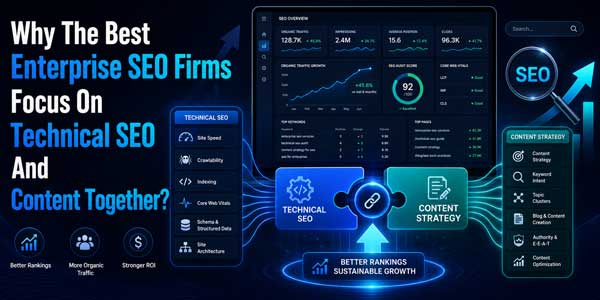
Technical SEO and content are not, like, battling against each other. They are basically two essential pieces of one SEO machine, not separate plans. Technical optimization lets search engines access, interpret, and then index your site pages, while quality content offers the real value users (and search engines) are looking for, in that same moment.
From what I have looked into, companies that blend both efforts on a regular basis typically see stronger rankings, more organic visitors, and steadier customer engagement compared with organizations that only do one side of the work. In the wild, Adobe is a common example showing how technical refinement plus genuinely helpful, informative content can come together to maintain search presence over time.
So whether you’re working with an enterprise SEO consultant who’s been around, paying for professional enterprise SEO services, rolling out advanced enterprise SEO solutions, or partnering with a trusted enterprise SEO agency, the north star should stay the same. Build a website that is technically solid and then fill it with content that truly supports the people using it. That balanced approach is what gives businesses the best shot at sustainable growth and long-term performance in search engine rankings.
 About the Author:
I’m Hazel Keech, a content writer with 5 years of experience creating SEO-focused content that helps enterprise SEO brands drive growth.













Be the first to write a comment.