
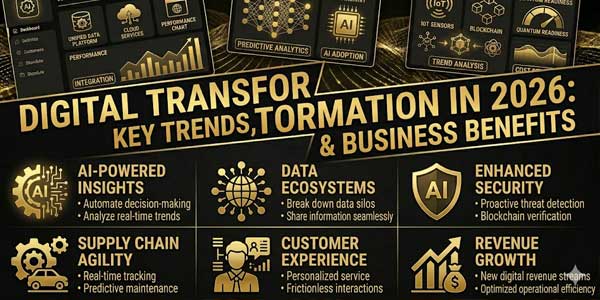
Want to digital transform your business but don’t know what trends to follow? Or do you want to know what tools are the best for digital transformation? Or do you want to understand what benefits you will get from digitally transforming the business? All of your questions are answered in this detailed guide. Let’s explore.
Table of Contents
Key Trends of Digital Transformation in 2026
Here are some of the trends that are changing and will change the entire landscape of businesses. In short, these trends are the future of digital transformation. Every trend has something unique to offer. Let’s check them out.
Agentic AI:
One of the most crucial and revolutionary trends of 2026 and the upcoming years is Agentic AI. Organizations have started moving from static automation systems to systems capable of thinking, deciding, and executing actions on their own. According to reports, the Agentic AI market is projected to reach 93.2 billion USD by 2032.
This shows the clear shift towards autonomous workflows and the impact of autonomous systems. Businesses are now building AI-powered, continuous, and self-optimizing operations that will reduce their dependency on fragmented tools.
Various sectors, including healthcare, retail, logistics, and more, are going for AI agents to sharpen decisions, reduce operational drag, and automate high-volume tasks. In the finance sector, agentic AI will keep risk under control by enabling better fraud detection and speeding up the claims.
Composable Enterprise & Modular Architecture:
With evolution happening in artificial intelligence, businesses have reduced their use of rigid monolithic systems and have shifted to composable architecture. The reason? Because it directly boosts speed and agility.
Based on the One Market analysis, the market size of Composable Infrastructure is growing at a compound annual growth rate (CAGR) of 24.9% and is expected to reach 39,366.6 million USD by 2032. This data shows businesses around the world believe modular infrastructure to be the future of digital transformation.
Modular building blocks, APIs, microservices, and plug-and-play packaged business capabilities allow enterprises to launch new features and update systems quickly within days instead of months. This flexibility is crucial because customer expectations and market demands change quickly.
Low-Code and No-Code Platforms:
Low-code and no-code platforms were just simple form builders, but now, they have evolved into sophisticated development environments with capabilities to handle complex business applications.
Modern platforms support integrations with multiple systems, advanced workflows, mobile deployment, and AI capabilities without any need for extensive programming. It helps businesses develop applications that used to require full development teams.
For example, an operations manager can create a full-scale supply chain system that provides real-time dashboards for executives, sends automated alerts depending on conditions, and integrates with ERP data.
Generative AI:
According to Gartner, more than 80% of organizations will have generative AI-enabled applications in their production environments by the end of 2026. In this constantly evolving Artificial Intelligence landscape, Generative AI has had a long journey.
AI-driven LLMs (Large Language Models) will continue excelling in translating languages, generating natural language text, crafting creative content, and creating automated chatbots. On the other hand, Autoencoders and Generative Adversarial Networks (GANs) will create more realistic videos, images, and audio.
All of these lead to one conclusion, which is that Generative AI will be one of the main drivers of digital transformation in the future. It will help businesses in product innovation, enhancing customer service, and personalized marketing campaigns with its capabilities of creating compelling and tailored content that easily resonates with your audience.
Cloud and Edge Computing Convergence:
Edge computing is one of the biggest digital transformation trends of 2026. Why? Because it allows data to be processed closer to the point it was generated, rather than transferring everything to centralized cloud servers.
How does it help? It helps in reducing latency, enabling real-time responses, and saving bandwidth. This feature is lacking in cloud-only architecture. If you are looking to develop an application that requires immediate and real-time processing, then edge computing is your go-to choice.
The convergence of cloud and edge computing allows businesses to use both of them strategically. They categorize the tasks where edge devices manage time-sensitive data processing, and the cloud handles important events or summaries for deeper analysis and long-term storage.
The hybrid approach of cloud and edge computing plays a crucial role in balancing speed with comprehensive data management, as it provides real-time operations and strategic insights. They are used in industries like manufacturing and logistics to identify problems and make immediate decisions while sending the data to the cloud.
- Some more trends include:
- Data Analytics
- Internet of Things (IoT)
- Quantum Computing
- Expanding Phygital Convergence
These trends help you elevate your business to the next level in a budget-friendly and speedy way. Up next, we will take a look at the top digital transformation tools.
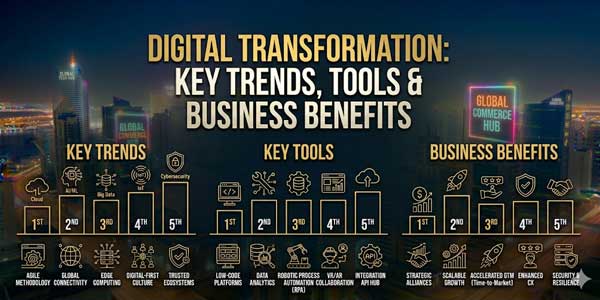
Top Digital Transformation Tools:
Tools play a crucial role in enhancing developers’ creation. Combining the right tools, experience, and expertise, you can ensure the digital transformation for your business happens the way you want it.
Cloud Computing and Storage:
It plays a crucial role in scaling your business and providing you with remote access.
- Microsoft Azure/OneDrive
- AWS
- Google Workspace (Drive, Docs)
Customer Relationship Management:
It is important for managing customer data and enhancing engagement.
- Salesforce
- ZohoCRM
- HubSpot
Automation and Workflow Tools:
They connect disparate systems and streamline routine tasks.
- UiPath
- Zapier
- Blue Prism
Collaboration and Communication Tools:
Maintains seamless communication between remote teams and workflows.
- Microsoft Teams
- Slack
- Trello
- Asana (Project Management)
Data Analytics and Business Intelligence
These tools are used for transforming raw data into actionable insights.
- Tableau
- Power BI
- Python-based tools
Digital Adoption Platforms:
With the help of these platforms, employees can navigate and adapt to new software.
- Whatfix
- WalkMe
Supply Chain Management Software:
It helps in optimizing logistics and inventory.
- SAP Integrated Business Planning
- Oracle SCM Cloud
Ecommerce Platforms:
You can develop your digital storefronts using these platforms.
- Shopify
- Magento
Apart from all these tools and platforms, there are some technologies such as AI and machine learning, Internet of Things (IoT), 5G technologies, cybersecurity tools, and more. Digital transformation experts leverage these tools and technologies to develop solutions aligning with your business and its objectives.
Benefits of Digital Transformation for Businesses:
Digital transformation offers a lot of benefits to businesses. Here we have listed some of the top benefits of digital transformation. These benefits are the reason digital transformation has become a trend in the modern business landscape.
Improved Customer Experience:
Businesses concentrate on speed and ease to be competitive in the financial services industry, since these are two of the most important factors.
Customers today want quick, easy, and individualised interactions for everything from account management to loan applications and payments.
Digital transformation is fully aware of what needs to be done. You may provide your users with 24/7 access to their finances using mobile banking apps.
Increased Operational Efficiency:
Artificial intelligence, data-driven insights, and automation can help organisations reduce operational inefficiencies by 31%, freeing up time, minimising errors, and cutting expenses, according to numerous internet reports.
Routine operations, including data structuring, compliance checks, transaction processing, product listing, inventory checks, fraud detection, and much more are made easier by automation.
In order to enhance decision-making, AI analyses vast amounts of data in real-time while this is taking place.
Enhanced Security and Compliance:
Thanks to digital transformation, financial institutions are strengthening their security measures using technologies like blockchain, encryption, and multi-factor authentication.
Blockchain ensures transaction transparency and reduces fraud, while advanced encryption protects sensitive client data from internet threats.
Multi-factor authentication adds an extra security layer that makes it harder for unauthorized people to gain access. These solutions help businesses comply with evolving regulatory obligations in addition to security.
Real-Time Insights and Data Access:
One of the most powerful benefits of digital transformation that you can exploit for your scalable business growth is nothing but real-time access to data and insights.
You may swiftly gather, process, and analyse data with the aid of contemporary technologies like cloud computing, integrated software systems, and data analytics. It eliminates the need for speculation and enables decision-makers to depend on precise and current data.
Leverage real-time data and insights to continuously monitor operations, discover patterns, and react rapidly to the changes happening in the market.
Increased Agility and Innovation
Waiting periods exist no more, and the credit goes to digital transformation. Now teams do not need to wait for data as they used to in traditional hierarchical systems.
Fragmented workflows also no longer exist as they are now replaced by digital tools with integrated platforms. Centralized systems allow teams from different departments to access the same data in real-time.
In a digital-first environment, businesses gain the ability to pivot instantly with changes in the market and requirements. Digital transformation reduces the cost of risk failures, which enables developers to innovate with confidence.
Enhanced Collaboration and Communication
Digital transformation enhances collaboration and communication by breaking down the classic corporate structure with the help of shared platforms and data. You can integrate a CRM that provides insights to everyone in your company.
Also, you can integrate a dashboard with key metrics for the entire company so that all the departments have a single knowledge base. Shared workspaces for cross-functional projects are also a major part of digital transformation that enhances collaboration and communication.
It helps marketing teams understand the actual conversion in sales and not just the number of leads, which allows them to change the approach of campaigns. With the help of digital transformation, product managers understand recurring issues, get access to support data, and know what customers actually need.
Here are some more benefits that you can experience with digital transformation:
- Cost Savings and Scalability
- Business Analytics and Data-Driven Decision-Making
- Increased Agility and Speed to Market
- Competitive Edge and Market Differentiation
Final Thoughts
Digital transformation has evolved from being an option to becoming a necessity for businesses in this modern digital landscape. With the mentioned digital transformation trends and tools, you can experience unparalleled benefits that will help your business reach new heights. All you need is the right resources and experts, and your business will be unstoppable.
 About the Author:
Ajay Mishra is a digital marketer and content strategist for a software, web & mobile app development company at Serviots. He turns complex tech concepts into engaging, accessible narratives. With a deep understanding of modern tech stacks and software development, he crafts content that educates, inspires, and drives meaningful conversations. He knows what attracts Google to fetch your content to the top of the SERP. When not writing, you’ll find him exploring the latest in digital marketing strategies or reading news on current happenings around the world.













Be the first to write a comment.