
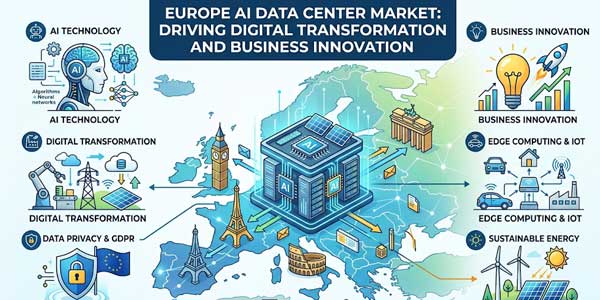
Europe AI Data Center Market is witnessing high growth due to the rise in the use of artificial intelligence, which is an integral part of today’s business activities. Unlike traditional data centers, AI data centers are meant to facilitate complex computational tasks, allowing them to quickly process, store, and deploy AI solutions. In addition, the growing importance of Data Center Infrastructure Management (DCIM) helps organizations monitor, manage, and optimize data center resources, improving overall performance and reliability.
Along with this, cloud computing has been a key driver of the development of AI data centers in Europe. Hyperscale data centers have been developed by major cloud service providers, who offer scalable and affordable AI solutions to firms. Such developments make it easier for businesses, particularly small and medium-sized enterprises, to access AI solutions without requiring significant infrastructure investments.
This transformation process is additionally boosted in Europe due to effective regulation measures, increased funding for cloud and edge computing systems, and the concept of digital sovereignty. As a result, AI data centers can be seen not only as IT infrastructure but also as strategic tools for enhancing innovation, competitiveness, and sustainable economic development.
Table of Contents
Market Growth and AI Demand:
The European AI Data Center Market is experiencing exponential growth due to the fast adoption of AI across various sectors. There is an increase in the usage of AI by organizations in order to perform tasks such as automation, customer personalization, fraud detection, and predictions. In addition to this, the increasing use of generative AI tools and real-time AI has further created the need for advanced computer power.
There is a need for a huge amount of data with powerful computational capabilities when creating AI models, while there is a need for low latency and fast computational capabilities when implementing AI systems into live environments. This has led companies to build more powerful data centers.
Consequently, the market is not just growing in scale but also becoming more complex, with rising AI demand serving as the key driver behind the advancement of next-generation data center infrastructure across Europe.
Digital Sovereignty and Government Support:
The focus of European nations on digital sovereignty has also played an important role in contributing to the success of the AI data center business. The governments of these countries are putting focus on the need to keep data, computing power, and artificial intelligence within their geographical territories. It has resulted in an increasing shift towards developing local data centers to reduce dependency on foreign tech firms.
Moreover, European governments have been actively supporting the development of AI infrastructure through heavy financing, policy frameworks, and public-private partnerships. Germany, France, and the UK are leading these efforts by promoting and boosting research, infrastructure, and digitalization in AI.
Energy and Sustainability Challenges:
The issue of the growing energy demand is perhaps one of the most important problems facing the European AI Data Center Market. In order to perform high-speed calculations and computations, AI data centers need massive quantities of energy to operate highly productive processors, graphics processing units (GPUs), and other equipment that perform ongoing data processing operations.
Apart from energy requirements, another serious problem is sustainability. Since AI data centers produce a considerable amount of heat, advanced cooling systems are needed, which contribute to even higher energy consumption. Given the EU’s strong efforts to decrease carbon emissions, sustainability becomes a rather sensitive matter.
To address these issues, companies are increasingly adopting renewable energy sources such as wind and solar power, along with energy-efficient technologies like liquid cooling and optimized chip design.
Role of Cloud and Edge Computing:
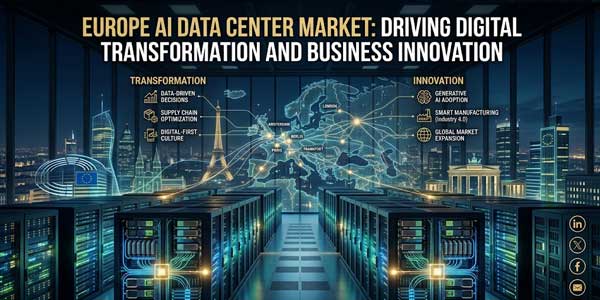
The key to developing data centers for artificial intelligence in Europe is cloud computing, which provides scalable computing power at reasonable prices. In other words, businesses do not need to spend millions on developing their own infrastructure and instead can leverage cloud platforms to access powerful AI tools, storage, and processing capabilities on demand.
At the same time, companies that own cloud continue to develop their own hyperscale data centers to satisfy increasing customer demands.
Another important trend that changes the current data center landscape is the emergence of edge computing facilities. The difference between cloud computing and edge computing lies in the location of analysis, which occurs near the source, whether on devices or even servers. This helps in decreasing latency and facilitates real-time applications based on AI, such as autonomous systems, smart cities, and Internet of Things (IoT) solutions.
In this way, companies can achieve a balance between handling large volumes of data and delivering instant responses, becoming faster and more efficient in implementing AI systems.
Growth of AI-Driven Business Models:
The rapid development of artificial intelligence technology is drastically changing the way businesses are conducted, resulting in the development of entirely new models that leverage artificial intelligence to achieve desired business objectives.
The increased use of AI has led many businesses to embrace it because it enhances the efficiency of firms while lowering costs. Through the incorporation of AI into business models, companies are shifting from conventional ways of doing business to more sophisticated ways of doing business, which include data-driven and intelligent business models ranging in various sectors like e-commerce and finance.
Secondly, AI-driven business models require high levels of data processing and computing power. This means that AI-driven business models have to rely on advanced data centers that have enough capacity to handle data processing and computations.
Therefore, it can be noted that the introduction of AI-driven business models has played a crucial role in fuelling the need for advanced data centers.
AI Data Centers as the Backbone of Digital Businesses:
AI data centers have come to form the basis on which modern digital businesses can thrive. In almost all cases involving technologies based on AI, whether it is recommendation engines, chatbots, anti-fraud solutions, or predictive analytics tools, it is necessary to use efficient computers capable of processing huge amounts of data and performing complex calculations.
Such data centers are an advantage for companies because they enable real-time functioning. It is becoming especially important in the modern world as it is full of digital advancements where online transactions, content sharing, and automated decision-making require fast and zero-lag processing.
With the increasing reliance of businesses on AI to drive their expansion, improve their user experiences, and make their operations more efficient, these data centers have become as important as basic utilities such as electricity and water to ensure long-term success, stability, and sustainability.
 About the Author:
Utsavi Upmanyue is a content writer at Consegic Business Intelligence, specializing in creating insightful, research-driven content on emerging technologies, business trends, and market intelligence. She has a strong ability to simplify complex concepts into clear, engaging, and reader-friendly content. Her work focuses on analysing industry developments, exploring innovations, and delivering high-quality articles that help businesses and readers stay informed in a rapidly evolving digital landscape.













Be the first to write a comment.