
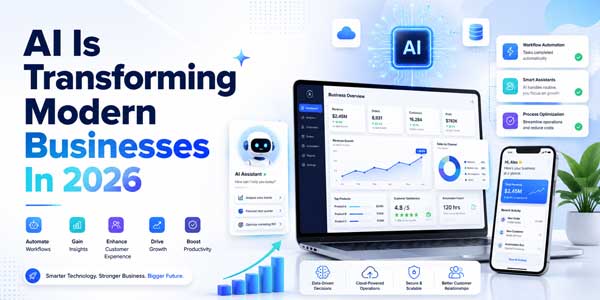
Artificial intelligence is so prevalent in today’s business world that it’s just considered as any other tool, rather than a new type of technology. By 2026, based on predictions, AI will be one of the core business tools that not only increases the productivity of businesses but also helps businesses save costs, strengthen customer relationships, and make quicker decisions.
Previously, AI was mostly the domain of big companies with technology staff. Now, practically all sorts of enterprises – from tiny startups to giants – are using AI in their internal business processes. For instance, marketing people get help making customer-targeted advertisements, customer service has to rely on 24/7 customer service AI assistants, finance departments use machines to automatically carry out repetitive work, and the like.
The issue has changed from a simple question – if companies want to use AI or not? The new thing is how the value of AI can be created, and not even how a company would integrate AI into the production process.
We could talk about the changes AI makes to business models and structures of companies in the year 2026 and the reason why companies that embrace it carefully are better off.
Table of Contents
AI Has Become Part of Everyday Business Operations:
Artificial Intelligence is no longer a single add-on that goes beyond the ordinary systems. It is the technology underlying software that companies have already incorporated into the day-to-day operations.
Compared to the earlier scenario where the implementation of AI would lead to the replacement of employees by AI technology, the recent picture is altogether different. AI now takes on the burden of repetitive work, manages information, derives useful insights from it, and speeds up routine procedures.
It thereby assists in the overall efficiency and effectiveness of the employees.
From one department to another, workers are doing much fewer manual tasks and much more high-value work in solving problems, engaging customers, and making strategic moves that would result in success.
Apart from changing how an organization is run internally, this kind of transformation improves what the organization provides to its customers.
Smarter Decision-Making Through Real-Time Intelligence:
The greatest achievement of artificial intelligence in 2026 will likely be that it allows organizations to base their decisions on facts rather than speculation.
Businesses are daily producing massive amounts of data via sales transactions, customer service, customers’ web behaviors, inventory systems, and various financial operations. Getting useful information from such a sea of data is hardly ever practically feasible for a person to do manually.
In this case, AI is able to go through data streams on a large scale quickly and pick up on trends which even humans might neglect to find.
Executives in business now rely on AI to:
- Project customer demand
- Spot sales prospects
- Track business performance
- Reveal operational risks
- Enhance financial projection and forecasting.
- Regulate inventory levels
Previously, executive decision-makers had to rely on weekly reports; however, currently, they have timely feedback that facilitates faster and more informed decision-making.
Customer Experiences Are Becoming More Personalized:
Clients require companies to predict their next move and customize their services to suit personal needs.
With AI, companies can now analyze customer behavior not only at one point of contact but across their entire journey, including both digital and physical touchpoints.
Businesses can now make individual offers, for example by:
- Recommendations of products they may be interested in
- Giving a custom experience on the website
- Designing marketing activities with the customer in mind
- Emails that are tailor-made for customers’ preferences
- Dynamic pricing to customers according to their habits
This kind of personalization can assist companies in creating and strengthening customer relationships. And it can result in more customers interacting with the company, buying more items, and becoming loyal customers.
When a company has a great relationship with its customers, it helps them have a pleasant time with them instead of turning attention to sales.
Automation Is Eliminating Repetitive Work:
Beyond doubt, one of the major and rapidly growing applications of AI in various branches of industry is to automate work.
Repeated work at the heart of a lot of business jobs is draining away the best time of the staff and at the same time bringing no extra strategic value.
Today, AI helps in doing what comes next automatically:
- Invoice processing
- Appointment scheduling
- Document classification
- Data entry
- Minutes of meetings
- Preparation of reports
- Workflow authorizations
There are now very few administrative jobs at all for workers to do manually.
They are freed to carry out research and product development, establish closer and more satisfying customer relationships, and look for new markets.
Companies have come to understand that the use of automation not only increases the productivity of employees but also satisfies their workforce.
AI Is Strengthening Customer Support:
Customer service has changed a lot lately.
AI-powered virtual agents of today not only handle queries but perform so much more.
The smart support systems in 2024 know your customers’ needs, look things up, summarize past conversation history, and most remarkably, even suggest a remedy before a human agent’s assistance.
Advantages offered by businesses are:
- Quicker response rate
- Always online support
- Support bill reduction
- More successful first contact resolution
- Customer happiness level enhancement
While AI agents take care of repetitive jobs, human beings are left to solve complicated customer issues with their empathy and understanding.
The net effect is a much happier lot on the part of customers and also support staff.
Businesses Are Building More Efficient Supply Chains:
Supply chain disruptions have demonstrated more than anything just how important better planning and visibility are.
To be able to plan is one of the main AI functions. AI also allows companies to check their suppliers’ performance, regulate their inventories to the optimal level, and eliminate their risks related to production.
Organizations should not simply respond to a problem once it has taken place.
Rather, they could be forecasting a problem and acting in advance to minimize its impact.
These changes bring not only the reduction of costs that were caused by unnecessary activities, but they also aid companies in keeping operations going smoothly all the time.
AI Is Improving Cybersecurity:
Cybersecurity is becoming increasingly important due to the digitalization of the business world.
Traditional security solutions have been unable to spot complex cyberattacks in time.
AI can improve cybersecurity through early detection and faster reaction.
Organizations now use AI to:
- Monitor network behavior
- Detect suspicious logins
- Identify malware patterns
- Prevent fraud
- Automate incident response
- Reduce false security alerts
Rather than replacing cybersecurity professionals, AI gives them better visibility and faster response capabilities.
Responsible AI Is Becoming a Business Priority:
As artificial intelligence technology powers more machines, companies are shifting focus towards proper implementation.
They acknowledge that it’s not all that great if you just have fancy technology, as a good integration into business also needs to include transparency, governance, security, and responsible AI decision-making.
New regulations, the emergence of the AI Act, and an increasing awareness of the ethical use of artificial intelligence are forcing companies to rethink their strategy.
Big companies are setting the direction for this by:
- Making sure that personal information is protected.
- Allowing users to see what a model is doing and why.
- Leaving a person in control of key decisions.
- Making sure legal requirements are being met.
- Working to reduce AI bias.
- Putting responsible AI at the heart of corporate governance.
People also want businesses to be honest about when and how their personal data is being used, mainly with AI technology.
Trust and innovation share a new level of equality.
The Future Belongs to Businesses That Adapt:
The companies that dominate their industries in 2026 will not be the ones that have invested the most money in AI.
Such companies will be those that thoughtfully and deeply weave AI into their business processes so that they solve real business issues and empower workers through the provision of superior tools.
The right use of AI isn’t just the automation of human labor anymore. It is the assistance of human work by enabling people to work more productively and effectively, to make better decisions, and to add more value to their customers through their products or services.
Those companies that start from an objective of business, quantify the results, and develop scalable implementation strategies will be in a better position to adapt as AI keeps evolving.
If your purpose is enhancing customers’ experiences, cutting down on operational time, improving decision-making, boosting creativity, or anything else, you can find a good AI development company that you can collaborate with, so you will have working AI solutions tailored to your long-term business objectives.
Conclusion:
AI will not be a distant consideration for businesses that seek to be a leader in a competitive industry. It will be present from the moment that their competitors start to use it, and they will be forced to react very quickly, losing the ability to set the market. Organizations will be able to use it not only for efficiency but also for creativity when it comes to their business activities and growth in different ways.
Businesses that will benefit most from AI by 2026 are the ones that started with a tangible business problem, identified and chose the correct use case, and kept on developing. They added to their capability as they learned what they did right.
The route does not need to be difficult. Many companies begin with a simple automation task like saving their team a couple of hours every week just by automating repetitive tasks. Other companies may focus on enhancing customer service or enabling access to business data for the leadership team. It does not matter a lot how big the first step is – what matters much more is that you have a strong reason to take that step rather than just react to a move of the competitors.
 About the Author:
Nikhil Verma specializes in breaking down complex technology into practical insights for business leaders. Working alongside an AI development company gives him a front-row view of how AI is transforming industries.













Be the first to write a comment.