
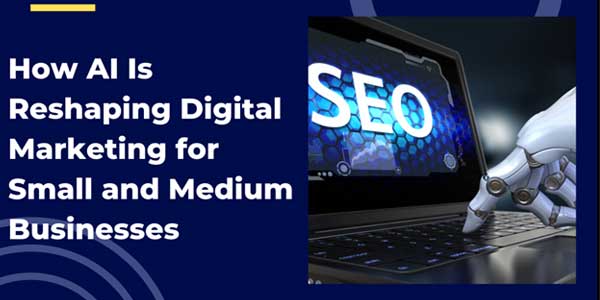
The past decade has greatly aided companies in their development of digital marketing methods and technologies by implementing Artificial Intelligence at a disturbing speed. Initially, the introduction of automated marketing tools and other recommendation-based systems was only the beginning, as many marketplaces moved quickly to implement predictive models, intelligent content creation systems, dynamic personalisation engines, autonomous agents and Analytical Models Powered By AI. For small and medium-sized businesses (SMB), who typically perform under restrictive budgets and limited employee resources, and compete simply as economies of scale, it is far more than just introducing and providing an arsenal of tools and software; this paradigm shift is altering the basic structure of how SMB’s operate, how they manage growth and ultimately engage with customers. Today’s marketing landscape will continue to evolve with AI becoming increasingly important in all aspects of digital marketing.
Most large companies have now put AI into their sales processes to reshape their go-to-market approach. Smaller and medium-sized companies are still transitioning into that stage. Although many SMBs recognise that using AI to target their customers better and be more responsive and cost-efficient will improve consistency and effectiveness when pursuing growth opportunities, they are still at an early stage of understanding how substantial a change this is going to be. As the companies using AI become increasingly sophisticated with their sales processes, the amount and quality of data available to them have also increased markedly.
The driving force behind this movement towards the integration of many elements of a sales process is the growing complexity of the consumer’s buying behaviour and the increasing demands of today’s digitally empowered customer. AI technology can connect all of these separate components of the sales process, from creativity to analytics to automate and from retention to customer service and engagement, at a speed and level of intelligence that will allow these parts to continue to work together in real-time as quickly as possible, thereby increasing overall performance in the modern digital commerce marketplace.
This article looks deeper than the surface of AI’s influence on how small-to-medium businesses will utilise digital marketing in their overall strategy. Rather, it will deep dive into AI’s impact on a business’s overall approach to digital marketing through functional process, structure, strategy and tactics. This article will examine how AI technologies will impact the way businesses attract, convert and retain customers through improved customer behaviour modelling, enhanced Content Intelligence, automated workflow processes, predictive segmenting, and Performance Optimisation. This article will also discuss the operational/cultural impediments that businesses need to address to deploy AI effectively. Finally, it will describe how SMB’s become successful with their Marketing Strategies through treating AI as a long-term strategic asset, rather than short-term automation tools.
Table of Contents
AI-Powered Customer Understanding: The New Foundation of SMB Marketing
AI-driven marketing has become as simple as knowing this one truth: the more a business knows about its customers, the better it will perform compared to other businesses with a limited understanding of their customers. In the past, many small and mid-sized businesses (SMBs) had difficulty accessing the advanced behavioural analytics platforms used by large corporations to identify and target their customers, but now they can bridge the gap between the two through the use of artificial intelligence.
By leveraging AI to generate a comprehensive profile of customers’ behaviour based on the user’s historical data, businesses can clearly identify what a customer is interested in and what kind of behaviour they exhibit when making a purchase. Previously, businesses could only look at broad fact-based analyses of past user activity, such as clicks or purchases; however, now AI will allow businesses to identify customer intentions and predict which customers will make a purchase. AI will also allow businesses to identify and track what type of information will cause a customer to drop out of the purchasing process and what types of marketing practices will maximise the amount of time a customer spends purchasing from their website.
The result of this shift towards using AI to build customer profiles allows businesses to quickly adjust and alter their marketing strategies based on the user’s behaviour in real time. This shift from a reactive marketing environment, where businesses respond to the behaviour of their users, to a proactive marketing model where the business adjusts its marketing strategy instantly based on the user’s behaviour, creates an entirely new level of personalised customer experience. While global brands were the only businesses that had access to this type of personalised customer experience, smaller businesses now have access to it as well.
Content Intelligence: From Guesswork to Algorithmic Precision
Many small and medium-sized businesses (SMBs) still adopt an analogue approach to content creation and distribution by brainstorming content ideas, writing content, publishing the content, and hoping to reach their target audience. With AI, businesses can dramatically change their approach to content production. With AI-based systems for creating content, businesses can utilise a variety of data-driven metrics such as search volume, competitive activity, language, user interactions and conversion behaviours to anticipate which types of content will be most successful prior to creating any content.
Using Natural Language Processing Systems (NLP), businesses can map complex sets of keywords, highlight opportunities in content where there may be limited opportunities, and also help organisations understand how search engines determine the position of a set of keywords and how they rank the content of that set. Rather than guessing what type of content a user will look for, businesses could develop content that is aligned with the way in which users search for information using search engines. Therefore, by aligning the content developed by businesses with the expected search terms of their customers, businesses benefit from increased visibility within the natural search engine results page (SERP), while expending less effort to optimise their content.
The advancement of technology in artificial intelligence has made a tremendous impact on the way we score content. Today, AI-assisted scoring systems can evaluate the tone of your content, its structure, its clarity, its factual accuracy, its emotional resonance, and its relatedness to the topic at hand, allowing businesses to refine their own content to an extent that was previously unattainable by small and medium-sized businesses (SMBs) with limited resources. A common use case for SMBs who are starting to leverage AI tools in marketing is through working with marketing partners that have also adopted AI-driven content production processes, allowing them to integrate these scoring systems directly into their campaign executions to produce a higher volume of successful content consistently.
Hyper-Personalisation Across Every Customer Touchpoint:
In Marketing, the personalisation component was once understood to be an advantage, but now it has become a standard expectation for each customer to experience personalised communications. Previously, it took many data scientists and a great deal of resources to execute a deeply personalised marketing campaign; however, AI has made it possible to achieve deep personalisation without the utilisation of any data scientist resources. The automation of the creation of dynamic content tailored specifically to the individual consumer, through AI, has allowed marketers to reach their target customers effectively.
Previously, personalisation relied on data points like demographic segments, age, gender, income level, etc. AI now relies on many different data points when creating personalised content for individual customers while they interact with marketing. The personalisation of all aspects of Marketing (across all channel types) can now occur automatically (without requiring manual intervention) for every individual user through AI technology.
Additionally, AI personalisation has dramatically influenced how small-to-medium-sized businesses advertise online. With AI adaptive campaigns, small-to-medium-sized businesses can automatically optimise ad placements, bidding strategies, messaging, and overall campaign strategy based on the likelihood of converting a customer who interacts with the campaigns. This means SMBs will now have the ability to maximise their advertising budgets by eliminating the ability to spend money on ads that are not going to convert.
In conclusion, Personalisation has changed from a marketing technique that relied on manual processes to a marketing technique that utilises automated processes in real-time based on algorithms that continue to evolve as the way consumers interact with the experience continues to change.

Predictive Conversion Optimisation: How AI Enhances Performance Efficiency?
SMBs often struggle with conversion rate optimisation because traditional experimentation requires time, traffic volume, and analytical expertise. AI fundamentally reshapes CRO by predicting what will convert before testing begins.
Predictive optimisation models evaluate layout structures, CTA placements, colour psychology, content length, user emotion patterns, and behavioural triggers to simulate user reactions. This helps businesses make smarter decisions faster, reducing the number of experiments needed to achieve meaningful improvements.
AI also introduces probabilistic attribution—an evolution from outdated last-click models. By analysing multi-touch behaviour across channels, predictive attribution helps SMBs understand which marketing actions contribute most to conversions. This allows small teams to allocate budget more intelligently, improving ROI while reducing guesswork.
Autonomous Workflows and AI Agents: Redefining Marketing Operations
AI is not just transforming marketing strategy—it is transforming marketing operations. SMBs traditionally rely on small teams responsible for campaign execution, reporting, creative development, and optimisation. AI-driven automation fundamentally changes that structure.
Autonomous agents can now:
- execute multi-channel campaigns
- optimise ad budgets
- generate personalised content variations
- manage CRM workflows
- score leads
- assign sales tasks
- deliver customer support
- analyze performance
- handle repetitive administrative tasks
This turns marketing into a more strategic function where human teams focus on creativity, brand building, and long-term growth, while AI handles execution speed and operational precision.
As automation grows more advanced, SMBs are finding that they no longer need large teams to achieve enterprise-level marketing output. This democratizes capabilities that were previously locked behind corporate budgets.
AI and Customer Retention: The Shift from Acquisition to Lifetime Value
Many SMBs invest heavily in customer acquisition but struggle with retention due to a lack of structured follow-up systems. AI changes the equation by analysing churn risk, engagement signals, purchase cycles, and loyalty triggers to produce tailored retention strategies.
AI-driven retention engines can:
- predict when a customer is likely to churn
- trigger personalised retention messaging
- recommend upsell or cross-sell opportunities
- adjust re-engagement timing based on behavioural patterns
This pushes SMBs to shift their mindset from quick conversions to long-term lifetime value. As acquisition costs continue to rise, AI-powered retention has become a critical growth pillar.
The Organisational Shift: How SMBs Must Adapt Internally
AI adoption is not simply a technical shift—it requires internal organisational evolution. Many small businesses underestimate the cultural, operational, and strategic shifts needed to integrate AI meaningfully.
To succeed, SMBs must:
- restructure workflows around automation
- invest in training teams to work with AI systems
- adopt data governance practices
- upgrade internal processes to support predictive analytics
- break departmental silos to create unified data flows
The businesses that thrive with AI are those that treat it as a foundational capability, not an add-on tool.
Where Expert AI Partners Fit Into the SMB Ecosystem?
Many SMBs eventually reach a stage where internal resources are not enough to design scalable AI-driven marketing systems. At this point, many organisations work with external partners who specialise in integrating AI-backed automation, analytics, content intelligence, and workflow optimisation into existing marketing operations. Agencies that focus on AI-supported strategies often bring the advantage of prior experimentation, framework development, and cross-industry insights. When executed well, these partnerships help SMBs accelerate their adoption curve and bypass costly trial-and-error periods.
Many companies collaborate with external partners who specialise in AI-backed digital marketing systems, helping businesses integrate automation, analytics, and intelligent workflows into their long-term growth strategy.
Conclusion:
Today’s applications of Artificial Intelligence (AI) are no longer limited to necessarily larger companies or industries; rather, AI has transitioned into being used by smaller and
mid-sized businesses (SMBs) as an essential tool for improving their operations and competitiveness. In the future, the divide between those businesses that have embraced AI as a strategic bent and those businesses that have not will likely continue to grow larger.
With the advantages to business such as improved customer insight, highly personalised communication, automated operational processes and predictive improvement, AI will continue to provide SMBs with advantages that in the past were unachievable. Businesses will have a competitive edge by embracing AI to support growth opportunities through the establishment of stronger, more efficient and scalable marketing systems.
The current rate of increase of the overall use, adoption and specific implementations of these technologies suggests that for those businesses wishing to compete successfully in an increasingly competitive marketplace, utilising AI will no longer be an alternative but rather a requirement to remain successful and viable.
 About the Author:
I’m Vishal Bhatia, a Link Building Strategist at Triple Minds, where I help brands strengthen their online presence through smart, ethical, and scalable SEO strategies. I’m passionate about the evolving world of digital marketing, and I love reading and writing about the latest trends in marketing, AI-driven growth, and how technology is reshaping online visibility. When I’m not working on link-building campaigns, you’ll find me exploring new insights, tools, and ideas that push the boundaries of modern marketing.












Be the first to write a comment.