
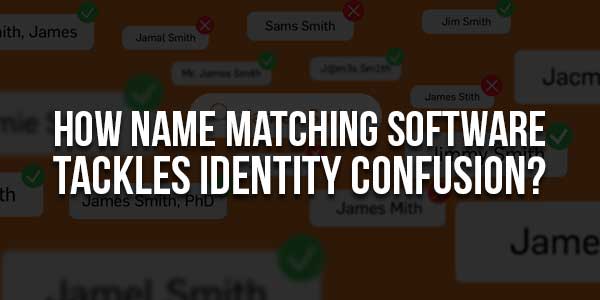
In an increasingly interconnected world, accurately identifying individuals has become more critical and challenging. From financial institutions preventing fraud to healthcare systems ensuring patient safety, organisations face a persistent problem: people with similar or identical names. Name-matching software has emerged as a sophisticated solution to this age-old challenge, using advanced algorithms to distinguish between individuals who might otherwise be confused.
Table of Contents
The Challenge of Name Ambiguity:
Identity confusion isn’t just an inconvenience; it can have serious consequences. Imagine a patient receiving the wrong medical treatment. Their records were merged with someone else’s, or an innocent person was flagged during a background check because they share a name with someone on a watchlist. These scenarios happen more often than we’d like to admit.
The problem becomes even more complex when dealing with international names, cultural naming conventions, and the endless variations in how names can be spelt, abbreviated, or transliterated. A person might use their full legal name on official documents but go by a nickname in daily life. Names might be recorded in different orders depending on the cultural context. Spelling variations, typos, and data entry errors add another layer.
How Name Matching Technology Works?
Modern name-matching software goes far beyond simple exact matching. These systems employ sophisticated algorithms that can recognise patterns, similarities, and variations that would escape basic database searches.
Phonetic matching is one fundamental technique. This approach focuses on how names sound rather than how they’re spelt. Two names that sound similar when spoken aloud might be variations of the same person, even if they’re spelt differently. This helps catch common misspellings and alternative spellings that have emerged over time.
Fuzzy matching algorithms take another approach by measuring the similarity between strings of text. These systems can identify how many changes would be needed to transform one name into another, assigning similarity scores that help determine whether two names likely refer to the same person. This technique is particularly useful for catching typos and minor variations.
Beyond Names Alone:
The most effective name-matching systems recognise that names are just one piece of the identity puzzle. These platforms incorporate additional data points to build confidence in their matches. Date of birth, location, address history, and other demographic information help distinguish between individuals with similar names.
This multi-factor approach creates a more complete picture. While two people might share identical names, the likelihood of them also sharing the same birthdate, address, and other characteristics drops dramatically. By weighing multiple data points together, these systems can make more accurate determinations about whether records refer to the same person or different individuals.

Cultural and Linguistic Considerations:
Global organisations face unique challenges when dealing with names across different languages and cultures. Name-matching software designed for international use must account for various writing systems, from Latin alphabets to Chinese characters to Arabic script.
Transliteration adds another dimension of complexity. The same name might be romanised in multiple ways depending on the system used. Someone’s name might appear differently on various documents simply because different transliteration standards were applied. Advanced name-matching systems maintain databases of common transliteration patterns and can recognise when seemingly different names are actually the same name rendered in different writing systems.
Real-World Applications:
The applications for name matching technology span virtually every industry. Financial institutions use these systems for customer verification and anti-money laundering compliance. Healthcare providers rely on them to maintain accurate patient records and prevent medical errors. Government agencies employ name matching for border security, benefits administration, and law enforcement.
Human resources departments use this technology during background checks and candidate screening. Educational institutions apply it to maintain accurate student records across systems. Even e-commerce platforms leverage name matching to detect fraudulent accounts and prevent abuse.
The Balance Between Accuracy and Privacy:
As name-matching systems become more sophisticated, organisations must balance accuracy with privacy concerns. While comprehensive data matching improves identification accuracy, it also raises questions about data collection and usage. Responsible implementation requires transparent policies about what data is collected, how it’s used, and how individuals can verify and correct their information.
The future of name-matching technology lies in continuing to refine these algorithms while respecting individual privacy rights, ensuring that identity verification serves its protective purposes without becoming invasive or discriminatory.
 About the Author:
Kathrine Kreger is a freelance writer based in Dallas, Texas, where she finds inspiration in the city’s vibrant culinary scene and outdoor adventures with her dog. When she’s not exploring new restaurants or travelling to uncover fresh perspectives, Kathrine is immersed in writing projects that reflect her curiosity and creativity. For insights on name-matching software, she suggests reaching out to a trusted third-party expert.












Be the first to write a comment.