
Table of Contents
The Limits Of Standard CRM At Enterprise Scale
Out-of-the-box CRM platforms promise speed and simplicity. For startups and mid-sized companies with linear sales cycles, the promise often holds. But enterprises operate in a different reality, with multiple business units, layered approval structures, region-specific compliance rules, partner ecosystems, subscription billing models, and complex forecasting logic.
A standard Salesforce CRM solution provides core modules for sales, service, and marketing. It supports lead management, opportunity tracking, and case handling. However, once revenue models diversify and data volumes surge into millions of records, friction appears:
- Rigid workflows that don’t reflect real-world processes
- Manual workarounds that bypass governance
- Disconnected data across ERP, billing, and analytics platforms
- Reporting gaps that affect executive visibility
- Performance bottlenecks at scale
Enterprises rarely fail because CRM lacks features. They struggle because the system does not reflect operational complexity.
Enterprise Complexity Is Structural, Not Cosmetic
Enterprise CRM challenges are rarely about layout tweaks or new fields. They involve structural alignment:
- Territory hierarchies spanning global regions
- Multi-currency revenue recognition logic
- Complex CPQ (Configure, Price, Quote) requirements
- Regulatory constraints like HIPAA or GDPR
- Integration with legacy systems
Without tailored architecture, CRM becomes a transactional system rather than a revenue engine.
This is where Salesforce customization services shift the equation.
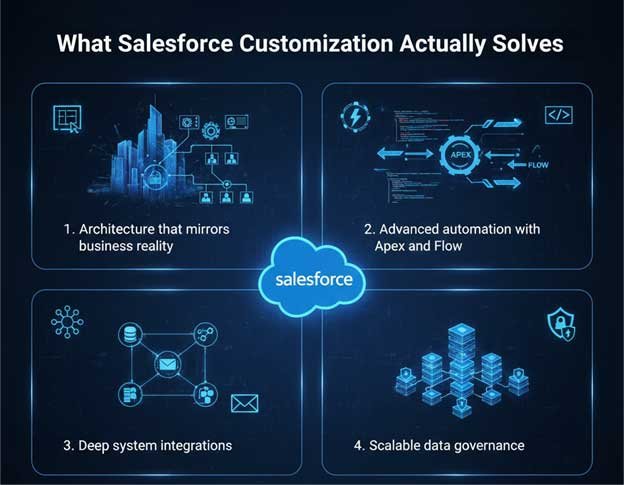
What Salesforce Customization Company Actually Solves
Customization is not about adding code randomly. It is about designing Salesforce as an enterprise infrastructure.
1.) Architecture That Mirrors Business Reality:
A skilled Salesforce customization company begins with data modeling and process mapping. Instead of forcing operations into default objects, they design:
- Custom objects for subscription lifecycles
- Junction objects for complex partner relationships
- Advanced sharing rules based on matrix reporting
- Record types for multi-product segmentation
This architectural alignment reduces shadow systems and manual spreadsheets.
2.) Advanced Automation With Apex And Flow:
Standard automation handles basic triggers. Enterprise operations demand layered logic:
- Multi-step approval chains
- Conditional revenue routing
- Automated entitlement assignment
- SLA escalation with time-based rules
Through Apex triggers, asynchronous processing (Queueable and Batch Apex), and Flow orchestration, custom logic operates reliably at scale. Proper governor limit management and bulkification techniques prevent runtime failures under heavy data loads.
3.) Deep System Integrations:
Enterprise CRM rarely operates in isolation. It connects with:
- ERP systems for financial reconciliation
- Data warehouses for analytics
- Marketing automation tools
- Payment gateways
- Customer portals
Using REST and SOAP APIs, middleware like MuleSoft, and event-driven architecture through Platform Events, a customized Salesforce CRM instance acts as a synchronized hub rather than a silo.
4.) Scalable Data Governance:
As record volumes grow, performance tuning becomes critical. Custom development addresses:
- Index optimization
- Selective queries
- Archival strategies
- Shield Platform Encryption
- Field-level security governance
Without this layer, reports slow down and dashboards lose credibility.
When Enterprises Know They’ve Outgrown Standard CRM?
Common signals include:
- Sales teams relying on spreadsheets outside CRM
- Delays in generating accurate pipeline forecasts
- Excessive admin overhead for configuration changes
- Compliance audits revealing data gaps
- Executive dashboards lacking real-time accuracy
At this stage, incremental configuration changes are no longer sufficient. A structured customization roadmap becomes necessary.
The Strategic Role Of A Salesforce Customization Company:
Enterprises often attempt in-house modifications. While Salesforce is highly configurable, large-scale customization requires architectural discipline.
A mature Salesforce customization company brings:
- Certified architects who design scalable data models
- DevOps pipelines using Salesforce DX
- CI/CD deployment via Git-based repositories
- Sandboxes for regression testing
- Code review protocols and documentation standards
This governance avoids technical debt—a common issue when customization grows organically without oversight.
Why Hiring Salesforce Developers Matters?
Salesforce customization at enterprise scale is not a one-time effort. It evolves alongside business strategy.
When organizations hire Salesforce developers, they gain:
- Expertise in Lightning Web Components (LWC) for dynamic UI
- Apex development for custom business logic
- Integration specialists for API orchestration
- Experience with large data volumes (LDV) optimization
- Knowledge of Salesforce security model and role hierarchy
Dedicated developers also manage release cycles aligned with Salesforce seasonal updates (Spring, Summer, Winter), reducing compatibility risks.
Beyond Sales – Enterprise-Wide CRM Intelligence:
Customized Salesforce implementations extend well beyond sales pipelines.
Revenue Operations Alignment:
Sales, finance, and customer success operate on a unified data layer. Subscription renewals, churn metrics, and ARR calculations integrate directly within CRM.
AI And Predictive Analytics:
With structured data models, enterprises integrate Einstein AI or external machine learning pipelines. Predictive lead scoring and churn risk modeling rely on clean, normalized data.
Customer 360 View:
Through integration and customization, enterprises achieve a consolidated customer profile: purchase history, service interactions, contract data, and marketing engagement metrics, all within one interface.
This level of intelligence cannot emerge without architectural intent.
The Cost Of Staying Standard:
Some organizations delay customization due to perceived cost. However, the hidden cost of stagnation often exceeds development investment:
- Lost cross-sell opportunities
- Revenue leakage through inaccurate quoting
- Reduced rep productivity
- Compliance penalties
- Poor executive decision-making due to unreliable reports
A tailored Salesforce CRM solution shifts CRM into a strategic revenue system rather than a record-keeping tool.
Customization Without Chaos – Best Practices:
To scale customization responsibly:
- Start with business process mapping before writing code.
- Establish naming conventions and documentation standards.
- Implement role-based access control early.
- Use sandbox environments for testing.
- Monitor performance using Salesforce Optimizer and debug logs.
- Maintain version control and structured release management.
Customization without governance creates fragmentation. Structured development creates operational clarity.
The Enterprise Advantage:
Out-of-the-box CRM suits companies in early growth phases. Enterprises, however, operate in layered ecosystems with revenue complexity, regulatory oversight, and global scale.
Custom Salesforce bridges that gap. With structured architecture, integration strategy, automation logic, and performance optimization, CRM evolves into a unified operating system for revenue.
Organizations that invest in Salesforce customization services, partner with a capable Salesforce customization company, and strategically hire Salesforce developers position their Salesforce CRM as a central enterprise platform—not just a sales tool.
When CRM reflects operational reality, executives gain accurate forecasting, sales teams gain process clarity, and leadership gains confidence in data-driven decisions.
That is the real advantage that custom Salesforce delivers.
 About the Author:
Prathik Kantesiya is a Content Writer at Agile Infoways LLC, a leading Salesforce development company in USA. He specializes in creating strategic content around Salesforce customization, enterprise CRM architecture, AI integration, and digital transformation. Prathik focuses on helping business leaders understand how scalable Salesforce solutions, automation, and system integrations drive operational efficiency and long-term revenue growth.













Be the first to write a comment.