
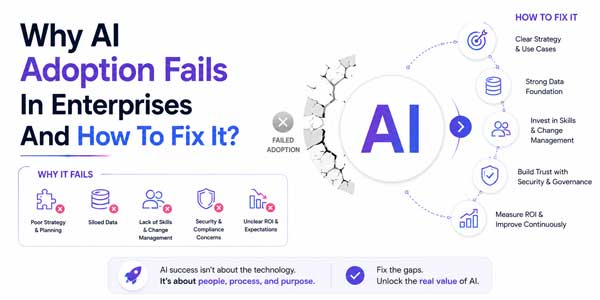
Artificial Intelligence is not a futuristic tool in the hands of big tech corporations. AI technologies are being used extensively by industry leaders, from predictive analytics and automation to customer support and business intelligence, to gain an edge over the competition and improve time efficiency. Unfortunately, despite the level of interest in enterprise AI, many initiatives never deliver real value. One reason for this lack of traction is the overwhelming number of approaches to integrating AI into real-world business applications.
It’s hardly ever the technology that’s the problem. A majority of AI failures occur when enterprises lack a proper understanding of the complexity in execution. In some cases, they jump into the deep end of the pool with an AI buy without a plan; use disparate tools lacking integration; ignore data readiness altogether; or try to shoehorn AI into aged systems that were never designed to enable intelligent automation.
This widening gap between AI aspirations and practical implementation has given rise to what many experts refer to as the “AI execution gap.” The desire to instill proactive artificial intelligence into the enterprise has risen well beyond a three-year high; yet organizations still face significant complexity when it comes to implementation, integration, scalability, and long-term adoption.
This is where AI development services come in to be most important. These services enable businesses to create a practical, scalable foundation to build an AI ecosystem that addresses genuine operational needs, not just treating AI as plug-and-play.
Table of Contents
The Enterprise AI Boom — And Why Expectations Often Collapse:
Enterprise AI adoption has seen a rapid uptick over the last few years. Organizations are using AI for:
- Process automation
- Customer support
- Data analytics
- Forecasting and predictions
- Marketing personalization
- Cybersecurity monitoring
- Supply chain optimization
Based on the research by McKinsey, it can also be concluded that businesses worldwide are investing more in companies with AI-powered transformation projects. However, transitioning a project from its pilot phase to complete operational success is often where many organisations stumble
In theory, AI leads to faster operations, lower costs, and better decision-making. But AI isn’t as simple as buying software licenses or adding chatbots to workflows, and many enterprises figure that out quickly.
Why AI Adoption Fails in Enterprises?
1.) Lack of a Clear AI Strategy:
Missing strategy is the most common cause of AI project failures. Often, enterprises are being dragged into the AI revolution by virtue of their competition or trend in the Industry.
As a result:
- Goals remain unclear
- KPIs are undefined
- Teams lack direction
- AI used for experimental instead of practical projects
Many businesses launch exciting AI projects without ever defining a clear business problem to address.
For instance, using AI-driven analytics without clearly comprehending how those insights will benefit operations tends to be a good way to throw money down the drain.
The beginning of a successful AI adoption journey begins with an important question:
“What Business Problem Are We Solving?”
Without this clarity, enterprises end up implementing technology without purpose.
2.) Poor Data Quality and Fragmented Systems:
AI systems are completely reliant on data. Sadly, most enterprises work with disconnected databases, legacy infrastructure, and inconsistent data formats.
Common challenges include:
- Duplicate records
- Missing information
- Unstructured datasets
- Siloed business systems
- Legacy software limitations
According to IBM, one of the major roadblocks for enterprises today is poor data quality, which prevents them from successfully implementing AI. AI systems are only as good as the data it is fed; easy to digest, but if there is poor-quality data when collecting and feeding, then anything that comes out of it cannot be dependable. This results in wrong predictions, erroneous automation, and mistrust in AI-generated results
3.) Integration Problems with Existing Infrastructure:
Another major obstacle is integration.
Many enterprises still rely on:
- Legacy ERP systems
- Older CRMs
- On-premise infrastructure
- Isolated operational tools
Modern AI solutions often struggle to integrate smoothly into these environments. As a result, businesses experience:
- Workflow disruptions
- Data synchronization issues
- Slow implementation cycles
- Increased operational complexity
AI tools that operate independently from core business systems rarely create long-term value.
Without proper integration, enterprises end up with disconnected AI systems that create more confusion than efficiency.
4.) Unrealistic Expectations from AI:
AI is often marketed as an instant business transformation tool. This creates unrealistic expectations among leadership teams.
Many organizations expect:
- Immediate ROI
- Fully autonomous systems
- Zero human involvement
- Instant process optimization
In reality, AI requires:
- Continuous training
- Monitoring and optimization
- Human oversight
- Long-term refinement
AI is not magic. It is a technology that improves gradually over time when implemented correctly.
5.) Lack of Internal AI Expertise:
AI implementation requires specialized expertise in:
- Machine learning
- Data engineering
- Cloud architecture
- API integrations
- Automation workflows
- Security and compliance
Many enterprises lack internal teams capable of managing AI infrastructure effectively.
As a result:
- Projects become delayed
- AI systems are poorly configured
- Security vulnerabilities emerge
- Teams struggle with scalability
This skills gap is one of the biggest reasons enterprises fail to move beyond experimental AI pilots.
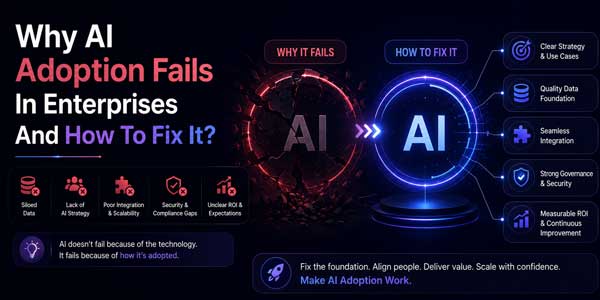
Understanding the AI Execution Gap:
The AI execution gap refers to the difference between:
- Planning AI initiatives
and - Successfully implementing them at scale
Many enterprises understand the AI conceptually but struggle operationally.
They know:
- AI can improve efficiency
- AI can automate tasks
- AI can generate insights
But they often don’t know:
- How to implement it properly
- How to integrate it into workflows
- How to scale it across departments
- How to measure long-term success
This gap is where most AI projects collapse.
How AI Development Services Solve the Execution Gap?
Strategic AI Planning:
Professional AI Development Services help enterprises align AI initiatives with actual business objectives.
Instead of implementing AI randomly, they:
- Identify operational bottlenecks
- Analyze workflow inefficiencies
- Define measurable outcomes
- Create realistic implementation roadmaps
This strategic approach prevents businesses from investing in AI without direction.
Custom AI Solutions Instead of Generic Tools:
Every enterprise operates differently. Generic AI software often fails because it doesn’t align with existing workflows or industry-specific requirements.
AI development teams create:
- Custom automation systems
- Industry-specific AI models
- Personalized recommendation engines
- Predictive analytics tools
This allows businesses to implement AI solutions tailored to their operational structure.
Seamless Integration with Existing Systems:
One of the biggest advantages of professional AI implementation is system integration.
AI development experts help enterprises connect AI with:
- ERP systems
- CRM platforms
- Cloud infrastructure
- Business intelligence tools
- Customer support systems
This creates a unified operational ecosystem where AI supports existing processes instead of disrupting them.
Businesses looking for scalable transformation strategies often rely on modern AI integration services to connect AI systems with their existing digital infrastructure.
Scalable Infrastructure and AI Cloud Solutions:
AI systems require a strong infrastructure to handle:
- Large datasets
- Real-time analytics
- Automated workflows
- High processing demands
Modern AI cloud solutions help enterprises scale AI efficiently without overloading internal systems.
Cloud-based AI environments provide:
- Flexibility
- Scalability
- Faster deployment
- Better performance optimization
According to Microsoft AI transformation resources, scalable cloud infrastructure plays a major role in improving enterprise AI performance and deployment efficiency.
Continuous Monitoring and Optimization:
AI implementation is not a one-time project.
AI systems require:
- Ongoing training
- Performance monitoring
- Bias detection
- Accuracy improvements
- Security updates
AI development teams continuously optimize systems to ensure long-term effectiveness and reliability.
This prevents AI models from becoming outdated or inefficient over time.
The Business Impact of Successful AI Implementation:
When AI is implemented strategically, enterprises begin to experience measurable improvements such as:
- Faster operational workflows
- Reduced manual workload
- Improved customer experiences
- Better forecasting accuracy
- Smarter business decisions
- Increased scalability
More importantly, businesses shift from reactive operations to proactive decision-making.
Instead of responding to problems after they occur, AI helps organizations predict trends, identify risks, and optimize performance in real time.
Conclusion:
The truth is, AI adoption in enterprises does not fail because AI itself is limited, but rather because the last-mile execution is often flimsy. Bad strategy, insufficient infrastructure, disconnected systems, poorly set expectations in the organization, and no best practice experience thwart many organizations from generating real value with AI. It takes more than just plugging AI software into your tool suite to close this execution gap. This calls for strategic planning, scalable infrastructure, seamless integration, and continuous optimization. This is where AI development services come into play.
These services assist enterprises in developing practical, ethical, and scalable AI ecosystems, which allow them to realise the theoretical investment value of AI as a real business benefit. As the world of AI-driven change unfolds, it will be execution-focused, not merely adoption-focused
 About the Author:
Kirti Chauhan is a technology content writer who specializes in AI, software development, SaaS platforms, and digital transformation topics. She creates informative and research-driven content focused on helping businesses understand modern technologies, automation strategies, and enterprise innovation trends. Website: https://www.talentelgia.com/












Be the first to write a comment.