
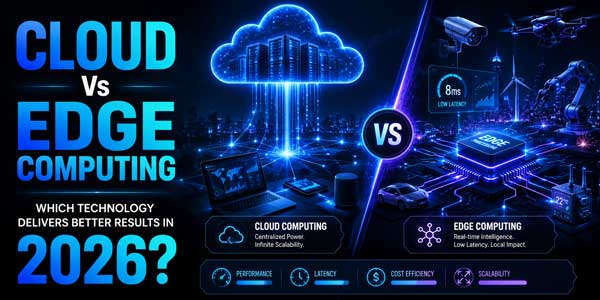
Cloud Computing and Edge Computing are expected to be the two major trends in data processing, workloads, and user experience for your businesses by 2025. If you find yourself in a situation where you have to choose between the two, or perhaps want to know which is becoming trendy, it is necessary to think about how each of these two technologies works, the solution requirements, and the new technology for this year.
Table of Contents
Difference Between: Edge Computing & Cloud Computing
The key idea behind edge computing is placing the computation process of data in proximity, such as in a factory with sensors, an intersection with cameras, or even on your mobile device with image analysis.
There is no need for information to travel from one side of the globe to another, which makes the process extremely fast. This speed is essential for self-driving cars that have to monitor vital signs in real time.
In contrast to that, cloud computing is what makes the whole thing work. It enables you to use your beloved web applications, offers itself as a platform for enterprise software, gives the necessary processing power for all kinds of analysis, and brings machine learning to everyone.
Amazon Web Services, Microsoft Azure, and Google Cloud are large server farms that offer virtually unlimited capacity for storing and processing data needed for streaming and business intelligence.
But how can you choose between these two approaches in 2025? Let us look at their advantages and development.
Cloud Computing: What’s New This Year?
When you imagine cloud computing to be an enormous system in the sky with unlimited capacity for storage and processing power, you’re definitely on the right track. This year’s cloud platforms would no longer serve as platforms for website hosting or abstracted storage. The use cases of this technology include:
- AI-powered infrastructure: Cloud service providers make use of AI to scale workloads automatically and manage computing resources.
- Cloud-native computing: With serverless computing and containerization technologies, cloud computing becomes an attractive solution for developers who want to implement their applications efficiently without having to worry about underlying infrastructure.
- Hybrid and multi-cloud: Most organizations implement both public clouds, private clouds, and edge infrastructure in order to increase flexibility, save costs, and comply with regulations.
- Sustainability: Because of the worldwide concern about energy usage, cloud data centers rely on renewable sources of energy and are eco-friendly.
Google Cloud takes the lead in this arena as the company has made investments amounting to billions of dollars in artificial intelligence and the sustainability of data centers, making Google Cloud one of the best options for organizations developing advanced applications supported by AI.
Why Will Edge Computing Gain Traction?
Edge computing will gain traction in 2025 for the following reasons: there are some time-sensitive activities. Your autonomous car has to stop immediately or change direction, and you do not have time to wait for the response from the cloud.
- Ultra-low latency: The data processing will occur within milliseconds rather than within seconds, which is crucial when it comes to wearables for health monitoring, smart machines or security systems.
- Reduced costs of data transfer: The unnecessary bandwidth costs won’t be spent on transferring gigabytes of data to the cloud.
- More privacy and compliance: Sensitive data and information can be analyzed using computing power right where the device is located – which is crucial for some industries due to regulations.
- Offline and remote functionality: Edge devices function under frustrating network connectivity, which can be beneficial in remote mining and in different conditions – maritime, offshore or in rural areas.
In 2025, there will be five main industry sectors, which will use edge computing technologies: industrial automation, predictive maintenance, augmented/virtual reality applications, logistics and smart city infrastructures through 5G rollout.
Comparing The Two Technologies
Here, we created a list of how cloud and edge computing would be different from each other in 2026.
Processing:
- Cloud Computing: Centralized, remote data centres
- Edge Computing: Local, at or near the device
Latency:
- Cloud Computing: Moderate to high (10-100ms)
- Edge Computing: Ultra to low (<10ms)
Scalability:
- Cloud Computing: Virtually limitless
- Edge Computing: Limited, locally based
Security:
- Cloud Computing: Strong, Centralized
- Edge Computing: Decentralized, riskier endpoints
Data Storage:
- Cloud Computing: Extensive, centralized
- Edge Computing: Local or temporary storage
Cost Efficiency:
- Cloud Computing: Pay-as-you-go, optimized
- Edge Computing: Bandwidth savings; hardware investment
Use Cases
- Cloud Computing: Machine learning, analytics, SaaS
- Edge Computing: Real-time IoT, AR/VR, Autonomous tech
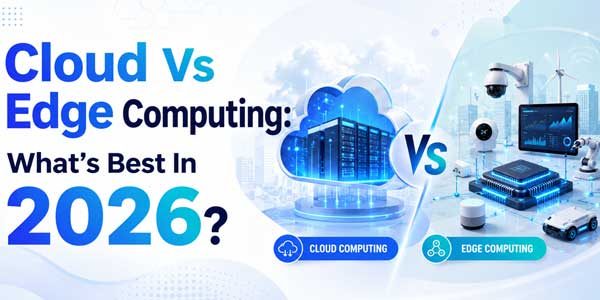
Influential Trends of 2025 for IT Infrastructures:
It appears that business IT is receiving its facelift mainly because of demands for speed, flexibility, and sustainability. Some of the trends that will lead the way in 2025 concerning data and applications in the cloud, edge, and data centers will be:
- AI Operations: Used for improved operations through the implementation of AI in order to reduce costs.
- Real-Time Everything: Edge, i.e., the need for local processing, enables real-time analytics because it is capable of obtaining real-time analytics on the IoT, smart cities, and autonomous vehicles.
- Hybrid Designs: Combining cloud and edge computing in order to fulfill compliance, cost, and performance needs.
- Green Data Centers: Cloud providers are racing in order to become more sustainable, fast to harness renewable energy, and use cooling methods more effectively.
Hybrid design is becoming mainstream. It is not about cloud against the edge for most organizations; cloud and edge computing is today’s reality. Actions and data travel wherever they have to reside. Enterprises require application-agnostic cloud-based applications deployed in the edge closest to the end-user, due to speed and local privacy reasons, while cloud computing will provide scalability, deep analytics, or application updates.
Cloud Hosting: What Will Be Important in 2026?
Being flexible and providing you with the services that fit your requirements and reliability has always been the core concept of cloud hosting; however, in 2026, there will be much emphasis placed on agility, best-fit customization, and reliability in the context of the cloud. In 2026 (AWS, Azure, Google Cloud), the service providers will have offered,
- The managed level of services that will cover everything from web hosting, app deployments, storage, high-performance database, big data storage, and other applications.
- Security patching, live backups, and disaster recovery will be automated within the cloud.
- Customizable and adjustable pricing model that allows running the workload either on a public, private, or hybrid cloud.
Companies concerned about vendor lock will look at multi-cloud environments. Most companies will distribute their workloads across several providers since they are able to do so because of the open standards and interoperable platforms.
Cloud Computing Via Google: A Solid Investment For 2026
Google Cloud has distinguished itself through massive investments in AI, infrastructure, and developer experience:
- Vertex AI: Behind many developments based on AI, including workflows and predictive analytics
- Next Generation Infrastructure: Billions of dollars spent on energy-efficient and robust data centers with acceptable performance characteristics for high-throughput tasks and AIs
- Application Integration: The platform integrates with things we use every day (Drive, Gmail, Workspace), allowing small businesses to benefit from the strength of cloud computing.
- Active Community: Over a million developers using generative AIs work at Google, making it a perfect choice for teams building future applications.
Choosing Between Cloud and Edge Computing: Which is Better in 2026?
The truth is, there’s no clear-cut victor here. If your organization demands quick action from machines in the field, then edge computing is mandatory. Also, in case you’re looking forward to combining data, deploying applications on a global scale, and having humans operate the software, cloud computing is the way to go.
Hybrid infrastructures that are fueled by both cloud and edge computing will certainly be adopted in future organizations.
- Startups and SMBs: Take advantage of cloud computing resources to get faster start-up capabilities, cost controls, and scalable solutions.
- Enterprises: Use the cloud to centralize the management and analysis of resources using edge computing where it counts, i.e., low-latency and privacy are critical.
- Industries: Healthcare, manufacturing, logistics, urban services—they all will keep being the core of edge growth in order to get real-time responsiveness.
And finally, while we speak of real-time, here are the key words to remember regarding cloud vs edge computing: these two technologies are not competing; the right tool is the key. Cloud hosting and Google Cloud, which keeps getting smarter, greener, and more competent, are the trends in IT Infrastructure which goes towards the hybrid cloud & edge approach.
The final decision in 2026? It depends on your workload: cloud for scaling and centralized intelligence; edge for speed and local control; and the best solution is to design for both, as that is the future of the IT world.
 About the Author:
Ajay Mishra is a digital marketer and content strategist for a software, web & mobile app development company at Serviots. He turns complex tech concepts into engaging, accessible narratives. With a deep understanding of modern tech stacks and software development, he crafts content that educates, inspires, and drives meaningful conversations. He knows what attracts Google to fetch your content to the top of the SERP. When not writing, you’ll find him exploring the latest in digital marketing strategies or reading news on current happenings around the world.












Be the first to write a comment.