
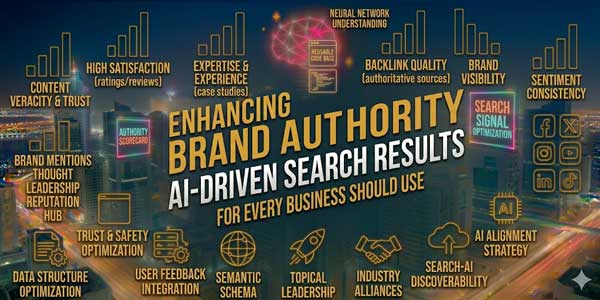
The digital search landscape has fundamentally changed. Artificial intelligence now powers how millions of people find information, make decisions, and discover brands. Tools like ChatGPT, Google’s AI Overviews, Perplexity, and similar platforms have shifted the paradigm from keyword matching to contextual understanding and trusted recommendations.
For businesses, this shift carries enormous implications. Being visible in traditional search results is no longer enough. Brands must now position themselves as credible, authoritative sources that AI systems confidently recommend — a challenge that requires an entirely new strategic approach.
Table of Contents
Understanding How AI Platforms Evaluate Authority:
Before you can build authority in AI-driven search, you need to understand how these systems assess credibility. Unlike traditional search engines that rely heavily on backlinks and keyword density, AI platforms evaluate content through a much more nuanced lens.
According to SEO Brand, an AI SEO agency, AI models are trained on vast amounts of web data and are designed to surface sources that demonstrate expertise, reliability, and consistency. They look for depth of information, a coherent subject-matter focus, and the frequency with which authoritative third parties reference or validate a brand’s claims.
This means that surface-level content strategies will not work. Brands that produce thin, generic content may rank in traditional search but will struggle to be cited or recommended by AI systems that are specifically trained to distinguish between credible and superficial sources of information.
Why Brand Authority Matters More Than Ever?
In a world where AI synthesizes answers rather than just listing links, the stakes for brand visibility have risen dramatically. When an AI platform answers a query, it typically references one or two trusted sources — or none at all if no credible option exists.
If your brand is not recognised as authoritative, you effectively become invisible in this new ecosystem. A competitor who has invested in thought leadership and credibility will be the one cited, trusted, and ultimately chosen by the consumer who never even saw your name in the AI’s response.
Brand authority is no longer just a marketing aspiration — it has become a direct driver of discoverability, conversions, and long-term business growth in an increasingly AI-mediated world.
Creating Content That Signals Expertise:
One of the most powerful ways to build authority in AI-driven search is through the consistent creation of deeply expert content. AI platforms favour content that goes beyond surface-level explanation and actually demonstrates nuanced, first-hand knowledge of a subject area.
Long-form, well-researched articles, original studies, and data-backed insights perform especially well. When your content answers not just the primary question but also the follow-up questions a curious reader might have, AI systems are more likely to identify your brand as a comprehensive and trustworthy resource worth recommending.
It is also important to write with clarity and precision. AI models are highly sensitive to factual accuracy and logical coherence. Content riddled with vague claims or unsupported assertions will be deprioritised in favour of sources that back their statements with evidence, citations, and transparent methodology.
Techniques for Building Trust in AI Platforms:
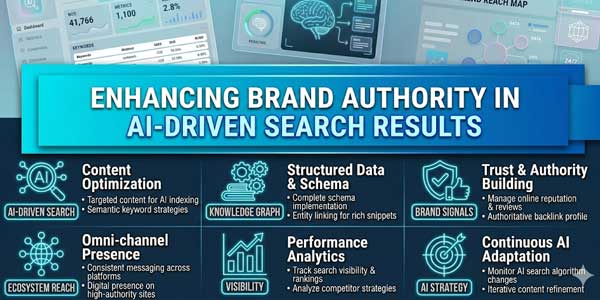
Trust is the currency of authority in AI-driven search, and building it requires a deliberate, multi-layered strategy. The first and most foundational technique is establishing consistent brand signals across the web — ensuring that your brand name, expertise, and key messages appear cohesively across your website, social media, press mentions, and third-party platforms.
AI models cross-reference information from multiple sources to validate credibility. If your brand is mentioned consistently and positively across high-authority domains, AI systems begin to associate your name with reliability. This makes digital PR and earned media an essential part of any modern SEO and brand authority strategy.
Another critical technique is leveraging structured data and schema markup on your website. When you use structured data correctly, you make it significantly easier for AI systems to understand who you are, what you do, and why you are a credible source. This includes marking up your organisation details, author credentials, product information, and review data in a format AI can read and process efficiently.
Building a Strong Topical Authority Framework:
Topical authority is the concept of owning a subject area comprehensively in the eyes of both users and AI systems. Rather than creating scattered content across many unrelated topics, brands that dominate AI-driven search focus deeply on a specific niche or industry cluster.
When your website consistently produces high-quality, interlinked content around a defined set of topics, AI platforms begin to recognise your domain as a go-to resource for that subject area. This concentrated expertise signals authority far more effectively than broad, unfocused content production.
Building a content hub model — where pillar pages link to detailed supporting articles — helps AI systems map the depth and breadth of your expertise. The more comprehensively you cover a topic, the more likely an AI system is to surface your brand when a relevant query is made by a user.
The Role of E-E-A-T in AI Visibility:
Google’s E-E-A-T framework — which stands for Experience, Expertise, Authoritativeness, and Trustworthiness — has become a guiding philosophy not just for traditional search but for AI-driven visibility as well. Brands that embody these four qualities at every touchpoint are significantly better positioned to be recommended by AI systems.
Experience refers to demonstrating real-world, first-hand engagement with your subject matter. Expertise means showing deep, specialised knowledge. Authoritativeness comes from being recognised and cited by other reputable sources. Trustworthiness involves transparency, accuracy, and ethical business practices that users and AI systems alike can verify.
Incorporating these principles into your content strategy, website design, and overall brand communications creates a compounding effect over time. AI platforms reward consistency, and the longer you maintain high E-E-A-T standards, the stronger your authority signal becomes.
Adapting Your Strategy for Long-Term AI Visibility:
Building brand authority in AI-driven search is not a one-time project — it is an ongoing commitment. The AI landscape is evolving rapidly, with new platforms, new evaluation criteria, and new competitors entering the space regularly.
Brands that stay ahead will be those who treat authority-building as a core business function rather than a marketing afterthought. This means investing in original research, developing genuine thought leadership, fostering media relationships, and continuously refining content quality.
It also means paying close attention to how AI tools are responding to your brand in real time. Regularly querying AI platforms with relevant industry questions and assessing whether your brand is cited, referenced, or recommended will give you valuable data on where your authority strategy is working and where gaps remain to be filled.
Conclusion:
AI-driven search has permanently altered the rules of brand visibility. The brands that will thrive in this new era are not necessarily the loudest or the most aggressive in their marketing — they are the ones that have quietly and consistently built genuine authority, trust, and expertise across the web.












Be the first to write a comment.