
India’s manufacturing sector is expanding at a pace that demands operational precision. According to MOSPI, India’s Index of Industrial Production (IIP) recorded a growth rate of 5.8% in FY 2023-24. The country’s manufacturing value-added output reached USD 447 billion in 2022, according to UNIDO, placing India among the top 10 manufacturing economies globally. DPIIT data confirms that manufacturing-linked FDI inflows stood at USD 10.4 billion in FY 2022-23, reflecting sustained investor confidence in India’s industrial base.
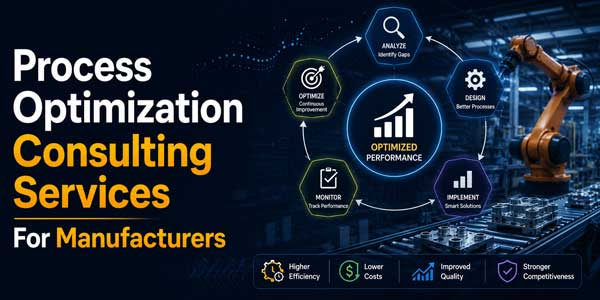
Within this environment, process optimization consulting services have become a core strategic lever for manufacturers seeking to improve operational efficiency, reduce production costs, and strengthen profitability. As global competition intensifies and input cost pressures mount, manufacturers across sectors — from auto components and electronics to pharmaceuticals and specialty chemicals — are engaging process consultants to identify and eliminate inefficiencies embedded across their production, supply chain, and quality systems.
This article examines how process optimization consulting services deliver measurable improvements in manufacturing efficiency and profitability, what specific areas they address, which industries benefit most, and what manufacturers, investors, and OEMs should prioritise when evaluating a consulting engagement.
Table of Contents
India’s Manufacturing Landscape and the Case for Process Optimization:
India’s industrial growth is structural, not cyclical. The Production Linked Incentive (PLI) Scheme, covering 14 sectors with an outlay of over INR 1.97 lakh crore (approximately USD 24 billion) as reported by Invest India, has accelerated capacity creation across electronics, pharmaceuticals, textiles, auto components, and food processing.
However, capacity creation alone does not guarantee profitability. Many Indian manufacturers — including mid-scale and large enterprises — operate with significant hidden inefficiencies:
- The MSME Ministry estimates that over 63 million MSMEs contribute approximately 30% of India’s GDP and 45% of total exports, yet the majority operate below optimal efficiency levels due to outdated processes, poor capacity utilisation, and inadequate quality systems.
- India’s manufacturing sector productivity per worker remains significantly below global benchmarks. According to World Bank data, India’s manufacturing labour productivity is approximately one-third of China’s, signalling substantial room for process improvement.
- Industrial energy consumption in Indian manufacturing is estimated to be 20-30% higher than global best-practice benchmarks across comparable sectors, according to Bureau of Energy Efficiency (BEE) assessments — representing direct, recoverable cost inefficiency.
- The National Manufacturing Competitiveness Programme (NMCP) identified capacity utilisation gaps of 15-25% across key manufacturing segments, directly impacting unit economics and profitability margins.
These gaps define the operating environment that process optimization consulting services are designed to address.
What Process Optimization Consulting Services Cover?
Process optimization is not a single intervention — it is a structured, multi-dimensional engagement that examines manufacturing operations across production, quality, supply chain, energy, and maintenance systems.
1.) Production Process Analysis and Re-engineering:
Consultants map existing production flows, identify bottlenecks, redundant steps, and non-value-adding activities using tools such as Value Stream Mapping (VSM), time-motion studies, and OEE (Overall Equipment Effectiveness) analysis.
- OEE benchmarking — world-class OEE is considered 85% or above; many Indian manufacturers operate between 45-65%, representing direct output and profitability loss.
- Cycle time reduction through process sequencing optimisation, reducing work-in-progress (WIP) inventory and shortening order-to-dispatch lead times.
- Identification and elimination of the eight forms of waste under Lean Manufacturing principles: overproduction, waiting, transportation, over-processing, inventory, motion, defects, and underutilised talent.
2.) Quality System Strengthening:
Quality failures are among the largest hidden cost drivers in manufacturing. Rework, rejection, customer returns, and warranty claims directly erode margins.
- Implementation of Statistical Process Control (SPC) to shift quality management from reactive inspection to real-time process monitoring.
- Root cause analysis frameworks (8D, CAPA, Fishbone/Ishikawa) to systematically eliminate recurring defect sources.
- Quality Management System (QMS) upgrades aligned to ISO 9001:2015, IATF 16949 (automotive), GMP (pharmaceuticals), and sector-specific standards.
- According to UNIDO research, manufacturers with certified quality management systems demonstrate 10-20% lower defect rates and measurably higher customer retention.
3.) Supply Chain and Procurement Optimisation:
Supply chain inefficiency is a significant but frequently underestimated profitability drain. Process consultants evaluate end-to-end material flow, vendor performance, and inventory management.
- Vendor rationalisation and qualification — reducing procurement risk while negotiating improved terms from a consolidated, high-performing supplier base.
- Inventory optimisation using demand-driven replenishment models, reducing carrying costs and working capital tied in excess stock.
- Logistics cost reduction through route optimisation, mode selection, and warehousing configuration improvements.
- India’s logistics cost as a percentage of GDP stands at approximately 13-14%, compared to 8% in developed economies, as noted by the Ministry of Commerce and Industry, indicating significant supply chain cost recovery potential.
4.) Energy Efficiency and Utility Optimisation:
Energy is a major controllable cost in manufacturing. The Bureau of Energy Efficiency (BEE) under the Ministry of Power has identified that the Indian industry can reduce energy intensity by 20-25% through proven efficiency measures.
- Energy audits to identify high-consumption processes, equipment inefficiencies, and avoidable utility losses.
- Compressed air system optimisation, HVAC efficiency, motor efficiency upgrades, and heat recovery systems — areas where payback periods frequently fall within 12-24 months.
- Transition to renewable energy procurement for manufacturing facilities, aligned to India’s target of 500 GW renewable capacity by 2030 (Ministry of New and Renewable Energy) — reducing long-term energy cost exposure.
5.) Maintenance System Improvement:
Unplanned downtime is one of the most direct and measurable efficiency losses in manufacturing. Process optimization consultants implement structured maintenance frameworks to shift operations from reactive to preventive and predictive maintenance.
- Total Productive Maintenance (TPM) implementation — a structured methodology proven to reduce unplanned downtime by 30-50% in documented industrial deployments.
- Preventive maintenance scheduling aligned to equipment OEM recommendations and operational data.
- Introduction of condition monitoring technologies — vibration analysis, thermography, oil analysis — to predict failures before they cause production stoppages.
6.) Workforce Productivity and Skill Optimisation:
Human factors account for a significant proportion of manufacturing inefficiency. Process consultants assess workforce deployment, skill gaps, and labour productivity metrics.
- Workforce productivity benchmarking against sector norms — identifying departments or shifts where output per worker is below achievable levels.
- Structured skill development aligned to the National Skill Development Corporation (NSDC) frameworks, addressing competency gaps in machine operation, quality inspection, and process adherence.
- Ergonomic workplace design improvements that reduce fatigue, improve safety, and directly lift throughput rates.
Measurable Outcomes of Process Optimization Consulting:
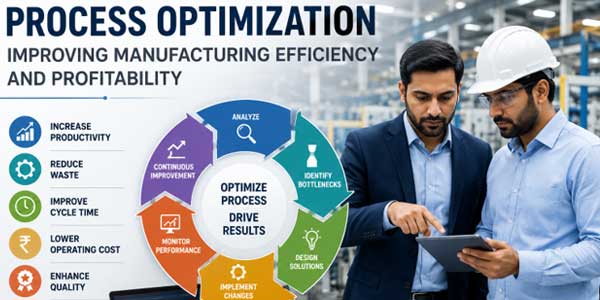
Manufacturers engaging structured process optimization consulting services consistently achieve quantifiable improvements across key operational metrics. Based on industry data and consulting benchmarks:
- Production Efficiency: OEE improvements of 15-25 percentage points are achievable within 12-18 months of structured lean and process improvement implementation.
- Cost Reduction: Manufacturing cost reductions of 8-15% are commonly documented through waste elimination, energy optimisation, and supply chain rationalisation.
- Quality Improvement: Defect and rejection rates typically decline by 30-50% following SPC implementation and quality system upgrades, directly reducing rework costs and customer claims.
- Inventory Reduction: Working capital tied in inventory can be reduced by 20-35% through demand-driven replenishment and supplier lead time compression.
- Energy Cost Reduction: Energy audits and efficiency implementations typically deliver 15-25% reductions in energy spend, with payback periods of 12-36 months depending on the measures deployed.
- On-Time Delivery Improvement: Lead time reduction and production planning improvements typically raise on-time delivery rates by 10-20 percentage points — a direct driver of customer satisfaction and repeat business.
These outcomes directly translate to improved EBITDA margins and competitive positioning — making process optimization consulting a high-return investment rather than an operational overhead.
Industries Where Process Optimization Consulting Delivers the Highest Impact:
Automotive and Auto Components:
India’s auto component industry generated exports of USD 21.2 billion in FY 2023-24, as reported by the Automotive Component Manufacturers Association (ACMA). Precision manufacturing, just-in-time delivery, and IATF 16949 compliance requirements make this sector highly receptive to process optimization interventions.
Pharmaceuticals and Life Sciences:
India is the world’s third-largest pharmaceutical producer by volume. With pharmaceutical exports of USD 27.9 billion in FY 2023-24 (Pharmexcil), GMP compliance, batch consistency, and validation process efficiency are critical areas where process consulting directly improves both regulatory standing and production throughput.
Electronics and Electrical Equipment:
Electronics manufacturing output is targeted to reach USD 300 billion by 2026 under India’s National Policy on Electronics. With PLI scheme incentives driving investment, manufacturers in this sector face rapid scaling demands — where process optimization is essential to maintaining quality and efficiency at volume.
Textiles and Apparel:
India’s textile and apparel exports stood at approximately USD 34.4 billion in FY 2023-24, per the Ministry of Textiles. Labour productivity, loom efficiency, and fabric waste reduction are primary optimization targets in this sector.
Food Processing:
India’s food processing sector attracted FDI of USD 11.77 billion between April 2000 and March 2023, as per DPIIT. Energy efficiency, yield improvement, and waste reduction are high-value optimization areas given the margin sensitivity of processed food manufacturing.
Common Gaps That Limit Manufacturing Efficiency in India:
Despite significant capacity investment, many Indian manufacturers carry persistent efficiency gaps that directly constrain profitability. Process optimization consultants consistently identify the following across engagements:
- Absence of structured production planning and scheduling systems — resulting in machine idle time, labour inefficiency, and missed delivery commitments.
- Inadequate incoming material quality inspection — quality failures entering the production process cause cascading defects, rework, and output losses.
- Reactive maintenance culture — equipment failures are handled after breakdown rather than prevented, causing unplanned downtime with high direct and indirect costs.
- Siloed departmental operations — production, quality, procurement, and logistics teams operating without integrated data, leading to poor coordination and compounded inefficiency.
- Underinvestment in workforce training — operators running equipment below its capability due to skill gaps, reducing throughput, and increasing error rates.
- Lack of performance measurement systems — manufacturers without real-time production data cannot identify losses accurately, making improvement targeting imprecise and slow.
Common Mistakes When Engaging Process Optimization Consultants:
Manufacturers — particularly those engaging process consultants for the first time — frequently make avoidable errors that limit the return from consulting engagements:
- Engaging consultants without defining specific, measurable improvement targets — resulting in broad assessments with limited actionable output.
- Treating consulting as a one-time event rather than a structured, time-bound improvement programme with phased implementation milestones.
- Insufficient internal ownership — process optimization requires management commitment and cross-functional participation; engagements driven only by consultants without internal champions consistently underdeliver.
- Focusing exclusively on production while ignoring supply chain, energy, and maintenance, which collectively often represent 40-60% of recoverable efficiency losses.
- Selecting consultants based on generic business advisory credentials rather than sector-specific manufacturing and industrial engineering expertise.
- Failing to establish post-engagement performance monitoring systems — improvements achieved during the consulting period erode without structured sustenance mechanisms.
How IMARC Engineering Supports Manufacturing Process Optimization?
IMARC Engineering provides specialist process optimization consulting services for manufacturers, OEMs, investors, and global companies operating in India’s industrial sectors.
IMARC Engineering’s process optimization engagement scope includes:
- Current-state production process mapping and efficiency benchmarking against sector norms.
- OEE assessment, bottleneck identification, and capacity utilisation analysis.
- Lean manufacturing implementation — VSM, 5S, Kaizen, and waste elimination across production lines.
- Quality system assessment and improvement aligned to ISO, GMP, IATF, and applicable regulatory standards.
- Supply chain and procurement process review, vendor rationalisation, and inventory optimisation.
- Energy audit and utility efficiency assessment, with prioritised implementation roadmaps.
- Maintenance system review and TPM implementation support.
- Workforce productivity assessment and structured improvement planning.
IMARC Engineering integrates technical, operational, and commercial expertise to deliver process optimization recommendations that are practical, implementation-ready, and measurable — not generic advisory frameworks.
As competitive pressures increase across manufacturing sectors, partnering with experienced process optimization consultants can help businesses improve efficiency, reduce waste, and achieve sustainable profitability.
Conclusion:
India’s manufacturing sector is expanding in scale and ambition. With PLI scheme investments exceeding INR 1.03 lakh crore, engineering goods exports at USD 109.6 billion (EEPC India, FY 2023-24), and manufacturing-linked FDI at USD 10.4 billion in FY 2022-23, the industrial landscape is attracting serious capital and global supply chain integration.
However, growth in capacity does not automatically translate into efficiency or profitability. Manufacturing businesses that do not systematically address process inefficiency — in production, quality, supply chain, energy, and maintenance — will face compressed margins, inconsistent output, and competitive disadvantage as the market matures.
Process optimization consulting services provide manufacturers with structured, evidence-based improvement programmes that deliver measurable gains in OEE, cost reduction, quality consistency, and EBITDA performance. These are not optional enhancements — they are operational requirements for manufacturers competing in domestic and global markets.
As Indian manufacturing scales toward its target of contributing 25% of GDP (Make in India), manufacturers and investors who embed process optimization into their operational strategy will be best positioned to capture that growth profitably and sustainably.
 About the Author:
IMARC Engineering supports greenfield and brownfield industrial projects across pharmaceuticals, food processing, chemicals, and manufacturing sectors through feasibility studies, technical due diligence, detailed engineering, compliance advisory, project management, and process optimization consulting services. The company helps businesses improve operational efficiency, reduce project risk, strengthen regulatory compliance, and achieve sustainable industrial growth across India.













Be the first to write a comment.