
 Every business primarily focuses on acquiring new customers to keep profits coming and expand its scope. The essence of profit and scaling does not lie in getting new customers but in maintaining the customers you already have. The old customers who make repeated purchases are the ones who give you real profit. As per “Marketing Metrics: The Definitive Guide to Measuring Marketing Performance (Book) by Paul W. Farris, et al.”, the chance of selling your product or service to existing customers is 60%-70%, while the same stands at 5-20% with new prospects.
To bring the old customers back to your store, the loyalty programs are quite useful. The reward systems bring customers back to you. However, it’s important how you incorporate these reward systems into your system.
Modern-day Point of Sale (POS) systems are not just a screen recording the sales, but they have turned into a smart register that includes transactions, reporting, and integration of loyalty programs. You don’t need an additional app or system to run your loyalty program. The POS system with loyalty programs is capable of automating rewards and personalizing offers right at the time of purchase.A
POS loyalty program can do wonders when it is put into optimum use for business operations. In this blog, we will look into those features in detail that will transform your lookout towards the rewards programs and customer retention.
Table of Contents
Why POS-Integrated Loyalty Programs Matter?
In a quickly transforming world of business and technology, loyalty programs are a must-have strategy to ensure the survival of a business. Integration of the POS system with loyalty programs keeps you a step ahead in the discounts and rewards segment. It creates a quick checkout experience with immediate credit of reward points by capturing customers’ purchase data.
Nowadays, the punch cards in physical or plastic card forms are outdated, and digital loyalty points are taking over the discount programs. While physical cards were easily forgotten, lost, or damaged due to human errors, in addition to creating data errors, the digital reward systems are unique, efficient, and easily available on mobile phones and websites.
“83% of consumers say that loyalty programs specifically drive them to make repeat purchases,” as noted in the 2025 SAP Emarsys Customer Loyalty Index Report.
The statement alone is enough to explain the importance of loyalty programs. But having those programs is not enough! You need to learn the right use of the programs.
To make these programs effective, all you need is a POS loyalty program that brings all your operations on one counter with ease. The advantage of such systems is speed. Quick checkouts with rewards added and redeemed right away with the system impact the customer positively. Faster checkouts are crucial at gas stations, convenience stores, coffee shops, mini-marts, and similar stores where the high volume of goods is transacted on a daily basis.
The major difference between a great loyalty program that feels like a reward to loyalty and a forgettable regular program is that great programs go beyond offering the regular discounts and credit points. It brings personalized offers to customers, makes them feel seen, heard, and understood, and each reward delights them with an unspoken promise of the next purchase.
Let’s have a detailed understanding of the Features of Customer Loyalty Programs.
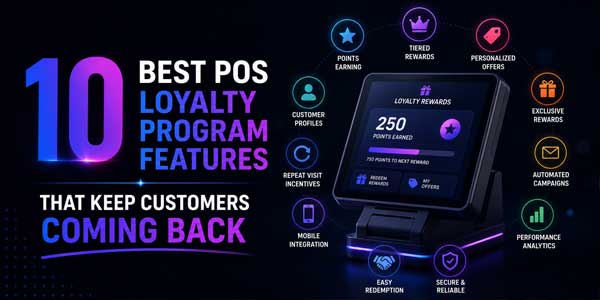
The 10 Best POS Loyalty Program Features:
The best loyalty programs turn your shoppers into your advocates. In this era, the best features of the programs bring in automation and real-time data to offer a satisfactory experience to customers at the time of checkout and redemption, asking for minimal human efforts within the store. Here are loyalty program features that bring the best out of your strategies and turn customers back to you.
Feature 1: Automatic Points Tracking & Redemption
This feature ensures that every purchase of a customer is stored in their profile, and according to the amount of purchase, the reward points or tokens are credited to their account. The balance is updated in real-time, and people on either side of the POS don’t have to worry about credits or go through the tedious process of redeeming reward credits.
While manual tracking gets tiring for the cashier, it gets equally annoying for the customer who has to wait at the counter. Manual points credit feels like an additional task and slows down the queue, and customers prefer to go to another place with faster checkouts rather than coming back and cashing in the rewards.
For example, a customer has just been handed a coffee mug while the transaction is going on at the counter, and a cashier is prompted in the POS that the customer has reached the reward threshold and they’re eligible for a free muffin or a cash discount. The same message appears on the customer-facing screen with the message “Would you like to avail your discount now?” This purchase becomes a delightful experience for the customer.
Business Benefit: Reduced Staff Workload and Higher Accuracy
- Automated systems reduce the chances of human error, bringing in more accuracy.
- Reduces and mainly stops “friendly favors” of crediting extra points into friends’ accounts.
- Reduces the burden on the staff, giving them scope to focus on store operations.
- Faster checkouts reduce customers’ waiting time and build trust.
ensures your loyalty data is 100% accurate, providing a reliable foundation for your marketing analytics.
Feature 2: Tiered Rewards System
The tiered rewards system distributes the customers into various categories, such as bronze, silver, and gold, considering their spending amounts or engagement with the store. This structure mainly deals with customer psychology, where it inspires them to get into a higher category by engaging more, and that increases stores’ Average Order Value (AOV). The higher the category, the better the benefits. This principle applies to various businesses where customers are constantly encouraged to reach new milestones.
To keep the customers engaged and motivated, the tiers should feel like a journey from basic to advanced level, step-by-step, that is a series of milestones, instead of an impossible Everest Climb.
Here’s a simple strategy to follow:
- The First Easy Leap: The first transition from entry level to intermediate level should be easy. It motivates them to climb further.
- Visible Progress of Journey: The “progress bar” in the loyalty app always works, where customers know how far they have come and how long they have to go for the next level.
- Upgrade the Rewards: As lower level just offers points, the higher levels should increase the type of rewards availing bigger discounts, free products, or special benefits like “priority service”. That makes them feel special.
The Sephora Beauty Insider Model:
A French-originated beauty retailer company, Sephora, offers three tiers, turning beauty care product shopping into a special experience. These levels offer more than just discounts; stepping up to a higher level means getting into the exclusive group. The levels are as follows:
- Insider (Entry-Level): It’s free to join, offering immediate access to birthday gifts and standard reward points.
- VIB (Very Important Beauty Insider): This level requires minimum annual spend, offering seasonal discounts and substantial gifts.
- Rogue (Elite level): This level is reserved for the highest spending customers, offering “First-Access” to new products, invitations to private events, and the highest discount percentage.
Why does it drive loyalty?
Offering early access to limited edition products, higher discounts, and an invitation to events creates an elite class experience for users, where a VIB level offers better discounts, seasonal offers and special gifts that tie the customer base to the brand and ensure they spend a minimum amount each year.
Feature 3: Omnichannel Loyalty Sync (In-Store & Online)
In the competitive market, customers wish to have similar ease of access and the best purchase experience, be it a storefront or an online shop. If their points are being credited or redeemed, they wish to have them at any front, be it offline or online. A well-designed and capable POS system with a loyalty program achieves this with ease. This system syncs the profile with e-commerce and ensures that the points are credited or redeemed regardless of the purchase mode.
The siloed loyalty programs fail to sync this since the loyalty program system is not synced with the main POS. It leads to the customer’s frustration who are not aware of this difference, which ultimately results in a lost buyer.
Business Benefit:
The POS system with loyalty program creates a “360-degree view” for the customer, which allows you to track their customer journey, which trends and discounts drive online and offline traffic, and leads to managing inventory effectively, making more informed marketing decisions.
Feature 4: Personalized Offers & Smart Promotions
Personalization is one of the best features of customer loyalty programs that makes each customer feel special. The integrated POS loyalty program simply tracks the data of purchases and specific preferences. Instead of general offers, the business can send specialized offers based on their choice to encourage them to come to the store.
When customers feel that the brand truly cares and understands their needs, their loyalty becomes stronger with emotional bonds. Integration of Customer Relationship Management (CRM) enables personalization by categorizing the audience and sending them the right message at the perfect moment.
Feature 5: Mobile Wallet & App Integration
Customers now don’t carry the cards, and instead, they prefer to go for the mobile wallet and app payments. Integration of the cashless and cardless payment systems is a game-changer. Mobile wallet integration allows the buyers to save loyalty credentials in Apple Wallet and Google Pay, allowing them to keep track of their rewards and redeem them as and when they wish. In addition, they get notified of expiring rewards, which they can redeem or waive off. These apps serve as active communication channels, where no extra storage is required, and at the time of payment, one touch or one scan is enough to complete the checkout.
Why does mobile integration reduce drop-off rates?
- Zero-Friction Access: No physical item is needed, which means the program is always ready to interact with.
- Immediate Feedback: Real-time points updated, offering satisfaction.
- Reminders and Notifications: Notifications based on location or occasion drive them to the store.
Feature 6: Real-Time Reporting & Customer Insights Dashboard
The best loyalty program software features include real-time reporting and a dashboard for customer insight. This dashboard and reporting provide detailed insights into customer behavior, their purchase history, shopping habits, average spend per visit, loyalty points, and the redemption rate. Such precision in reporting allows the owner to analyze the success of the loyalty program.
For example, if the purchase and enrollment rate is as expected, but the redemption rate is low, the owners understand that milestones are difficult to reach and hence, rewards are not redeemed. This allows them to update the program, lower the milestone standards, and engage customers more.
KPIs to track for loyalty program health:
- Participation Rate: Percentage of customers who are active members of the program
- Redemption Rate: How often the points are redeemed into rewards.
- Customer Lifetime Value (CLV): Total revenue generated by members compared to the non-members.
- Churn Rate: The speed at which the participating members stop engaging with the program or the brand.
Feature 7: Referral & Social Sharing Rewards
Referral is one of the most common features of loyalty programs; however, it is one of the most powerful. Referring to the family and friends and social sharing earns the program member additional points and discounts, as well as offering welcome discounts to the joining member. This turns your current members into your brand ambassadors. It simply expands the circle of your customer base, and a positive word from the referring person ensures initial positive feedback from the new one. Now it’s the store’s job to stand true to that expectation and deliver the best service.
It’s an organic growth strategy that turns out to be more cost-effective than traditional marketing.
Example campaigns that drove measurable growth:
Campaigns like “Give $10, Get $10” have been massively successful, offering rewards to both parties in the transaction.
Many local stores run “Bring a Friend” discount schemes where POS doubles the points for transactions involving two members, resulting in a rise in footfall at the store, along with the new members’ registration.
Feature 8: Flexible Reward Structures (Points, Cashback, Discounts, Freebies)
Cinderella’s shoes didn’t fit any of the girls in the town. One-size-fits-all approach doesn’t work in loyalty programs as well as the preference to avail reward after shopping differs from customer to customer. One customer may prefer cashback, another likes a discount on the bill, and another might prefer a free product. Letting customers choose their reward increases the value of the program. The POS data is a useful tool to offer flexible rewards for spending eligibility. It increases customer engagement.
Configuring reward rules within the POS system:
The modern POS allows the owners to set the rules like “double the points on Friday”, “a free item after every $100 spent,” and so on. Such basic rules automatically offer the selected choice to the customer for rewards and ease the task for the cashiers.
Feature 9: Expiry & Urgency Mechanics
The point expiry is something that benefits you or damages you. It mainly drives the engagement as the customer plans to get benefits before it expires; however, you must make sure that this notification does not become annoying to the customers. Mainly, the purpose of the urgency is to encourage them to repurchase, while sometimes customers choose to ignore it when it’s too frequent, sounding desperate from the store’s end.
The points should not expire in no time or too soon to drive them back. The store needs to give them flexibility and time to return to the store and let them get the benefits from those rewards. It’s important to consider notifying them of the expiry period to avail the reward.
Best practices: expiry windows, reminder notifications
- Generous Windows: Expiry window should be set for 6 to 12 months for a realistic chance to return.
- Multichannel Alerts: Automated SMS, email, or notification should be sent 30 days, 14 days, and 7 days before the date of expiry.
- The “Last Chance” Offer: A small additional incentive can be included in the final notification to ensure the customer’s return.
Feature 10: CRM & Email/SMS Marketing Integration
Features of loyalty programs are backed by the CRM & Email/SMS marketing integration, as it helps to reach the customer effectively. When POS data is integrated by the marketing automation tool, the generic marketing newsletter and ads can turn into highly effective, triggered, and targeted campaigns, focusing on customer loyalty level and milestones. This informs the customers that you haven’t forgotten them, and you want to maintain this relationship with the best rewards.
For example, when a customer hits a milestone, send them congratulations messages, along with the benefit of the new tier, and offer a discount.
This integration ensures your marketing is relevant, on time, and personalized.
Examples: “You’re 50 points away from a free reward!” Messages
- Milestone Nudges: “You’re 50 points away from a free cup of coffee. Claim it!”
- Tier Status Updates: “You’re a Gold Member now! Enjoy your new 15% discount on every purchase starting now.”
- Personalized Surveys: “We noticed you loved the ‘Double Cheese Pizza” Rate your experience and earn 20 bonus points.”
Conclusion
When you implement a strong loyalty program, it becomes necessary to prepare an appropriate strategy with optimum use to ensure it works for you the way you expected.
Features of POS loyalty programs keep you a step ahead in the competition and by taking advantage, transform your simple cash register into a high-rewarding machine that builds powerful and strong relationships with the customers. On the other hand, the customers experience smooth transactions, bonding slowly with your brand.
Concluding to take away, the most successful loyalty programs are frictionless, personalized and data driven. It’s time to move away from the generic and manual system and start providing smooth services to your customers.
It’s not the system or program that drives growth, but the utility of the system that drives growth.
 About the Author:
James Kelly is a Content Strategist at Loyal N Save, specializing in customer engagement, retail technology, and POS loyalty program strategies. He has expertise in executive communication, crisis messaging, and transforming complex technology challenges into clear, business-focused insights that help brands improve customer retention and loyalty.











Be the first to write a comment.