
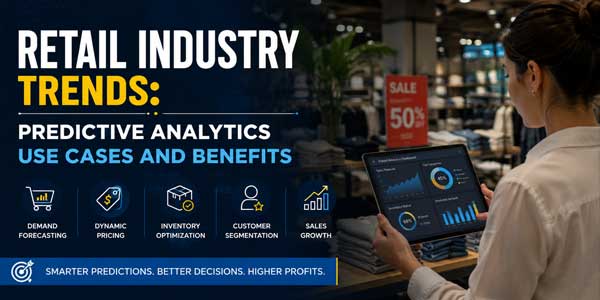
Predicting consumer demands has always been a cornerstone of successful retail operations. Predicting future trends in advance can bring significant success to the table and help prevent risks.
But have you ever wondered how these predictive analytics can deliver value, what their use cases are, and what the best modern approach to successful retail predictive analytics is? Do not worry, you have landed on the right page in this article. We will walk you through how predictive analytics in retail plays a backbone role. Let’s delve!
Table of Contents
What is Predictive Analytics in Retail?
Predictive analytics can be derived from the word itself: predictive means to predict or to make assumptions in advance about data. It is a forward-looking approach; for example, the stock market predicts trends and data in advance by analyzing past datasets. It helps to prevent risks and make strategic decisions.
So you must be thinking, how can humans analyze vast datasets in minimal time for future predictions? Humans do this with the help of Artificial Intelligence. They analyze complex datasets, even when historical data may be limited. Moreover, AI-driven analytics suggest more accurate and actionable forecasts.
How Predictive Analytics Works in Retail?
Think of predictive analytics in retail like a smart guess based on past behaviour. Instead of retailers just reacting to what customers are buying right now, they use data to predict what will happen next.
Here are some simple steps for retailers to use predictive analytics.
Collect data
Retailers can collect data through surveys or analyze past purchase records to understand consumer purchasing behaviour better.
- What do customers often buy?
- When do customers buy?
- How often do they buy?
Find patterns
Analyze the patterns, which product sells more on which of the following days.
For example;
- Chips sell more on weekends
- Chocolate sells more on Valentine’s Day
Make predictions
After analyzing historical datasets, retailers can easily make assumptions about future sales.
For example:
- Next weekend, chips will sell a lot
Take action
As soon as you know which product or service is going to sell out more in the coming days, start upgrading stocks. No aisle should be empty; this might create a negative impression in customers’ minds.
For example:
- Stock more chips, offer deals
Use Cases of Predictive Analytics in Retail:
Let’s understand the top use cases of predictive analytics in the retail industry.
Predict Revenue:
Predictive analytics in retail helps estimate future revenue based on past sales and trends.
Forecast Product Demand:
Helps to predict which products customers will want and how much stock is needed to avoid shortages or overstock.
Predict Changes:
Easily identify upcoming shifts in customer preferences or market conditions before they happen.
Offer Tailored Shopper Recommendations:
Suggests products to customers based on their past behaviour, making shopping more personalized.
Market Basket Analysis:
Understand which products are often bought together to improve product placement and offers.
Anticipate Trends:
Spot new trends early so retailers can stock the right products at the right time.
Understand Customer Behaviour:
Analyze how customers shop, what they like, and what influences their decisions.
Enhance Marketing Targeting:
Send the right promotions to the right customers to keep them engaged and loyal.
Tailor Loyalty Program:
Customize rewards and offers for different customers to keep them engaged and loyal.
Enhance Pricing Options:
Adjust prices smartly based on demand, competition, and customer behaviour to maximize sales.
Benefits of Predictive Analytics in Retail:
Let’s look for the benefits of predictive analytics in the retail industry.
- Helps retailers make better, data-driven decisions instead of relying on guesswork
- Improves demand forecasting, reducing overstock and stockouts
- Increases sales and revenue by identifying high-value opportunities
- Identifies customer retention by understanding and meeting customer needs
- Minimizes risks by predicting potential issues before they occur
- Optimizes pricing strategies to stay competitive and profitable.
Real-World Examples of Predictive Analytics in Retail:
Let’s clear your doubt about how predictive analytics works in real-world scenarios.
Amazon:
Uses predictive analytics to recommend products based on your browsing history and purchase history, enhancing sales and improving the user experience.
Walmart:
Predicts product demand to manage inventory efficiently and ensure popular items are always in stock.
Netflix:
It is not a retailer platform; it uses predictive analytics to recommend content, similar to how retailers suggest products.
Starbucks:
Uses data to predict customer preferences and send personalized offers through its app.
Conclusion:
Predictive analytics is transforming retail by improving retail forecasting, enabling smarter inventory optimization, and enhancing customer behavior prediction.
As AI predictive analytics in retail trends continue to grow, businesses that understand how retail uses predictive analytics and follow future trends in retail predictive analytics can stay ahead, often choosing to hire dedicated developers to build smarter solutions.
 About the Author:
Ajay Mishra is a digital marketer and content strategist for software, web & mobile app development company at Serviots. He turns complex tech concepts into engaging, accessible narratives. deep understanding of modern techs stacks and software development, he crafts content that educates, inspires, and drives meaningful conversations. He knows what attracts Google to fetch your content to the top of SERP. When not writing, you’ll find him exploring the latest in digital marketing strategies or reading news on current happenings around the world.








Be the first to write a comment.