
Real-world investments often involve paperwork, intermediaries, banks, brokers, and complex legal processes. Private credit, infrastructure, artwork, and commodities or real estate also can be capital intensive and have limited liquidity.
Asset tokenization provides an alternative way by creating digital records of ownership rights or economic interests on a blockchain as tokens. It can simplify the distribution, monitoring and even the transfer of some assets.
Tokens are part of the broader trend toward “digital finance and Web3,” expanding investment management possibilities in the real world. It is not, however, a substitute to the legal, financial or regulatory obligations of asset ownership.
Table of Contents
What Is Asset Tokenization?
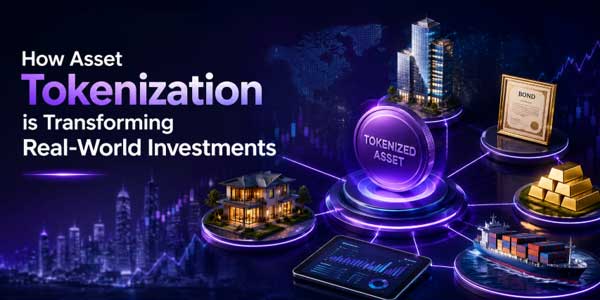
Asset tokenization is the process of creating digital tokens that represent ownership or economic rights in a real-world asset. Those assets can be in the form of real estate, gold, artwork, infrastructure, or even financial assets, like private credit.
A simple tokenization process is:
Real-world asset → Legal structure → Digital token → Blockchain → Investor interest
For instance, a property might be divided into several smaller ‘tokenised interests’, meaning that more buyers can invest in the property but not the whole asset. Whereas cryptocurrencies are not tied to any specific asset or legal right, tokenised assets are attached to an underlying commodity or legal right, and investors’ rights vary according to their legal and financial structure.
Why Traditional Real-World Investments Can Be Difficult to Access?
The barriers to traditional investments in physical or private assets may include several factors.
One of the most apparent is high capital requirements. Spending a lot of money to buy an entire commercial property, infrastructure project, or significant artwork can be very costly.
Lack of liquidity may also be a problem. Many assets in the real world do not have separate markets for primary and secondary trading and cannot be quickly traded. There’s a lot of time that can pass from identifying a good fit, doing due diligence around a purchase, transferring the deed, to any related legal issues.
There may be more than one intermediary, too. Several players are involved in a transaction, such as brokers, banks, lawyers, administrators, etc.
Let’s take real estate as an example. A lot of information and multiple parties are involved in the process of property transactions. Blockchain-based systems could be used to digitize property data and eliminate some of the inefficiencies in real estate transactions, as we discussed earlier in EXEIdeas.
Blockchain won’t solve these problems. But tokenization has the potential to offer a digital means of structuring and ceding some ownership interest.
How Asset Tokenization Is Transforming Real-World Investments?
1. Fractional Ownership
One of the key benefits of asset tokenization is fractional ownership. High-value assets can be broken down into smaller units (also called digital assets) with no one owning them outright, or having a defined ownership or economic interest in them. A token might be for a million-dollar home, for instance, and from that point, you might require fewer than a million dollars’ worth of cash to become a part of it. Who can invest, however, is still dependent on investor eligibility, securities regulations, and the legal form of the asset.
2. Greater Transferability and Potential Liquidity
Tokenization allows stakeholders to represent specific investments of interest in the digital realm of a blockchain, making such investments easier to transfer. If established secondary markets are good, tokenized assets might be easier to trade than traditional ownership interests. But tokenization does not come with liquidity. There is still a need for market demand, compliance with regulations, reliability of information, and trading infrastructure.
3. Improved Transparency
A blockchain gives a decentralized, shared ledger of transactions and token movements. This can be helpful for the ease of ownership transfer, transaction history, and records among the participants. A shared record can help in cases where several parties are involved in an investment to minimize the need for maintaining separate databases. Platforms still need to ensure they strike a balance between transparency, privacy, and privacy protection, and regulatory requirements.
4. Faster and More Efficient Settlement
In a traditional way, one has to deal with multiple intermediaries, paperwork, verification, and payment processing in adapting an asset transfer. Some of these activities can be automated via smart contracts and digital workflows in blockchain-based systems. This can minimise manual reconciling and settlement. With digital payment and compliance mechanisms, tokenization could be a more effective way to handle investment transactions.
5. Broader Investment Access
The ability to tokenize could open up potentially many more investment opportunities that were previously the privilege of large investors. Rather than buying a whole business, a piece of artwork, or a project that interacts with infrastructure, an investor may be able to buy a tokenized stake in that infrastructure. But wide opening doesn’t mean wide opening. KYC/AML requirements, securities laws, tax rules, and investor eligibility requirements will continue to apply.
Which Real-World Assets Can Be Tokenized?
Tokenization can be used for any asset class. Each market is trying to use the application in various ways.
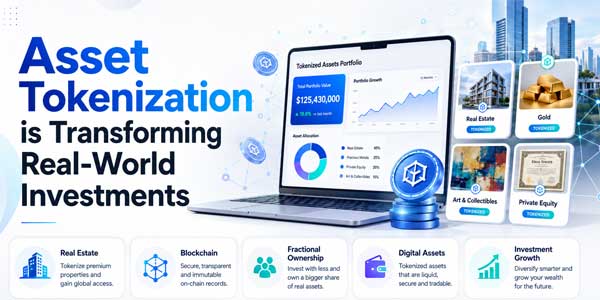
Real Estate:
The most popular use case is real estate. Ownership in properties can be severed and represented as a digital ownership interest, making property investment structures accessible to a multitude of participants.
Commodities:
Gold and other commodities can also be tokenized, based on a token mappable to physical assets and/or claims to them.
Art and Collectibles:
Dividing and transferring high-value art and collectibles can be challenging. There is a possibility for fractionalization of investment structures around some assets, using the tokenization approach.
Private Credit and Debt:
Some financial interests, such as financial claims and private credit instruments, could also be potentially digitally represented, which may provide new methods to issue, administer, and transfer certain financial interests.
Infrastructure:
Creating infrastructure projects often requires considerable investment and long time horizons for the investment. Alternative structures that may be eligible to represent investment interests could be made available with tokenization.
This is a general concept that blockchain could function as an infrastructure platform linking existing assets from the traditional to digital financial systems.
The Role of Blockchain and Smart Contracts:
The digital infrastructure that enables tokenization, known as blockchain, is at its core.
The ownership of any token and transfers can be documented in a structured and auditable way on the blockchain. Specific rules that control tokens’ transactions can be automated by smart contracts.
A smart contract can, for instance, be written to prevent transfers from the contract if there are certain conditions are not fulfilled. Depending on the system architecture, it may be able to support automated distributions, compliance, as well as settlement processes.
It can thus be helpful to grasp the basic principles of blockchain when considering tokenized investment opportunities. In previous articles, EXEIdeas has fully described the structure of Bitcoin blocks, blockchain transactions, and distributed records.
Meanwhile, don’t consider blockchain as a substitute for financial market regulation or legal agreements. Technology documents digital transactions, and legislation clarifies and outlines the rights behind the transactions.
What Does the Future of Tokenized Investments Look Like?
How technology evolves as the industry adapts to regulation and traditional financial services will likely be central, as will how the asset tokenization service is eventually adopted in the real world.
Proponents in the tech and financial sectors are keen to link existing investment systems with blockchain networks. With more clarity in the regulatory conditions, tokenization may be seen in more real estate, credit, commodities, funds, infrastructure, and asset classes.
Interoperability also could be an increased priority. Eventually, there will be a need for investors and institutions to have inter-platform communication with systems that function across different financial platforms and blockchain networks.
Another important development could be automated compliance. Eligibility, identity, transfer limitations, and reporting requirements could be codified and embedded within digital workflows, rather than as a distinct set of regulatory checks, for a future tokenized investment platform.
The expansion of investment in Web3 also illustrates the need for risk vs opportunity. When opining about Web3 opportunities, EXEIdeas has previously noted volatility, uncertainty, regulatory changes, technological evolution, and investment risk.
Conclusion:
Asset tokenization is a process that links traditional assets to blockchain technology by converting assets into tokens. As a model of fractional ownership, it will help to clarify the nature of the asset, streamline the ownership process, and enable new forms of investment and asset management.
But it doesn’t eliminate the requirement for compliance with laws, safe custody of tokens, proper valuation, liquidity, and investor protection. Given current developments in the supporting infrastructure and regulations, asset tokenization may prove to play a significant role for real-world investments in the future, as they are acquired, transferred, and managed.
 About the Author:
Yokesh Sankar is the Co-Founder and COO of BlockchainX, with expertise in blockchain, fintech, cross-platform applications, and supply chain technology. He shares insights on blockchain innovation, Web3, digital assets, and real-world asset tokenization, helping businesses understand emerging opportunities in the decentralized ecosystem. His expertise also includes white label tokenization solutions, helping businesses build scalable and customized platforms for the growing tokenized asset market.













Be the first to write a comment.