
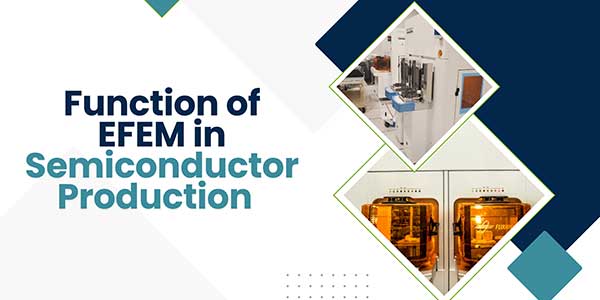
Precision, automation, and contamination control are the main characteristics that define operational excellence in the semiconductor industry. As fabs demand smaller nodes and higher throughput, Equipment Front End Modules (EFEM) play a critical role in ensuring wafers move without interruption from storage to transport and process tools. Knowledge about the working of EFEM allows producers to assess the performance, reliability, and the level of efficiency that is necessary in the semiconductor production of large volumes.
These systems serve as the critical interface connecting tools with automated handling equipment, and because Equipment Front End Modules manage such sensitive transitions, they significantly influence wafer integrity, productivity, and cleanroom performance. Their importance continues to grow as fabs invest in faster, smarter, and more automated production lines.
Table of Contents
What Is an EFEM? A Core Component of Front-End Automation?
An Equipment Front End Module is a sophisticated subsystem positioned at the “front end” of semiconductor processing tools. It acts as the bridge between the fab’s automated material handling systems (AMHS) and the wafer processing equipment. The EFEM in semiconductor manufacturing controls the flow of wafers, ensures proper alignment, and maintains an ultra-clean environment throughout each transfer step.
At its core, an EFEM consists of several integrated technologies:
- Load port modules for receiving and returning wafer carriers
- Wafer alignment mechanisms for ensuring precise orientation
- Semiconductor robotics for controlled wafer movement
- Sensors and mapping systems for position and defect detection
- Enclosures that maintain ISO-level cleanroom environments
These elements combinedly generate a simplified wafer handling flow that is capable of sustaining high throughput and limiting the possibility of contamination.
The Primary Function of EFEM in Semiconductor Production :
EFEMs serve multiple essential functions that directly impact tool performance and fab efficiency. Understanding these core capabilities helps manufacturers choose the most effective automation solutions.
1.) Load and Unload Wafers Efficiently:
The first responsibility of an EFEM is managing the load port modules (LPMs) through which wafers enter and exit a processing tool. These modules:
- Accept FOUPs or other wafer carriers
- Verify correct carrier placement
- Perform wafer mapping to ensure slot integrity
- Coordinate with central robotics for pick-up
Reliable load port operation is crucial for maintaining consistent and uninterrupted production cycles.
2.) Precision Alignment for Accurate Processing:
Wafer alignment mechanisms guarantee that every wafer is set at a micron-level of precision. This is a very important step, as making wrong alignments can cause:
- Misprocessing
- Edge damage
- Lithography errors
- Defects that affect yield
High-quality alignment is a trademark feature of advanced front-end automation systems.
3.) Robotic Wafer Transfer Mechanisms:
Central to any EFEM is a high-performance wafer handling robot. These robots perform zero-touch wafer transfers with the precision and care required to avoid:
- Particle contamination
- Scratches or micro-cracks
- Handling-related yield loss
Modern wafer transfer mechanisms support complex motions, high repeatability, and long operational lifespans.
4.) Maintain Strict Cleanroom Compliance:
EFEM enclosures create an isolated environment that meets stringent cleanroom standards. They incorporate:
- Optimized airflow
- Anti-contamination seals
- ISO-rated modules
- Particle monitoring sensors
This cleanroom automation ensures wafers stay protected during every transfer step.
The Significance of EFEM in Semiconductor Manufacturing:
As semiconductor wafers are very delicate, even the tiniest changes can affect them. The EFEM, the front-end module in semiconductor fabrication, performs operations that have a decisive effect on yield and overall production quality. Such systems:
- Protect wafers from airborne contaminants
- Minimise human intervention to reduce handling errors
- Support fast wafer exchange during high-volume production
- Standardise workflows across multiple tools
- Reduce costly downtime and unnecessary tool idle times
As fabs transition to Industry 4.0 and adopt autonomous manufacturing models, EFEM technology becomes even more central to operational success.
Advantages of Using EFEM in Front-End Automation:
Upgrading or optimising EFEM systems provides several clear advantages:
1.) Increased Throughput:
EFEMs can handle a large number of wafers per hour with constant loading, alignment, and transfer of the wafer.
2.) Consistent Accuracy:
Automated wafer positioning is necessary to provide accurate positioning when proceeding to higher processing, such as lithography and etching.
3.) Reduced Contamination Risk:
Minimal human touch and enclosed transfer environments preserve wafer quality.
4.) Enhanced Operational Efficiency:
Automation of workflows decreases the delays, idle time of the tools and the production interruptions.
5.) Improved Overall Yield:
Fewer handling errors and optimised wafer movement translate into stronger yield performance across the fab.
Core Components Inside an EFEM: A Closer Look:
The architecture of an EFEM can vary, but most include these key components:
| EFEM Component | Primary Role |
| Load Port Modules | Receive, verify, and map wafer carriers |
| Wafer Alignment System | Orient wafers accurately before processing |
| Robotic Transfer System | Move wafers safely and precisely |
| Environmental Enclosures | Maintain cleanroom integrity |
| Sensors & Detection Systems | Monitor wafer position and detect abnormalities |
These components work together to create a highly controlled wafer handling ecosystem.
How EFEMs Support Cleanroom Automation and Smart Manufacturing?
Modern fabs rely on cleanroom automation to minimise human intervention. EFEMs play a key role in enabling:
- Automated wafer inspection
- Smart tool-to-tool transfers
- Predictive maintenance for robotics
- Integration with AMHS systems
- Real-time monitoring and data collection
Paired with semiconductor robotics, the EFEM becomes the foundation of a fully automated fab environment.
Choosing the Right EFEM: Factors to Consider:
Manufacturers evaluating EFEM upgrades or new installations should consider the following factors:
1.) Throughput Requirements:
Match robot speed, load port performance, and alignment capacity to fab volume needs.
2.) Cleanroom Standards:
Ensure compliance with the ISO class level required for your process.
3.) Robot Compatibility:
Choose robotic arms that support your wafer size and processing conditions.
4.) Integration Capabilities:
EFEMs must work seamlessly with current and future tools, AMHS, and MES systems.
5.) Reliability & Maintenance:
Look for modular designs, easy serviceability, and long operational lifetimes.
To Sum It Up:
The function of EFEM extends far beyond simple wafer handling. These mechanisms tightly control efficiency, make sure that the alignment is very accurate, and maintain the level of cleanliness that is necessary for high-end semiconductor fabrication. With the continuous advancement of wafer technologies and fabs becoming increasingly automated, EFEMs will remain indispensable for maintaining operational stability and total yield.
When it comes to fabs that need trustworthy, ultra-precise wafer handling, Kensington Labs pledges to deliver the most dependable and cutting-edge wafer handling robots, along with precision motion control stages that guarantee the highest level of efficiency and semiconductor environments operating at the utmost quality.
 About the Author:
Mateo Gonzalez is a dedicated professional at Kensington Labs, where he contributes to developing and communicating advanced solutions for the semiconductor and automation industries. He specialises in creating technical and industry-focused content that highlights the capabilities of precision robotics, motion control systems, wafer-handling, and Equipment Front End Modules technologies. With a strong background in industrial operations and client collaboration, Mateo works closely with engineering and manufacturing teams to ensure customers receive reliable, high-performance automation solutions that support efficiency, accuracy, and long-term operational success.













Be the first to write a comment.