
Table of Contents
Why An Optimized Slug Still Matters For SEO?
A page slug is the readable part of a URL that usually comes after the domain name. In a URL like example.com/blog/seo-slug-guide, the slug is seo-slug-guide. It looks small, but it affects how users read links, how teams manage pages, and how search engines understand URL structure.
An optimized slug is not a magic ranking switch. You will not outrank stronger content just because your URL looks clean. But a clear slug supports technical SEO by making the page easier to understand, easier to share, easier to crawl, and easier to maintain over time.
Google’s URL guidance has long encouraged simple, descriptive URLs and recommends hyphens instead of underscores for separating words. That advice still fits modern SEO because readable URLs reduce confusion for users and make page purpose easier to recognize at a glance.
The best slug is short, descriptive, lowercase, keyword-aware, and stable. It should match the page topic without stuffing keywords or copying a full title. A good slug tells readers what they will get before they click. A bad slug adds noise, numbers, symbols, dates, or vague words that create doubt.
This guide explains how to write the best optimized slug for web pages across blogs, service pages, product pages, categories, landing pages, and static websites. The goal is simple: create URLs that are clean for users, useful for search engines, and safe for long-term site growth.
What A Web Page Slug Actually Is?
A slug is one part of a full URL. The URL may include a protocol, domain, folder path, slug, query string, and tracking parameters. The slug is usually the final named path that identifies a specific page. It is the human-readable label for that resource.
For example, in example.com/services/custom-web-development, the slug is custom-web-development. In example.com/products/tcl-smart-tv-32s59k, the slug is tcl-smart-tv-32s59k. In both cases, the slug gives meaning without needing extra explanation.
Slugs are important because URLs appear in browser bars, search results, social shares, internal links, reports, server logs, sitemaps, and marketing materials. A clear slug helps everyone understand what a page is about, including developers, SEO teams, content writers, and customers.
A messy slug creates long-term problems. If a URL contains random IDs, irrelevant dates, uppercase letters, symbols, or internal system words, it becomes harder to read and harder to manage. It may also encourage duplicate URL patterns if teams create new pages without a naming rule.
An SEO-friendly slug should be treated as part of the content strategy, not an afterthought. Before publishing a page, the title, search intent, keyword target, and URL should all match the same core topic. That alignment gives the page a cleaner identity.
Core Rules For Writing SEO-Friendly Slugs:
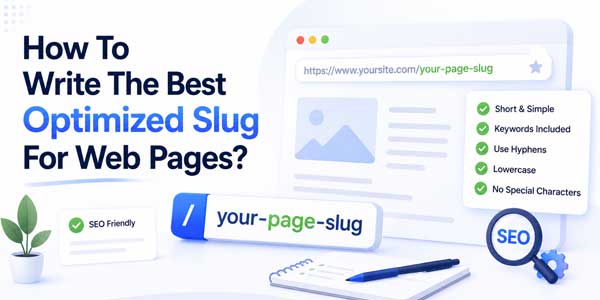
The strongest slug rules are simple. Use lowercase words, separate them with hyphens, keep the slug short, include the main topic, remove unnecessary filler, and avoid characters that make URLs harder to read. These basics solve most slug problems before they happen.
Hyphens matter because they separate words clearly. Search engines and users can read best-seo-tools more easily than bestseotools or best_seo_tools. Underscores may work technically, but hyphens are the cleaner and safer convention for public-facing URLs.
Lowercase URLs are easier to manage because some servers treat uppercase and lowercase paths differently. A page at /SEO-Slug and a page at /seo-slug can become separate URLs in certain setups. Lowercase slugs reduce duplicate risks and keep analytics cleaner.
Short slugs usually perform better for readability. A title may be long, but the slug should capture the core idea. For example, the title “How To Write The Best Optimized Slug For Your Web Pages” can become write-best-optimized-slug-web-pages. It is clear without copying every word.
- Use Lowercase: Keep slugs consistent and avoid case-based duplicate URLs.
- Use Hyphens: Separate words with dashes for better readability.
- Use Keywords Naturally: Include the main topic without stuffing.
- Remove Filler: Cut words that do not help users understand the page.
- Keep It Stable: Avoid dates or temporary words unless they are required.
A good slug should pass the “read aloud” test. If someone hears the slug, they should understand the page topic. If the slug sounds like a database record, an internal folder, or a keyword dump, it needs to be rewritten.
How To Choose Keywords For A Slug?
A slug should usually include the primary keyword or a close version of it. That does not mean squeezing every keyword variation into the URL. The slug should focus on the page’s main subject, while the title, headings, copy, image alt text, schema, and internal links support the wider topic.
Start by identifying search intent. If the page answers “how to optimize a URL slug,” the slug can be optimize-url-slug or seo-friendly-url-slug. If the page is a service page for Laravel development, the slug can be laravel-development-services. Match the slug to the real search need.
Do not include every modifier from the title. Words like “best,” “complete,” “ultimate,” “easy,” or “simple” can be useful sometimes, but they are often not needed in the slug. Use them only when they clarify the angle or match a meaningful search pattern.
For blog posts, one keyword phrase is usually enough. For products, include the product name, model, or distinguishing feature. For categories, use the category name. For service pages, use the service and location if local SEO matters.
The slug should feel natural and permanent. If you use seo-trends-2026, the URL may feel outdated next year unless the page is truly year-specific. Evergreen pages should avoid dates. Time-sensitive reports, annual guides, events, and seasonal campaigns can include dates when necessary.
Slug Length: How Short Is Too Short?
There is no perfect slug length for every page, but shorter is usually better when the meaning stays clear. A slug that is two to six words often works well for blog posts and service pages. Product pages may be longer if model numbers, names, or variants are needed.
A slug that is too short can be vague. For example, /slug is not clear enough for an SEO article. A slug like /optimized-slug-guide is much better. It tells users and search systems the page topic without becoming long or awkward.
A slug that is too long becomes hard to read, copy, share, and remember. Long slugs often happen when a CMS copies the full title automatically. That can create URLs filled with filler words, punctuation leftovers, repeated terms, and unnecessary date fragments.
When editing a long slug, keep nouns and verbs that explain the page. Remove weak words such as “the,” “a,” “an,” “for,” “your,” and “with” unless they are needed for meaning. The final version should still read naturally, not like a chopped-up phrase.
- Too Vague: /guide
- Better: /seo-slug-guide
- Too Long: /how-to-write-the-best-optimized-slug-for-your-web-pages-in-2026
- Better: /write-best-optimized-slug-web-pages
Think of the slug as a label, not a sentence. The title can carry the full human phrasing. The slug should carry the compact, permanent topic identity.
Slugs For Blogs, Services, Products, And Categories:
Different page types need different slug logic. A blog slug should explain the article topic. A service slug should match buyer intent. A product slug should identify the product clearly. A category slug should be broad, clean, and scalable for future pages.
For blogs, use the main topic and remove unnecessary words. A title like “How To Fix A Slow WordPress Website Without Breaking Your Design” can become fix-slow-wordpress-website. That is concise, useful, and easy to understand.
For service pages, focus on commercial clarity. A page about custom mobile app development can use custom-mobile-app-development. If the business is local, mobile-app-development-karachi may make sense, but only if the page genuinely targets that location.
For products, avoid vague auto-generated slugs. A product page should usually include brand, product type, model, and key variant when needed. For example, tcl-32s59k-qled-smart-tv is clearer than product-34982. Keep the product identifier stable to prevent future confusion.
For categories, choose broad names that can survive catalog growth. A category slug like smart-tvs is better than latest-smart-tvs-discounted-2026. Categories should feel like permanent shelves, not campaign headlines.
When To Include IDs In Slugs:
Some ecommerce and marketplace websites include IDs in URLs to avoid duplicate product names and support faster database lookup. This is fine if done cleanly. A URL like /product/tcl-32s59k-smart-tv-12345 is better than /product/12345 because it includes both meaning and uniqueness.
If you use IDs, keep them at the end and make sure the canonical URL is consistent. Do not let the same product open with multiple slug variations. If the slug text changes, redirect old versions to the preferred canonical URL.
Common Slug Mistakes To Avoid:
The biggest slug mistake is keyword stuffing. A URL like /best-seo-slug-url-slug-optimized-seo-url-guide looks spammy and weak. Search engines do not need that repetition, and users may distrust it. One clear phrase is stronger than five repeated variations.
Another mistake is keeping stop words that add no value. Not every small word is bad, but many title words do not belong in a URL. Remove anything that does not help the slug explain the page. The result should be shorter but still meaningful.
Dates can also create problems. If a page is evergreen, avoid adding the year. A URL like /seo-slug-guide-2026 may look outdated in 2027. Use the year only for annual reports, event pages, yearly trends, tax updates, or content where the date is part of the search intent.
Special characters are another risk. Avoid spaces, commas, apostrophes, question marks, ampersands, emojis, brackets, and unnecessary symbols. They can create encoding issues, ugly URLs, broken links, and confusing analytics reports.
- Do Not Stuff Keywords: Use one clear keyword phrase instead of repeated variations.
- Do Not Use Random IDs Alone: Add descriptive words when possible.
- Do Not Use Dates Everywhere: Keep evergreen URLs timeless.
- Do Not Change Slugs Casually: Every URL change can require redirects and cleanup.
- Do Not Mix Formats: Pick one structure and keep it consistent sitewide.
Inconsistent formatting is also common. One page uses hyphens, another uses underscores, another uses uppercase, and another uses numbers. This creates a messy site architecture. A slug policy prevents that by giving every team member the same rules.

How Slugs Affect Crawling, Canonicals, And Redirects?
Slugs are connected to technical SEO because URLs are crawlable resources. When a URL changes, search engines may need to recrawl, process redirects, update canonical choices, and transfer signals. A slug should be chosen carefully before publishing because changing it later adds risk.
If you must change a slug, use a 301 redirect from the old URL to the new URL. Update internal links, XML sitemaps, canonical tags, hreflang references, schema URLs, RSS feeds, navigation links, and marketing materials. A redirect alone is not enough if the rest of your site keeps pointing to the old URL.
Canonical tags should match the preferred URL. If your sitemap lists /seo-slug-guide but the page canonical says /seo-url-slug-guide, you are sending mixed signals. Keep slugs, canonicals, sitemaps, and internal links aligned.
Trailing slash rules should also be consistent. Pick either /page/ or /page as your preferred format and redirect the other version. Static sites, Next.js apps, Laravel routes, and CMS platforms can all behave differently, so test the final production URLs.
Slug changes can be especially sensitive for high-traffic pages. Before changing an existing URL, ask whether the improvement is worth the risk. If the current slug is not harmful and the page already ranks well, it may be better to leave it alone and improve titles, content, headings, and internal links instead.
Best Slug Practices For Multilingual And Local SEO:
Multilingual websites need extra care. You can translate slugs into the target language, keep English slugs across languages, or use a mixed strategy. The best choice depends on the audience, CMS capabilities, editorial workflow, and how users search in each market.
Translated slugs can improve user trust because the URL feels local. For example, a Spanish page may perform better with a Spanish slug if the audience expects Spanish content. However, translated slugs require stronger management because each language version needs its own canonical and hreflang setup.
Local SEO pages should include location only when the page is actually location-specific. A slug like web-design-karachi makes sense for a Karachi service page. It does not make sense for a national service page that serves multiple cities equally.
Avoid creating doorway pages with nearly identical slugs for dozens of cities if the content is not genuinely unique. Location slugs should match real local value, such as office information, service coverage, local case studies, pricing context, testimonials, or area-specific FAQs.
Slug Rules For International Sites:
Keep the language folder and slug structure consistent. For example, /en/seo-slug-guide and /es/guia-slug-seo are easier to manage than random language patterns. Make sure hreflang tags point to the correct full URLs, including the final slug for each language.
If your CMS cannot handle non-English characters safely, test URL encoding carefully before launch. Clean, readable URLs are ideal, but broken international slugs are worse than simple translated or transliterated alternatives.
A Simple Workflow For Creating The Best Slug:
A repeatable workflow prevents rushed slug decisions. Start with the page’s search intent. Write the working title. Identify the primary keyword. Remove filler words. Convert the phrase to lowercase. Replace spaces with hyphens. Check for duplicates. Confirm that the slug still makes sense without the title.
Next, compare the slug with the page type. A blog slug can be educational. A service slug should be commercial. A product slug should be specific. A category slug should be broad. A landing page slug may be campaign-focused, but it should still be clean and easy to share.
Then check permanence. Ask whether the slug will still make sense one year from now. Remove temporary words unless the page is truly time-based. Avoid “new,” “latest,” “cheap,” or “best” unless those terms are part of the long-term search angle.
Finally, test the full URL. Read it aloud. Paste it into a message. Look at it on mobile. Check whether it looks trustworthy. If the URL feels clean and the topic is obvious, the slug is probably ready.
For teams, document these rules in a short SEO checklist. Writers, developers, and product managers should all follow the same slug pattern. That keeps your website consistent as it grows from 20 pages to 2,000 pages.
Final Thoughts: A Great Slug Is Clear, Stable, And Useful
The best optimized slug for a web page is not the longest or the most keyword-heavy. It is the clearest permanent label for the page. It helps users trust the link, helps search engines understand the URL, and helps your team manage the site without confusion.
Use lowercase words, hyphens, a focused keyword, and a short phrase that reflects the page’s real purpose. Avoid keyword stuffing, random IDs, unnecessary dates, special characters, and casual URL changes. Keep slugs aligned with canonicals, redirects, sitemaps, and internal links.
If you are creating a new website, define slug rules before launch. If you are improving an existing website, audit your highest-value URLs first and avoid changing strong pages without a clear reason. SEO is not only about creating clean URLs; it is about protecting the authority those URLs build over time.
A clean slug may look like a small detail, but small details compound. When every URL is readable, consistent, and technically safe, your website becomes easier to crawl, easier to share, easier to analyze, and easier for users to trust.
Frequently Asked Questions:
What Is An Optimized Slug In SEO?
An optimized slug is the readable part of a URL written to clearly describe the page topic. It usually uses lowercase words, hyphens, a focused keyword, and no unnecessary filler. A good slug helps users and search engines understand the page before opening it.
How Long Should A URL Slug Be?
A URL slug should be as short as possible while still explaining the page. Most slugs work well at two to six words. Product slugs may be longer when brand names, model numbers, or variants are needed for clarity and uniqueness.
Should I Use Hyphens Or Underscores In Slugs?
Use hyphens in slugs. Hyphens separate words clearly and are the standard convention recommended for readable URLs. Underscores can make URLs harder to interpret and are less commonly used for public SEO-friendly URL structures.
Is It Bad To Change An Existing Slug?
Changing an existing slug can be risky if the page already receives traffic or backlinks. If you must change it, use a 301 redirect, update internal links, refresh the sitemap, check canonical tags, and monitor rankings and crawl reports afterward.
Should A Slug Include The Main Keyword?
Yes, a slug should usually include the main keyword or a close variation if it fits naturally. Do not stuff multiple keywords into the URL. One clear, relevant phrase is better than a long slug filled with repeated search terms.













Be the first to write a comment.