
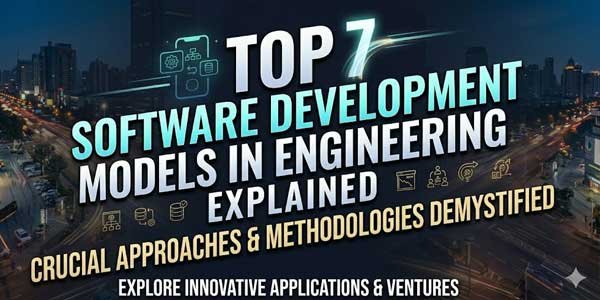
Software development is more than just writing code. It includes planning, design, testing, and maintenance, all in an orderly manner. Different teams or groups follow several approaches or processes of software development to manage this process. Different software development approaches are utilized based on the needs of a project, how long a project will take to complete, or the complexity of a project.
Choosing one of the many software development models available is very important to determining how well a project will run. A software development model assists a team with organization by minimizing risk, and consequently assists the team in producing better results. This paper presents seven commonly used models that have progressed modern software engineering.
Table of Contents
What Are Software Development Models?
Software development models are systematic approaches to the planning and execution of a software project. Each software development model outlines the various stages of a software project’s life cycle from the initial idea or requirements through to the final product delivery.
Software development models differ in their procedures or processes for performing work or communicating with other team members and for handling changes. Some software development models provide detailed planning processes, while other software development models are more fluid and allow for changes to be made on a continuous basis. The model selected will differ based on the nature of the project and the goals of the business.
Top 7 Software Development Models:
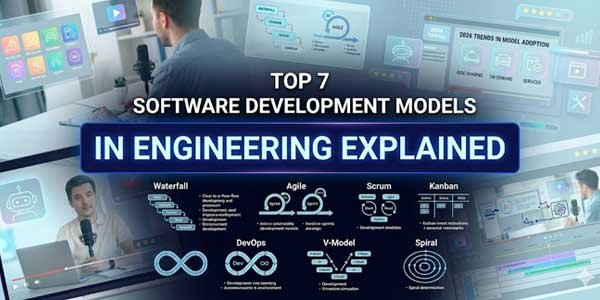
The seven software development models are as follows.
1.) Waterfall Model:
One of the oldest methods for developing software is the Waterfall Model. It takes a straight line approach, and the steps in the process must all be done before proceeding to the next step in the line.
This method of development produces good results for projects that have very specific requirements and will not change significantly over the life of the project. It does become quite challenging to incorporate changes to the project after development has begun.
2.) Agile Model:
Flexibility and continuous improvement are core concepts of the Agile Model. The Agile Model breaks the overall project down into many cycles rather than developing the project as a whole.
As a result, team members work very collaboratively together, collecting feedback and making changes during each cycle. For this reason, Agile is commonly used in today’s development environment since it allows developers to easily adapt to changes in their requirements.
3.) Iterative Model:
Using the Iterative Model will help you construct software in a series of steps, rather than providing a whole product at the conclusion of the process. The development team will create smaller versions of the finished product and then enhance them as you go along.
Teams can then detect errors early on and make adjustments accordingly. This model is beneficial whenever requirements change as your team works on the project.
4.) Spiral Model:
The Spiral Model has both aspects for design and risk management. The development team develops software in cycles that consist of planning, risk analysis, and testing.
The method is best suited to larger, more complicated projects where risk management is highly essential. The use of the spiral model gives the development team the ability to find possible issues early in the process.
5.) V Model:
The V Model is a method of developing software that places a strong emphasis on testing during the entire development process. Each stage of the software development process has corresponding testing stages, which help to identify problems early in the software development life cycle (SDLC) and ensure that the final product is of acceptable quality. The V model is typically used when delivering projects that require a high degree of accuracy and reliability.
6.) DevOps Model:
By uniting both development and operations teams, the DevOps model enables collaboration, continuous integration/delivery, and ongoing monitoring.
Through an increased rate of development without quality being compromised from the continuous testing/monitoring that occurs throughout all stages of development, DevOps helps ensure that new features can be released more quickly with lower levels of risk.
7.) Big Bang Model:
The Big Bang Model is a very simple format to get started with a project with minimal planning. It utilizes a bulk of the development at once, and the completed product will be delivered when the entire project has been completed.
Typically, this methodology is used in small, experimental-type projects, but due to the lack of planning and structure, it can be very risky.
How to Choose the Right Model?
It is important to take into account several factors when determining what model to choose – project size and complexity, timeframes for project delivery, and organisational structure of your team(s). If your project has defined requirements from the start, then one of the structured models (e.g., Waterfall, V Model) is likely to be appropriate.
However, if your project requires an agile (or iterative) methodology and will continue to evolve through subsequent iterations, then you will need to use either Agile and/or Iterative. Finally, businesses must also assess their available resources and technological capabilities, as well as long-term company goals, before determining which model to use
Conclusion:
Software Development Models outline the process of building and maintaining applications and provide an approach for building an application from beginning to end.
Each model has different benefits based on the planning, execution, and change management process that the model supports.
By understanding which model to use, an organization will choose one that is best suited to its needs. With the correct model, organizations can increase speed, be more flexible, and reduce risks while improving their overall efficiency and ultimate project outcomes.
 About the Author:
Sarah Lewis is an IT Project Manager at Binmile Technologies, a Software Development company in the USA. She has more than 10 years of experience in the IT sector. She likes to write technical articles in her free time.











Be the first to write a comment.