
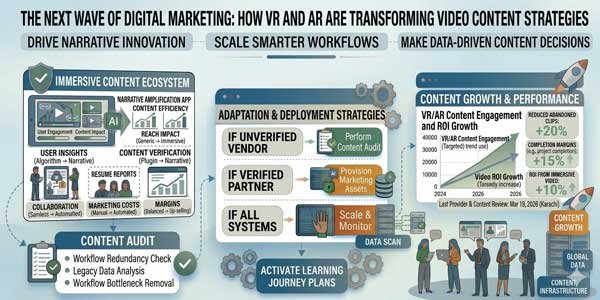
The future of video is no longer flat.
People have observed video content transform from fixed recordings into live broadcasts and viewer-based interactive material, and customized promotional content throughout the last ten years. The world faces an emerging revolution that merges physical elements with digital components to create complete immersive environments.
Welcome to the era of VR (Virtual Reality) and AR (Augmented Reality) in video marketing. These technologies have transformed brand storytelling approaches while expanding audience involvement and changing how content creators develop their material.
Digital marketers who want to maintain their position need to learn about VR and AR technologies, which reshape video content production, so they can benefit from this transformation instead of getting left behind.
Table of Contents
1.) Why VR and AR Matter Right Now:
Video marketing teams have worked to build audience connections since their launch because their primary focus has been spreading content to as many viewers as possible. Brands need to attract their target consumers at the starting point of their customer journey because today marks the first step in the process. The new goal is immersion.
Virtual reality and augmented reality technology allow viewers to experience content through different perspectives, which changes their interaction with digital information.
- Virtual Reality (VR) users gain access to fully digital environments, which include 360-degree brand experiences, virtual showrooms, and simulated events.
- Augmented Reality (AR) technology enables users to view digital information that appears in their real environment when they use their phone camera, smart glasses, or apply filters to their device. Users can experience direct interactions with brand spaces through this technology.
The process of change seeks to establish its own path through this development. People watch actively now instead of remaining inactive. The new approach brings complete transformations to every stage of video content creation and distribution, and assessment processes.
2.) The Market Momentum Behind VR & AR Video:
The numbers present an alternative perspective about how VR and AR technology function in what seems like a futuristic realm.
- The worldwide AR and VR industry will reach $300 billion by 2030, according to projections, which identify digital marketing as one of the fastest-expanding areas.
- The world’s leading brands, which make up 75% of the market, will start using immersive technology for their advertising campaigns by the year 2027.
- The social media platforms TikTok, Instagram, and YouTube have launched built-in AR features, which include filters and virtual product try-on options that show how immersive content experiences have become common practice.
In short: the future isn’t coming. It’s already here.
3.) How VR and AR Are Transforming Video Content Strategies:
Standard video content differs fundamentally from immersive video because they use distinct structural approaches to present its material. The following technologies have brought fundamental changes to how businesses handle their marketing operations:
A.) From “Watch” to “Experience”:
A traditional video presents its content through a narrative structure. The audience gains access to the experience because VR and AR provide entry into the simulated environment. The experience of taking a virtual factory tour through your home requires the same level of involvement as testing products from your living room. The memory of actual experiences creates stronger emotional ties than people can recall specific scenes, although they might remember the feelings they experienced during those events.
B.) New Levels of Engagement:
The AR filter system lets users become content creators who produce interactive videos instead of watching traditional passive ones. Users have the ability to modify your content while they insert themselves into your branded content and distribute their personalized versions of your marketing campaign, which leads to natural expansion of your audience.
C.) Data-Driven Creativity:
The platform delivers detailed analytic data when users interact with its immersive content features. The VR system lets users observe where people direct their gaze while they move and what virtual objects they choose to touch. The measurement of AR interactions goes beyond simple views and clicks because it tracks user tap zones, dwell time, and engagement rates.
D.) Storytelling That Sticks:
The sensory-rich virtual environments of VR and AR technology help people remember stories more effectively. Research shows that immersive experiences help people remember brands better by 70% when compared to watching traditional videos.
4.) The Challenges Marketers Face:
Every new invention creates its own set of challenges that users must overcome during the implementation phase. The adoption of VR and AR technology creates its own set of challenges that users need to overcome.
1.) Cost and Accessibility:
The production of high-end VR content requires major financial resources because 360-degree filming and custom application development become very costly. Users who want to experience VR technology face a barrier because not all of them own VR headset devices.
Workaround: focus on AR first. Instagram and Snapchat allow brands to use AR effects through their platforms, which provide affordable yet advanced technology experiences for users.
2.) Skill Gap:
The production of VR/AR content demands that creators learn fresh abilities, which include 3D modeling, motion design, and interactive storytelling techniques. Most marketing departments need to build this expertise because they lack it within their current staff.
Workaround: collaborate with tech partners or specialized agencies. The organization can create internal trust and forward motion through small-scale testing projects, which receive backing from outside resources.
3.) Production Complexity:
The video production process in traditional settings follows an organized sequence that starts at the beginning and moves forward through each stage. VR/AR content requires directors to create 360-degree spatial environments that allow users to explore stories through nonlinear navigation.
Workaround: start simple. A virtual walkthrough or AR filter is easier to execute than a full simulation. Build complexity gradually as your strategy matures.
5.) The Opportunities Hidden in Plain Sight:
Marketers who want to try new things can achieve their creative goals and financial targets through VR and AR technology because these tools provide them with endless possibilities.
A.) Virtual Product Demonstrations:
Instead of showing your product, let people use it virtually. A B2B company could develop a virtual reality factory experience together with an augmented reality machine display, which allows customers to examine their products through three-dimensional space.
B.) Immersive Customer Education:
The AR tutorial system would show users how to operate their workspace through direct instructions that appear on their desk. The VR training system allows users to experience actual workplace difficulties through its virtual training platform. The process creates value that goes beyond standard marketing activities.
C.) Enhanced E-Commerce Experiences:
The AR try-on feature enables customers to visualize glasses, furniture, and cars, which strengthens their decision-making process about buying products. Short-form videos function as storytelling tools that provide users with practical benefits through these experiences to create a shopping experience that tells a story.
D.) Next-Level Events:
Virtual events, which combine hybrid and virtual elements, use VR technology to enable worldwide viewers to join live events. The event will present its virtual showroom for product launches, where guests can experience holograms while watching live demonstrations.
E.) Emotional Storytelling:
The virtual reality experience functions as the perfect platform for empathy-based marketing campaigns. The platform enables nonprofits, sustainability brands, and mission-driven organizations to create immersive experiences that show their impact stories better than conventional video content allows.
6.) Integrating VR & AR Into Your Video Workflow:
Your strategy requires no urgent modifications to transform into a new approach. Here’s a roadmap for bringing immersive tech into your current video ecosystem:
Step 1: Define the Objective:
What’s the real goal — awareness, engagement, training, conversion, or retention? Organizations must identify their business needs before selecting any technological systems.
Step 2: Start Small:
Start your journey with AR effects and 360° social videos, and immersive landing page demonstrations. The process of scaling becomes possible when you learn how your audience members behave.
Step 3: Repurpose Existing Assets:
Transform your two-dimensional videos into AR overlays, while you can use existing footage to build virtual spaces. This reduces cost and maintains brand consistency.
Step 4: Use the Right Tools:
Meta Spark, Adobe Aero, and Unreal Engine function as accessible platforms that small teams can now operate. You need not have a big studio because your creative mind and leadership abilities will lead the way.
Step 5: Measure Impact:
The system allows you to track three detailed metrics, which include the areas users engage with most, their reply activity, and their total interaction duration. The results from these insights need to be combined with conventional data, which includes clicks and conversions, to create a complete picture of campaign results.
7.) What the Future Holds: Beyond VR and AR:
The development of hardware technology, together with 5G network expansion, will deliver faster and more interactive immersive content, which becomes lighter and more responsive. The upcoming marketing era will probably merge virtual reality with augmented reality and artificial intelligence to develop dynamic storytelling systems that adapt their content through live user interactions.
We’re already seeing early examples:
- AI-powered AR filters show facial expression detection features, which help users apply virtual effects to their faces.
- Virtual influencers use computer-generated content to create fake characters that tell stories through human-like behaviors.
- Users can access three-dimensional virtual environments, which function as platforms for shopping online and learning and building social connections.
People will experience your brand video through direct interaction instead of watching it on a screen.
8.) How Marketers Can Prepare:
Organizations need to establish three vital competencies that will create a defense system for their strategic approach against future environmental shifts.
- Creative Agility requires organizations to test various content formats at an accelerated rate. VR/AR developers who want to succeed in this field must start their testing work without delay while keeping their testing methods flexible.
- Cross-Functional Skills: The team needs to combine design expertise with technological knowledge and marketing experience through a unified approach. Immersive video exists as a meeting point between the art of storytelling and the technological landscape of software development.
- Community Collaboration: The audience should join your creative process through their participation with your brand by using AR filters and sharing their full 360-degree experience and modifying your content.
When you make your audience part of the story, you don’t just win attention — you build loyalty.
9.) Real-World Examples of VR/AR Video in Action:
- IKEA Place (AR): IKEA Place (AR) allows customers to check out how furniture will appear inside their rooms before they make a purchase. The design approach enables customers to experience practical solutions through an immersive process, which aligns perfectly with their mission to make design available to everyone.
- Nike’s SNKRS App (AR) launched limited-edition shoes through augmented reality scavenger hunts, which built up significant social media excitement and attracted many users.
- Accenture Virtual Campus (VR) functions as a digital space that helps new employees learn their roles while providing an interactive experience that shows off the company brand.
- Volvo XC90 VR Test Drive enables users to simulate a driving experience through 360-degree views, which delivers a luxurious experience to smartphone users across the globe.
The examples prove that immersive storytelling methods extend beyond major corporations because they function as creative tools that any business sector can apply.
10.) Final Thought: The Next Evolution of Connection:
The primary function of video content exists to establish bonds between viewers throughout all types of visual media, which include television advertisements and educational videos on YouTube. The combination of VR and AR technology enables people to connect at a more profound level because it transforms viewers into active players who experience stories together as a group.
The question for marketers isn’t if you’ll embrace these technologies — it’s when. Businesses need to adopt immersive video content because digital viewers now demand deeper engagement, which makes this format essential for their marketing approach.
Start now, experiment boldly, and remember: the next wave of digital marketing isn’t about more content — it’s about more dimension.
 About the Author:
Torrey Tayenaka is the co-founder and CEO at Sparkhouse, an Orange County-based commercial video production company. He is often asked to contribute expertise in publications like Entrepreneur, Single Grain, and Forbes. Sparkhouse is known for transforming video marketing and advertising into real conversations. Rather than hitting the consumer over the head with blatant ads, Sparkhouse creates interesting, entertaining, and useful videos that enrich the lives of its clients’ customers. In addition to Sparkhouse, Torrey has also founded the companies Eva Smart Shower, Litehouse & Forge54.













Be the first to write a comment.