
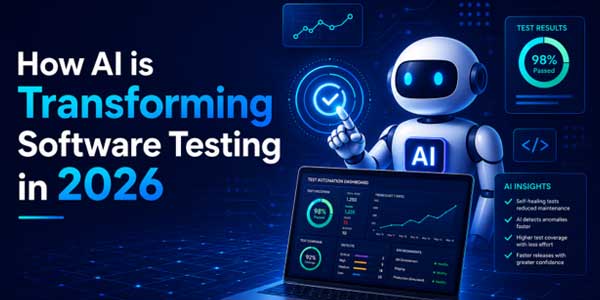
The software development life cycle has evolved from a linear to an iterative and adaptive cycle of feedback. Enterprises are under the highest pressure from traditional quality assurance practices that must deliver a product with reliability while advancing at unprecedented speed.
Manual validation is impractical for large feature changes, and the typical script-based test automation has a significant maintenance cost and is difficult to run. AI is transforming the field of quality engineering. In today’s landscape, AI in software testing isn’t simply an experimental tool for software developers or an additional function for basic productivity; it’s a competitive edge. It is now an integral part of the continuous integration and continuous deployment (CI/CD) methodology.
Today’s teams are leveraging intelligent systems that are not only rule-based and predictable but also rely on autonomous, learning-based frameworks to achieve maximum test coverage, error detection, and create highly robust software products.
Table of Contents
The Shift to Intelligent Quality Engineering:
Traditional test automation solutions have long depended on strict, human-written scripts. QA engineers spend significant working hours mapping out element locators, defining explicit execution steps, and writing hardcoded validations. While this approach provides consistency in stable environments, it lacks flexibility. A minor modification to an application interface element can cause a conventional automated suite to fail, requiring immediate manual intervention.
According to industry data from the World Quality Report, legacy automation frameworks consume up to 30% of a QA team’s weekly engineering bandwidth purely on script maintenance and fixing false positives. This operational bottleneck stifles delivery velocity and keeps highly skilled testers locked in a reactive loop, illustrating why teams are rapidly integrating advanced AI in software testing methodologies.
In contrast, modern frameworks rely on adaptive intelligence. By utilizing machine learning models and predictive analytics, these systems interpret applications contextually, learning from structural layouts and historical execution patterns. This technological advancement transitions teams away from standard automated testing toward a comprehensive model of AI in quality engineering.
Optimizing Workflows through Intelligent Test Automation:
One of the key factors for the widespread use of AI-driven software testing in organizations is the significant elimination of repetitive operational tasks. Many of the legacy QA processes bog down experienced engineers with time-consuming maintenance activities, including re-authoring failed scripts, sifting through false-positive logs, and entering data manually into data matrices.
All this repetitive work takes up a lot of time, which is not enough for complex security validation, exploratory testing, and strategic architecture reviews. These engineering challenges can be directly addressed by embedding intelligent test automation platforms with these key features:
Autonomous Script Maintenance and Self-Healing:
Frequently, the standard automation routines are disrupted by evolving application interfaces. AI-powered testing systems use multi-attribute element mapping to assess interactive elements based on text context, spatial relationships, and DOM hierarchy.
Whenever there is a change in the user interface, the platform automatically registers the changed component by the alternative attributes it has to detect and updates the internal locator logic without interrupting the execution flow. When an automation script encounters an element that has changed, there’s no crash.
As seen in the self-healing process, the system just works. Initializes an automatic 5-step recovery process:
- Element Identification: Tracking the targeted component using historical semantic baseline maps.
- Structured Test Execution: Attempting interaction based on multi-layered object properties.
- Problem Diagnosis: Isolating whether the failure is a genuine code regression or a harmless cosmetic shift.
- Self-Healing: Programmatically modifying the broken locator on the fly to match the live application state.
- Learning and Improving: Storing the modified layout characteristics back into the machine learning model to optimize future runs.
Automated Test Generation via Natural Language Processing:
Advanced QA tools utilize natural language processing (NLP) to bridge the gap between business logic and technical execution. Product managers and non-technical stakeholders can write operational flows in plain language, such as “Verify that a premium user can add a promotional code at the checkout screen and receive a 15% discount.”
The core engine processes these descriptions, identifies target paths, and compiles clean, executable automation components without requiring manual script construction. Utilizing AI in software testing in this manner slashes test creation times by up to 70%, allowing software iterations to move significantly faster from concept to deployment.
Smart Regression Management:
Executing entire testing catalogs for minor system patches causes significant operational friction. Predictive algorithms analyze incoming code changes to identify components that have changed and high-risk operational areas.
The system selectively runs only the corresponding regression pathways, significantly shortening execution cycles and maximizing continuous integration speeds.
Practical Business Benefits and Cross-Industry Impact:
Deploying scalable models of AI in QA testing delivers measurable commercial advantages, helping businesses lower the total cost of ownership, accelerate software delivery schedules, and avoid operational faults post-deployment. Real-world case studies across diverse industry sectors demonstrate the tangible metrics behind this shift.
Financial Services and Fraud Mitigation:
Large financial institutions deploy adaptive testing engines to manage complex transaction systems and secure accounting workflows. For instance, global banking platforms that process millions of daily transactions use intelligent automation to validate end-to-end payment rails.
By introducing AI-driven synthetic data generation, these banks can simulate millions of unique, compliant user profiles with varying credit profiles and geographical footprints. In practice, enterprise financial firms adopting these predictive QA models report a 45% reduction in production leaks in high-risk transaction logic, enabling security patches to be deployed safely within hours rather than weeks.
E-Commerce and Dynamic User Journeys:
Modern digital retail platforms rely heavily on personal user journeys and real-world interface layouts. Leading e-commerce brands experience significant layout fluidity due to regional sales promotions, dynamic content-recommendation carousels, and personalized UI blocks. Testing teams employ automated visual assessment systems alongside behavioral simulation models to test hundreds of personalized layouts across multiple device environments.
These tools analyze your website using computer vision algorithms to verify that all the content is visually aligned, the text doesn’t overlap, and the layout is consistent across 50+ browser device combinations. It has ensured that cross-browser verification cycles have been reduced from 48 hours down to less than 15 minutes for big retailers during the peak months of the season.
Healthcare Enterprise Systems:
Medical data platforms require precise accuracy, reliability of operation, and robust data privacy. Some engineering teams that install Electronic Health Record (EHR) systems utilize predictive analytics engines to analyze the underlying code modifications for vulnerabilities and hazards to system performance before deployment. The AI examines telemetry data and past system logs to detect tiny memory leaks or deterioration patterns in APIs that typical automated scripts can’t identify.
Detecting these architectural irregularities early on in the development cycle would allow healthcare software suppliers to prevent system downtime, safeguard patient health data, and adhere to stringent regulatory compliance throughout hospital software infrastructure. Ultimately, strong pipelines for AI in software testing ensure health tech deployments meet rigorous patient-safety benchmarks.
Emerging Software Testing Trends 2026:
The current year marks a defining milestone where testing environments evolve into self-directing ecosystems. Organizations moving to optimize their verification methodologies must prepare for several core software testing trends in 2026:
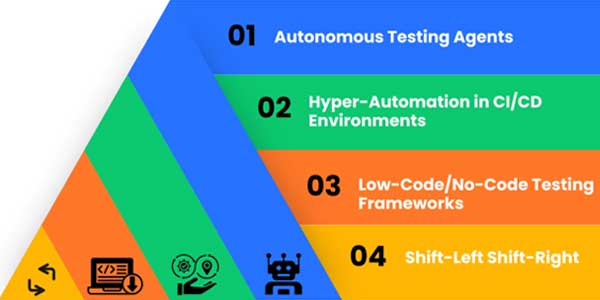
- Widespread Use of Autonomous Testing Agents
QA tools are evolving from simple task assistants into autonomous engineering agents. These systems independently explore application branches, construct comprehensive end-to-end testing scenarios, and evaluate application usability without needing human script design. - Hyper-Automation in CI/CD Environments
Modern delivery pipelines leverage end-to-end hyper-automation, connecting automated code-generation tools directly to self-adjusting validation environments. This unified framework automatically updates testing parameters as code repositories evolve. - Widespread Low-Code/No-Code Testing Frameworks
The democratization of test creation allows cross-functional team members to actively contribute to product quality initiatives. This collaborative structure expands quality ownership across entire product management teams. - Shift-Left Shift-Right Convergence
AI bridges the gap between pre-production testing and post-production monitoring. By feeding live user production logs directly back into development models, QA platforms can automatically generate new test scenarios based on actual consumer usage patterns, turning real-world behavior into test scripts.
The Collaborative QA Future
Artificial intelligence will not replace human quality specialists in software quality frameworks. Instead, it redefines the function of engineering. Automated engines are great at high-speed data processing, script development, and pattern monitoring, but human oversight is still critical for assessing business logic, risk priority setting, and building unique exploratory scenarios.
Intelligent automation systems can help quality assurance experts succeed in their primary work by offloading repetitive verification activities. This means teams spend less time fixing failing test scripts and more time refining system design, evaluating defect patterns, and ensuring that software releases are tightly aligned with corporate goals.
For modern development groups aiming to keep pace with rapid technical changes, the adoption of sophisticated testing frameworks is a crucial step to long-term product dependability. By implementing current quality practices, businesses may build scalable development loops, reduce release times, and offer great user experiences at scale.
 About the Author:
Kanika Vatsyayan, Vice-President – Delivery and Operations at BugRaptors, brings over 10 years of IT experience, leading quality assurance, quality control, and software testing services for diverse client engagements. She is proficient in agile testing practices, including automation test planning, test documentation, requirement analysis, and test case execution. Kanika is passionate about exploring cutting-edge technologies to optimize business models and enhance software quality. She actively contributes to the testing community through her insightful blog posts on automation testing, manual testing, and emerging trends in quality engineering.













Be the first to write a comment.