
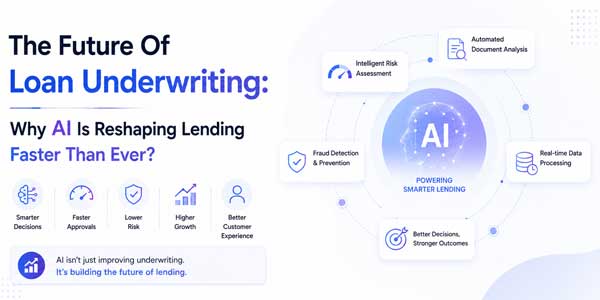
Loan underwriting has always been the foundation of sound lending. Whether evaluating a consumer loan, a mortgage, a small-business application, or a commercial credit request, lenders rely on underwriting to assess risk, verify borrower information, and make informed lending decisions.
For decades, underwriting was largely manual. Loan officers and underwriters reviewed financial statements, analyzed credit reports, verified documentation, and assessed risk using established policies and guidelines. While effective, the process was often time-consuming, expensive, and vulnerable to human error.
Today, artificial intelligence is fundamentally changing this model.
AI-powered underwriting enables lenders to analyze more data, process applications faster, reduce operational costs, and improve decision accuracy. As competition intensifies and borrower expectations continue to rise, financial institutions are increasingly turning to AI to modernize their underwriting operations.
The future of loan underwriting is not about replacing human expertise. It is about combining human judgment with AI-driven intelligence to create faster, more accurate, and more scalable lending processes.
Table of Contents
Why Traditional Loan Underwriting Faces Challenges?
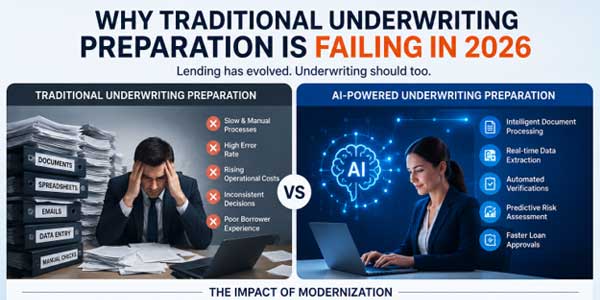
Most lending institutions still face several underwriting challenges:
- Lengthy approval cycles
- Manual document verification
- Inconsistent risk assessments
- High operational costs
- Limited scalability during peak application periods
- Difficulty processing large volumes of borrower data
Modern borrowers expect rapid responses. Waiting days or weeks for loan decisions is no longer acceptable in many lending segments.
At the same time, lenders must maintain strict compliance standards while minimizing credit risk.
Balancing speed, accuracy, and regulatory requirements is becoming increasingly difficult using traditional underwriting methods alone.
How AI Is Transforming Loan Underwriting?
Artificial intelligence introduces new capabilities that significantly improve underwriting efficiency.
Instead of relying solely on manual reviews, AI systems can analyze large amounts of structured and unstructured data in seconds.
These systems help lenders:
- Automate data extraction
- Identify risk patterns
- Detect fraud indicators
- Generate underwriting summaries
- Improve credit decision consistency
- Accelerate loan approvals
As a result, lenders can process more applications without increasing staffing costs.
AI-Powered Document Processing:
One of the most significant underwriting bottlenecks involves collecting and reviewing borrower documentation.
Underwriters often spend hours examining:
- Bank statements
- Tax returns
- Pay stubs
- Business financial statements
- Credit reports
- Identity verification documents
AI-powered document processing tools can automatically:
- Extract relevant data
- Classify documents
- Validate information
- Identify missing documents
- Flag inconsistencies
This dramatically reduces manual review time while improving accuracy.
Instead of spending hours gathering data, underwriters can focus on evaluating borrower risk and making informed lending decisions.
Smarter Credit Risk Assessment:
Traditional credit models often rely heavily on a limited set of financial indicators.
AI systems can evaluate a much broader range of variables, including:
- Credit history
- Income trends
- Banking behavior
- Cash flow patterns
- Debt obligations
- Employment stability
- Transaction activity
Machine learning algorithms identify relationships within data that may not be visible through traditional scoring methods.
This enables lenders to:
- Improve risk prediction
- Reduce default rates
- Identify qualified borrowers more accurately
- Expand lending opportunities responsibly
The result is a more complete view of borrower risk.
Faster Loan Approvals:
Speed has become a major competitive advantage in lending.
AI can automate numerous underwriting tasks simultaneously, including:
- Data collection
- Identity verification
- Document analysis
- Risk scoring
- Policy validation
Rather than waiting for multiple manual reviews, applications move through the underwriting pipeline much faster.
Many lenders now achieve:
- Same-day approvals
- Real-time prequalification
- Faster funding cycles
- Reduced application abandonment
For borrowers, this creates a significantly better customer experience.
For lenders, it improves conversion rates and operational efficiency.
AI Agents in Underwriting Workflows:
The next evolution of underwriting involves AI agents.
Unlike traditional automation tools, AI agents can perform multi-step tasks autonomously.
For example, an underwriting AI agent can:
- Collect borrower documents
- Extract key financial data
- Validate information against lending policies
- Calculate risk indicators
- Generate underwriting summaries
- Escalate exceptions to human reviewers
This creates a streamlined workflow that reduces repetitive manual work while maintaining oversight and compliance controls.
Fraud Detection and Identity Verification:
Fraud remains one of the biggest challenges in lending.
AI systems help detect suspicious activity by analyzing:
- Identity inconsistencies
- Synthetic identity indicators
- Document manipulation
- Transaction anomalies
- Behavioral patterns
Machine learning models continuously improve their detection capabilities as they process more data.
This helps lenders reduce fraud losses while strengthening customer verification processes.
As AI-generated fraud techniques become more sophisticated, AI-powered detection tools are becoming equally important.
Generative AI for Underwriting Teams:
Generative AI is introducing another layer of efficiency.
Instead of manually writing reports and summaries, underwriters can leverage AI to generate:
- Credit memos
- Loan summaries
- Risk narratives
- Policy explanations
- Exception documentation
- Borrower communications
These tools significantly reduce administrative workload.
Underwriters remain responsible for reviewing and approving content, but the drafting process becomes dramatically faster.
This allows lending teams to focus more on analysis and decision-making.
Compliance and Governance Considerations:
While AI offers significant benefits, lenders must ensure compliance remains a top priority.
Key considerations include:
Explainability:
Lenders must understand how AI-generated recommendations are produced.
Fair Lending Compliance:
AI models must be monitored to prevent unintended bias.
Data Security:
Borrower information must remain protected under strict security controls.
Human Oversight:
Final lending decisions should remain subject to human review and governance processes.
Successful AI implementations combine automation with strong regulatory controls.
Benefits of AI-Powered Loan Underwriting:
Organizations adopting AI underwriting solutions often experience:
Faster Decisions:
Reduced approval times and improved borrower satisfaction.
Higher Productivity:
Underwriters spend less time on repetitive tasks.
Improved Accuracy:
Data-driven assessments reduce human errors.
Better Risk Management:
Advanced analytics improve credit evaluation.
Lower Costs:
Automation reduces operational expenses.
Increased Scalability:
Lenders can process larger application volumes efficiently.
These benefits make AI one of the most impactful technologies currently transforming lending operations.
What the Future Looks Like?
Over the next few years, underwriting will become increasingly intelligent, automated, and proactive.
Future lending environments will likely feature:
- Real-time underwriting decisions
- AI-powered risk monitoring
- Continuous borrower analysis
- Personalized lending recommendations
- Autonomous underwriting agents
- Enhanced fraud prevention systems
Rather than replacing underwriters, AI will augment their capabilities.
Human expertise will remain critical for complex lending scenarios, exception handling, relationship management, and regulatory accountability.
The institutions that successfully combine human judgment with AI-driven automation will gain a significant competitive advantage.
Conclusion:
AI is reshaping loan underwriting faster than ever.
From automated document processing and risk assessment to generative AI-powered credit memos and intelligent underwriting agents, lenders now have access to tools that dramatically improve efficiency, accuracy, and scalability.
The future of underwriting is not fully automated decision-making. It is an intelligent collaboration between experienced lending professionals and advanced AI systems.
Financial institutions that invest in AI-powered underwriting today will be better positioned to deliver faster approvals, stronger risk management, and superior borrower experiences in the years ahead.
 About the Author:
Anand Subramanian is a technology expert and AI enthusiast currently leading the marketing function at Intellectyx AI, a leading loan underwriting ai agent development company in usa, a Data, Digital, and AI solutions provider with over a decade of experience working with enterprises and government departments.












Be the first to write a comment.