
A dependable backend is vital to a digital product’s ability to handle data, integrations, security, traffic growth, and complex business logic. For startups, the policies for the backend architecture should enable rapid product iteration along with the avoidance of technical debt. Meanwhile, enterprises face a variety of challenges, including legacy integration, the need for high availability, regulatory compliance, large data volumes, and distributed systems.
To prepare this selection, we carried out our research across about 60 software engineering providers appearing in directories like Clutch, DesignRush, GoodFirms, and Techreviewer. This editorial selection took into account such factors as API design, knowledge of databases, cloud computing systems, microservices, scalability of systems, security, DevOps, integration of third-party solutions, etc.
We also researched the providers’ expertise, as well as customer feedback, respective certifications, partners, awards, and experience in working on complicated backend projects.
Table of Contents
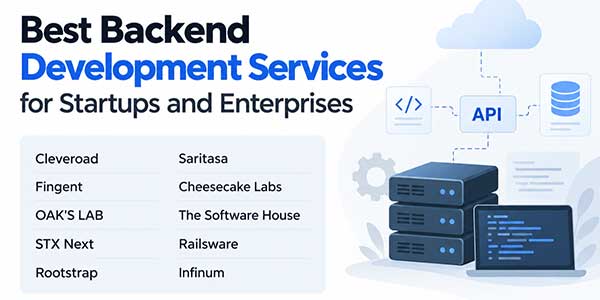
Best Backend Development Service Providers for Startups and Businesses: Comprehensive List:
The companies listed below were selected based on their capabilities in terms of technologies, experience in backend programming, feedback from clients in various areas, certification status, partner status, and reputation in the industry.
- Cleveroad
- Fingent
- OAK’S LAB
- STX Next
- Rootstrap
- Saritasa
- Cheesecake Labs
- The Software House
- Railsware
- Infinum
It is best not to treat the ordering of the listed companies as a ranking; instead, companies should understand the strengths of each provider in terms of their technologies, requirements, and pricing models.
1.) Cleveroad:
Cleveroad is responsible for backend development, which involves creating new digital goods for startups and established enterprises as well as modifying their existing frameworks or augmenting their engineering teams. The backend knowledge that the company possesses includes Node.JS, .NET, cloud systems, REST API, databases, integration, DevOps-related delivery, and other fields of application. It currently works with different industries such as FinTech, Healthcare, Logistics, Education, and others that require using complex technologies and require constant security measures, flexibility, and integration of data. Cleveroad follows international standards ISO 9001 and ISO 27001 and is regarded as an AWS Select Tier Partner.
2.) Fingent:
Fingent has an extensive background in enterprise software development that spans over 20 years and has established a reputation for delivering high-quality backend solutions using popular programming languages and tools like Node.js, Python, Django, Java, Laravel, .NET, and other cloud solutions. Its engineers are experts in several fields such as API development, application logic, enterprise integration, database engineering, cloud computing, and full-stack development of commercial products, which makes the company equally effective in developing products for startups and erecting complex corporate platforms. The company has been serving various business domains, including finance, healthcare, real estate, education, and enterprise technology. With an ISO 27001 certification and entry into the IAOP Global Outsourcing 100 list, the company is recognized on the global level.
3.) OAK’S LAB:
OAK’S LAB is an organization that mainly concentrates on product engineering for newly started organizations and technology companies. The organization adheres to a distinctive backend development approach utilizing the JavaScript and TypeScript ecosystems, while Node.js remains the organization’s major engineering stack along with state-of-the-art frontend technologies. The projects focus on scalable application architecture, APIs, SQL systems, microservices, continuous integration, and automated testing, as well as maintenance of products in the future. In addition, the company specializes in FinTech, SaaS, online security, marketplaces, and other successful technologies.
4.) STX Next:
STX Next is a perfect fit for companies looking for backend development using Python, data management, APIs, cloud technologies, or AI applications. Its backend solutions employ Python and Django, FastAPI, Flask, Celery, and SQLAlchemy, as well as Node.js, TypeScript, .NET, PostgreSQL, MongoDB, Redis, Kafka, REST, GraphQL, and gRPC. It also cooperates with AWS, Azure, GCP, Kubernetes, Terraform, and serverless architecture solutions. The company’s expertise is especially relevant for clients in the financial, insurance, healthcare, manufacturing, logistics, and other industries where much data is processed. STX Next holds the ISO/IEC 27001 certificate, TISAX certificate, and is an AWS Advanced Tier Partner.
5.) Rootstrap:
Rootstrap is a provider of product engineering and back-end development. The company specializes in utilizing Node.js technologies, including TypeScript, Express, NestJS, Prisma, PostgreSQL, real-time communication, and microservices. With Python, Django, Flask, FastAPI, Airflow, and PySpark for data-intensive applications, Rootstrap’s solutions are seamless products, where traditional back-end services converge with analytics and AI operations. Rootstrap has been listed among companies in the Inc. 5000 and the Financial Times’ fastest-growing American companies list. The company has received several awards in its working sphere as well.
6.) Saritasa:
Saritasa has backend engineering services including application development, API development and integration, database engineering, cloud development, DevOps, Backend Refactoring, and Legacy Modernization. The backend technology stack includes Python, Django, Flask, .NET and .NET Core, JavaScript, PostgreSQL, SQL Server, Redis, MongoDB, Kafka, AWS, Azure, Kubernetes, Grafana, Okta, and Auth0. These technologies are suitable for applications such as website development, IoT projects, and complex enterprise software solutions. Saritasa’s specialization includes the healthcare, manufacturing, education, business services, IoT, and enterprise technology areas.
7.) Cheesecake Labs:
When Cheesecake Labs does any backend engineering, it does it as part of the end-to-end product, cloud, data, and AI development process. The company’s work includes technologies such as Python, TypeScript, Node.js, AWS, databases, APIs, containerization, and modern distributed architecture. Since Cheesecake Labs has great capabilities in the cloud area, it is the company that suits best for modernization projects, because not only does it do monolith-to-microservices migration, but also Kubernetes orchestration, infrastructure as code, monitoring, access control, encryption, backup solutions, and recovery planning, among others. The company works in such sectors as FinTech, healthcare, enterprise software, AI, and blockchain. It is a recognized partner of AWS and has been awarded multiple times by Clutch, Great Place to Work, and Webby certifications.
8.) The Software House:
The Software House has a strong emphasis on back-end development, establishing high expertise in Node.js, TypeScript, GraphQL, AWS, PHP, Symfony, and microservices. Its Node.js units focus mainly on developing APIs, distributed services, real-time applications, and scalable back-end platforms, while engaging in cloud practices connected with migration, architecture modernization, and cost optimization solutions. The company is an AWS Advanced Tier Partner and is served by a big team of AWS-certified specialists, thus ensuring relevant cloud experience in back-end infrastructure. Its case studies embrace FinTech, marketplaces, travel, manufacturing, healthcare, SaaS, and enterprise modernization. The Software House received awards within the global software development program Clutch.
9.) Railsware:
Railsware is a mix of consulting for software development and its own SaaS solutions like Mailtrap and Coupler.io. It uses Ruby on Rails and Node.js as its main tech stack, with some other techs like Go and Python for other cases, while AWS and Google Cloud are used for cloud solutions. The company provides solutions from the bottom to the top for product engineering, audits, AI implementations, MVP development, architecture of a product, testing, and modernization. It’s important to mention that this experience is very useful for the startup sector since Railsware has worked with different projects at various phases of their growth and knows how to deal with their development hurdles associated with scaling SaaS platforms.
10.) Infinum:
Infinum provides backend and cloud-native engineering for companies needing scalable architectures and additional product development capabilities. The company’s backend technology repertoire consists of Java and Kotlin with Spring Boot, Node.js, .NET Core, Go, Python, and Ruby on Rails backed by Kubernetes, Docker, Terraform, AWS CloudFormation, CI/CD technologies, observability technologies, and application security technologies. This ensures the flexibility of Infinum to work both with established enterprise ecosystems and modern cloud-native architectures. Infinum has experience in finance, healthcare, automotive, telecommunications industries, and enterprise digital products. The company has also been certified with SOC 2 auditing and has partnerships with Databricks, AWS in its Select Tier Services, and Microsoft partner programs.
How to Choose a Backend Development Company?
At the level of describing their services, backend development companies often appear to be very similar; however, companies need to understand which architecture will be required for their product. For example, a startup that is building its MVP might give priority to speed, flexibility, manageable cloud costs, and the ability to iterate quickly. On the other hand, an enterprise that is trying to replace its legacy system will have more emphasis on expertise in integration, migration planning, observability, compliance, DevOps maturity, and uninterrupted service.
Another criterion to take into consideration when selecting backend development companies is technology stack. For instance, a company that is going to build a highly concurrent application may want to work with specialists in Node.js, while a company that is going to build a data-heavy application might find strong Python engineering beneficial. .NET and Java technologies are also still needed in enterprise systems, while modern cloud-native applications increasingly call for experience in fields such as Kubernetes, serverless cloud infrastructure, message queues, automated deployment, and infrastructure as code.
Final Thoughts:
The organizations mentioned here make use of dissimilar methods concerning backend software development. Some of them concentrate their efforts on enterprises with cloud-native solutions, whereas others work mainly with startups. In addition, some of these companies provide a combination of backend development and other services like data engineering, AI, and digital transformation.
While searching for backend development services, companies should not only examine technical abilities of their layers but also look at such factors as experience of working with various architectures, cybersecurity measures, delivery experience, knowledge of business domain, and skills of operational service providers.
 About the Author:
Yuliya Melnik is a technical writer at Cleveroad, a software development company that offers backend development services. She likes to write content that makes complex concepts seem straightforward and encourages readers to be creative through vivid and meaningful narratives.










Be the first to write a comment.