
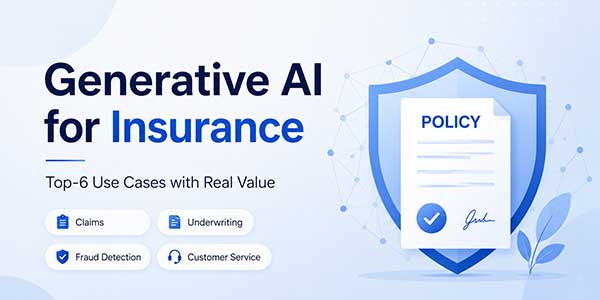
The generative AI that has been receiving a lot of hype is finally being used in a practical way to add value to the insurance industry. The insurance industry has an enormous volume of documents and data to work with, including policy files, claims files, customer emails, inspection reports, medical documents, repair estimates, and regulatory documents. Generative AI can help insurers process and analyze vast amounts of data much more quickly than humans could manually.
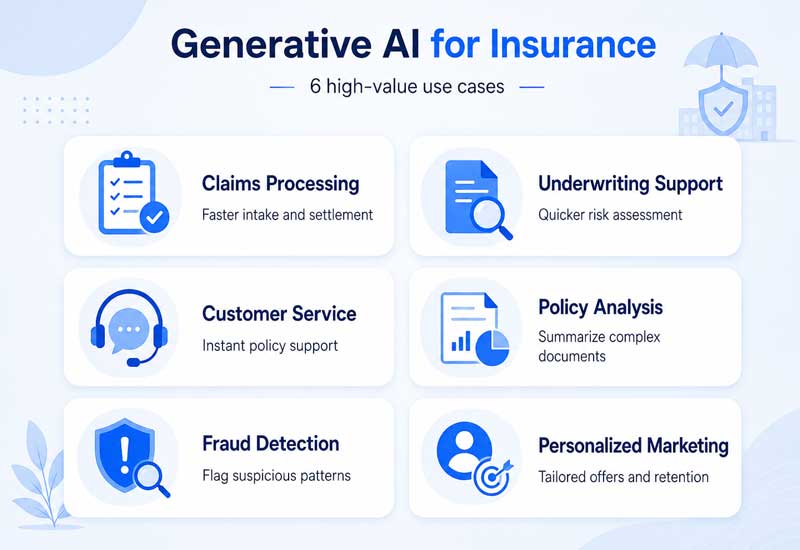
When generative AI is used in conjunction with solid governance practices, human oversight, and secure data-handling practices, it can enhance operational efficiencies, reduce costs, and create an overall enhanced customer experience. Below are six high-value use cases for insurers to consider implementing generative AI technology.
Table of Contents
1.) Claims Processing Automation:
Claims management is a major use of generative AI. Claims can contain many different types of content—a single claim might have photographs of the loss, descriptions of the loss, invoices/receipts from repairs, notes from the adjuster about the claim, police reports, and emails from the customer regarding their claim. All of this information must be individually reviewed by a claims team and can take a significant amount of time to do so.
With generative AI, claim files can be summarized in a way that highlights the most important parts of the file as well as pulling together information to show what is missing or needed before deciding. For example, in an auto insurance claim, an AI assistant can analyze the description of the accident to determine if the vehicle is covered, summarize the damages that occurred from an accident, and give the next steps for the adjuster to perform.
This allows the claims team to resolve claims faster while also allowing the claims adjusters to spend more time on making complicated decisions.
2.) Help with Underwriting:
When underwriting applications, underwriters typically look at the applications, financial information, property reports, loss history, and other third-party data sources. Generative AI can summarize this data and create summaries that highlight risk factors, generate drafts of risk assessments, and provide support for comparing submitted data against underwriting guidelines. Data in the commercial property, liability, cyber, and specialty insurance industries will be more complex and will often contain more than one document that the underwriter will need to make decisions from.
Although the final decision is still with the human underwriter, AI will allow them to do their jobs more quickly and provide greater consistency.
3.) Customer Service Assistants:
The customer service reps have direct contact with insurance customers. Examples of the types of questions they receive from customers are about coverage, deductibles, exclusions, renewals, or the status of their claims. Traditional chatbots are based on fixed answers and have difficulty processing complicated requests from customers.
On the contrary, generative AIs create more sophisticated assistants that can interpret natural language and provide custom responses throughout the entire process. They can clarify the actual meanings of policy terms, assist customers with filing their claims, keep them informed on the status of their claims, and transfer calls to live agents if their issue is too complex for them to answer.
This will result in lower call volume for the insurer’s call center and quicker assistance to customers around the clock.
4.) Analysis of Policy Documents:
Policies for insurance are often lengthy, convoluted, and can be complex to interpret. Generative AI can assist agents, brokers, claims personnel, and customers in understanding policy information more quickly.
AI tools can create summaries of documents, compare separate versions of the same policy, pull out important clauses, highlight exclusions from coverage as stated in the policy, and respond to questions regarding particular policies for which there is existing approval for use as evidence. For example, brokers may easily compare two separate commercial property insurance policies by using AI to identify significant differences in limits, endorsements, or exclusions from coverage as stated in the policy.
As a result, the time an agency or broker spends on reviewing policies will decrease substantially, which decreases the likelihood of an agency or broker overlooking any/all important detail.
5.) The Need for Help with Fraud Investigation:
Fraud in Insurance is a high cost for Insurance companies. There are several ways that generative AI can assist these fraud departments by reviewing unstructured data such as claim narratives, call transcripts, invoices, repair estimates, and claims history.
AI technology allows investigators to identify inconsistencies, summarize suspicious claims, provide comparative analysis against past claims patterns, and generate follow-up questions for investigators to pursue. In property and casualty Insurance, AI may identify cases where there is an inconsistency between images, descriptions of damages, and costs to repair those damages.
The purpose of the fraud tools is to be able to identify the potentially fraudulent claims that require additional review by the human investigator, not to automatically accuse the customer of fraud.
6.) Tailored Marketing & Keeping Customers:
Insurance firms are also able to enhance their ability to follow up with customers to improve sales, marketing, and retention using generative AI. By analysing customer profiles, policy information, and behaviour data, the insurer can provide personalised communication, including renewal notices, explanations of products, and cross-sell recommendations, along with email communications.
Sales teams use generative AI to assist with the creation of proposals, summarising customer needs, documenting meetings, and drafting messages for follow-up.
Marketing teams will produce educational material more quickly by utilising generative AI while ensuring that their marketing messages are consistent with the insurer’s brand and policies.
The true benefit of this technology is that it will increase the relevance of communications being sent to each customer.
Concluding Thoughts:
Generative AI offers great possibilities for the insurance sector since it is based on documents, relies heavily on data, and depends heavily on providing customers with service. The best applications that generative AI has for insurers will be those that help employees but do not take over jobs entirely. Generative AI will help the people who represent their companies develop faster, make better-informed decisions, and provide their customers with a better overall experience.
There are numerous areas of the insurance business where generative AI can provide measurable value, including claims automation, support for underwriting activities, AI assistants, policy analysis, fraud detection, and personalized engagements with customers. However, there are obstacles to the successful adoption of generative AI in the insurance sector beyond just implementing a chatbot. Organizations must build out secure integrations to their data, as well as develop compliance controls around the output produced by AI, and implement oversight of all models utilized. In addition, organizations will require clear definitions of when to utilize AI versus human intervention.
For organizations in the insurance sector that are willing to implement generative AI into their business processes in a thoughtful manner, generative AI has the potential to be a very potent source of competitive advantage through lower costs, faster processing times, improved customer confidence, and the potential to support the development of more advanced digital insurance offerings.
 About the Author:
Yuliya Melnik is a technical writer at Cleveroad, a software development company that offers insurance software development services. She is passionate about innovative technologies that make the world a better place and loves creating content that evokes vivid emotions.










Be the first to write a comment.