
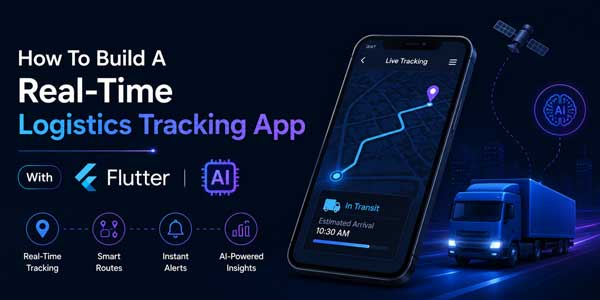
As we get modern and more digitized, the technology has been reshaped, and this results in more autonomous decision-making, passive tracking to predict, and eliminates manual tasks.
So the logistics industry has now shifted towards intelligent automation. Does your industry lack real-time tracking? Looking to build an AI-powered logistics tracking app? Do not worry, you have landed on the right page! In this article, we have created a step-by-step structured process to build a logistics tracking mobile app development, and also explained why real-time tracking matters!
Table of Contents
Why Real-Time Tracking Matters in Logistics?
Imagine your customers can easily access product delivery from dispatching to shipping, and you can even solve your query for any product-related or delivery issues 24/7/365. That’s what is known as a real-time logistics tracking app.
In today’s fast-paced delivery ecosystem, customers expect complete visibility into their shipments from dispatch to doorstep. Real-time tracking has become a critical feature for logistics companies because it improves operational efficiency, enhances customer satisfaction, and reduces delivery delays.
No matter what your business is, and what you offer. Businesses rely on real-time logistics tracking to stay competitive and responsive.
Below we have listed the benefits of the logistics tracking app:
- Customers can monitor deliveries live
- Businesses can track driver activity
- Operations teams can identify delays instantly
Building a logistics app is a topic that we can’t ignore, because it impacts ROI, decreases customer interest satisfaction rate, and more. So what are you waiting for to hire mobile app developers now, with expertise in logistics, AI integration, and real-time app development to launch a scalable and future-ready solution?”
Why Choose Flutter for Logistics App Development?
Developing a real-time logistics tracking app includes speed, scalability, smooth performance, and cross-platform compatibility. Flutter has become one of the most preferred frameworks for logistics app development. It helps businesses to create powerful, feature-rich mobile applications for both Android and iOS using a single codebase.
From live GPS tracking to AI-powered route optimization, Flutter provides the flexibility and performance needed for modern logistics solutions.
We have listed why Flutter is an excellent choice for logistics app development.
- Cross-platform compatibility (iOS, Android)
- Real-time performance (live tracking vehicles, delivery details)
- Fast development
- AI integration support
- Cost efficiency
- Scalability
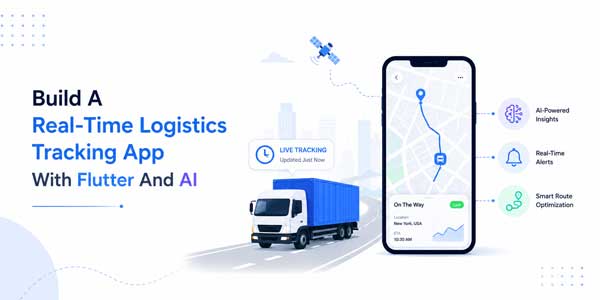
Process to build a Real-time Logistics Tracking App With Flutter and AI:
Selecting the right framework won’t solve the problem. For creating a successful application, you need to go through a structured process from defining the business requirements to deploying and monitoring.
Define Business Requirements:
Before starting the development, understand what problem the app should solve and who will use it. Decide whether the app is for delivery tracking, fleet management, courier services or supply chain operations. This will help you create the right features and business flow from the beginning.
Plan the App Features:
Create all the features needed for customers, drivers, and admins. Features like live tracking, delivery updates, route navigation, notifications, and AI-based ETA predictions make the app more useful and user-friendly.
Choose the Right Tech Stack:
Select the right technologies required to build the app smoothly and efficiently. Flutter is used for mobile app development, while tools like Firebase, Google Maps, Websockets, and AI APIs help manage real-time tracking and smart automation
Design the App Architecture:
Create a design simple, intuitive, and more user-friendly. A planned architecture helps the app stay fast, secure, and scalable as the number of users grows.
Set Up the Flutter Project:
Start the Flutter project and install the required packages for maps, GPS tracking, and live notifications. This step creates the foundation for developing all app functionalities in one codebase for Android and IOS.
Build User Authentication:
Add secure login and signup options for customers, drivers, and admin users. Authentication helps users’ data to be secure and guarded, and ensures each user can access only the features relevant to their role.
Implement Real-Time GPS Tracking:
Integrate live location tracking to monitor vehicles or delivery agents in real time. GPS tracking bridges the gap between customers, admins, and drivers, which helps for accurate delivery movement on the app.
Integrate Google Maps:
Google Maps helps display routes, delivery locations, and moving vehicles visually inside the app.
Build the Backend Infrastructure:
The backend app manages app data, user accounts, delivery updates, and communication between systems. It helps to deliver real-time tracking.
Add AI Capabilities:
AI integrations help apps to make smarter and more advanced applications by predicting delivery times, analyzing traffic conditions, and more.
Implement Push Notifications:
Push notifications help to alert customers about order status, estimated arrival times, delays, or successful deliveries instantly.
Build the Admin Dashboard:
Create an admin dashboard where businesses can monitor drivers, deliveries, and fleet activity from one place.
Optimize Performance:
Improve app speed, reduce battery usage, and ensure smooth performance even during heavy usage.
Test The Application:
Test all app features carefully to ensure everything works correctly under different conditions. This includes checking GPS accuracy, live tracking, notifications, user flows, and app stability.
Deploy the App:
Once testing is complete, launch the app on the Google Play Store and Apple App Store. The backend and databases are also deployed on cloud platforms to support real-time operations.
Scale the Logistics Platform:
As the business grows, the app should handle more users, deliveries, and vehicles without slowing down. Scaling helps maintain performance and supports future business expansion.
Monitor & Improve:
After launch, continuously monitor app performance, delivery data, and user feedback. Regular updates and improvements help fix issues, add new features, and keep the logistics platform competitive and efficient.
Future Enhancements:
The future for logistics apps is moving beyond simple tracking toward hyper-automation and predictive intelligence. If you are building with Flutter and AI, here is where the industry is heading in the upcoming years;
- Predictive Intelligence
- Agentic AI
- Smart exception handling
- Optimization goals
Final Thoughts:
Flutter logistics app development with AI makes it easy to build a real-time delivery tracking app that is fast, scalable, and smart. A Flutter app for fleet tracking with GPS tracking app with Flutter features helps businesses monitor deliveries and improve efficiency.
Adding AI in logistics app development improves routes and predictions, and it’s always better to hire app developers for building a strong, production-ready system.
 About the Author:Ajay Mishra is a digital marketer and content strategist for a software, web & mobile app development company at Serviots. He turns complex tech concepts into engaging, accessible narratives. With a deep understanding of modern tech stacks and software development, he crafts content that educates, inspires, and drives meaningful conversations. He knows what attracts Google to fetch your content to the top of the SERP. When not writing, you’ll find him exploring the latest in digital marketing strategies or reading news on current happenings around the world.












Be the first to write a comment.