
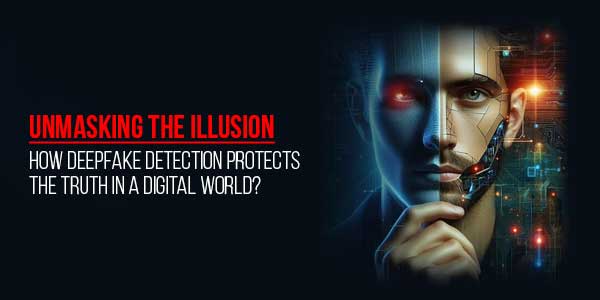
The digital world used to be a world that experienced coexistence of truth and visibility with confidence, but AI has changed the rules. The weird deceptions, produced by generative algorithms, known as deepfakes, have started to weaken the credibility of our online vision and audio. They can depict a face in the wrong place or replicate a voice in a disturbing realism. What began as a fun experiment in entertainment has overflowed into a dark pool of fraud, masquerades, and falsehoods. Deepfake detector is now the next line of defence against this increasingly popular digital illusion, enabling companies, governments and individuals to distinguish between authenticity and fake all-purpose.
Table of Contents
What Exactly Is A Deepfake?
A deepfake is an artificial creation by AI that implies replacing or manipulating a face, voice, or behaviour in a video or audio file. It is driven by the deep learning models that are trained on extensive datasets of images or voice samples to reconstruct the most realistic variant of an identity of a person. Given the appropriate technology and sufficient amounts of data, a fraudster is capable of producing a video that seems natural, expressive and frighteningly credible. Such tools have become more accessible, and it is now possible to do such impersonations with little effort and almost no technical expertise.
Importance of Deepfake Detection:
Deepfakes are no longer a frivolity of the internet, and they are now aimed at essential processes, such as digital onboarding, financial transactions, communicating with the public, and politics. Deepfakes enable fraudsters to open bank accounts, circumvent identity verification, manipulate executives in real-time, and even social engineer them. The stakes have skyrocketed. Businesses are at risk of losing their money, their reputation, penalties set by the authorities and loss of user confidence without the presence of detection systems. Finding out deepfakes is not only a technological requirement, but also a protection of digital integrity.
The Working Of Deepfake Detection:
Deepfake detection resorts to sophisticated AI algorithms that are able to identify the minor anomalies that manipulated content cannot conceal completely. These systems process a billion small cues that are embedded in facial expression, lighting, texture and audio syncing. A deepfake can even get emotion, but it tends to have a problem with biological rhythm. Micro-expressions can malfunction, the skin can look excessively smooth, or eye reflections can adhere to unnatural physics. Deepfakes in audio frequently have robotic intonations, inaccurate rhythm, or unnatural breathing rhythms. These anomalies are checked by detection systems with the natural human behavior and forgery is revealed where there is no forgery in the eyes of the human being.
Such a process is based on a combination of machine learning, forensic examination, and computer vision. With the advancement of deepfake generation, detection models evolve accordingly, where the models are trained on large amounts of manipulated and real content to be sensitive to new threats.
The Strengthening of Detection using Liveness:
Whereas deepfake detection determines the content of the message, liveness detection makes sure that the person is a real and physically present human being who is involved in the verification. The two constitute a strong force against impersonation. What would seem perfectly natural in a video clip may seem almost impeccable in a deepfake, but when it comes to making a person respond, minor irregularities start to emerge. The liveness models capture features such as depth, shadow realism, free movement, and natural timing. This two-tier system of detecting deepfakes and liveness results in a more resilient system that eliminates deceitful elements that may pass through electronic verification.
Deepfake: Threats in Industries:
Deepfake fraud has permeated the industry that depends more on remote communication. Criminals in the banking and fintech sectors can bypass digital KYC checks or open mule accounts using face-swapped videos. In e-business markets, the security of the seller is compromised when AI identities are introduced to the system. Deepfake-based onboarding is a threat to telecom companies. Even the healthcare systems face the issue of counterfeit patient identities that request access to benefits. The scams related to the impersonation of CEOs with the help of deepfake audio have resulted in millions of losses in the corporate world. All these threats are not theorised, but they have already started to transform the way businesses defending its systems.
Developing Trust in the Era of AI Manipulation:
Faith is now a precious possession in an online world of artificial content. Users desire to be certain that the identity and the information that they come across on the Internet are real. The reliability and responsibility of deepfake detection signals in the companies. They show that they care about the safety of users, and their platforms are safeguarded against the increasingly massive digital storm of digital manipulation. Openness stands out in a world that has been marred by lies, and technology turns out to be the prism that restores sanity. A business utilising deepfake detection soothes the mistrust that the artificial content produces and instils a feeling of online security.
Future Standards and Regulatory Pressure:
The regulators in the world are starting to see how serious fraud in the form of deepfakes can be. New compliance models are being developed requiring more robust identity verification, anti-spoofing, and systems resistant to deepfakes. Such standards as ISO/IEC 30107 encourage businesses to use the latest presentation attack detection and verification systems. Due to the ongoing development of deepfakes, it is plausible that future legal regulations will need even stronger detection systems to drive the industries to an even greater level of identity safety.
The Future of Deepfake Detection:
Deepfake software will keep becoming more accurate, efficient and responsive. The models in the future will examine the multimodal cues and combine the vision, sound, and behavioural patterns in one detection model. The AIs will acquire the skill of identifying even the tiniest inconsistency that is difficult to reproduce by the generative models. With more creative and difficult to detect deepfakes, detection systems will be used as active scorecards rather than reactive ones, knowing ahead of time attack vectors to protect. Generative models and detection models will probably never stop fighting, whereas the aim will not change, and it is to make the digital space safe.
Conclusion:
Deepfake detection is now an important countermeasure to protect truth in the increasingly fabricated digital environment. Such systems identify the undetectable distortions under the AI-created faces and voices to secure businesses and users against advanced impersonation and manipulation. Since the deepfakes are becoming more and more realistic, the detection technology also increases in accordance with it, so that authenticity still prevails over the fake. As the world is becoming increasingly more polished due to illusion, deepfake detection is the silent powerhouse which restores clarity, trust, and safety to digital interactions.










![5-Best-WordPress-Plugins-For-Restaurants-[2026]](https://www.exeideas.com/wp-content/uploads/2026/09/5-Best-WordPress-Plugins-For-Restaurants-2026-300x150.jpg)


Be the first to write a comment.