
Container terminal automation is becoming very important in logistics and shipping. Other industries are using technology to work faster. Now the shipping industry wants to use port automation technology to make things run smoothly.
“The maritime industry has been pretty slow to start using automation at container terminals says Howard Wren, Director of Logistics at Jade Software Corp in Australia. Now people really believe in automation technology, and it is getting very popular. Automated terminals are getting close to the point where a lot of industry companies will start to use them, and the maritime industry will see a big rush. The maritime industry is about to change a lot because of automation.”
Despite the vast financial flow through ports, many processes remain fragmented, non-standardized, and behind the technological curve. This is where INTECH Creative Services and its suite of terminal automation solutions can provide a significant advantage.
Table of Contents
What Is Container Terminal Automation?
Container port automation uses machines and computers to control the equipment and things that happen at the terminal. We can automate things at the container port when we do things in a way over and over again, and when we can tell a computer exactly what to do. This includes:
- Field instrumentation for data collection
- Management and processing of operational data
- Automated control of equipment and logistics
Container terminal automation can be classified into:
- Fully-Automated Terminals – Automation covers both the stacking yard and horizontal transfers between the quay and the yard.
- Semi-Automated Terminals – Partial automation, often limited to stacking yards, with manual processes still in place at the quay.
Technology for terminals is getting better and better. This means that some parts of how things are done will become more automated. The areas that will see the change are yard management.
Driving Forces Behind Automation in Ports:
Several key challenges are driving the adoption of automation in the maritime industry:
- Larger Ship Sizes: Mega ships need ports that can use space wisely. This helps to reduce congestion. It also helps to minimize charges for demurrage and detention. Ports can handle ships more efficiently with automated terminals. Mega ships and automated terminals go together to make things work better.
- Cost Efficiency: While investing a lot in software and automation for managing freight terminals at first seems expensive, it can actually help reduce costs by a lot, up to 55% over time. Freight terminal management software and automation can really make a difference.
- Labor Reduction & Safety: Automation reduces the need for manual labor. Tasks that once required dozens of workers can now be managed by a single operator via centralized control towers. Fewer human interactions also increase safety and minimize errors.
- Environmental Concerns: The shipping industry’s carbon footprint gets smaller with terminals. These Automated terminals help plan the routes for Automated Guided Vehicles and handle containers in a smarter way. Chen Wuyuan, who is the President of Shanghai International Port Group, says that automation at container ports can cut down carbon emissions by as much as 10 percent. This is because Automated terminals make things more efficient.
INTECH Creative Services specializes in port management software and terminal automation solutions that help ports achieve these operational and environmental benefits.
Current State of Terminal Automation:
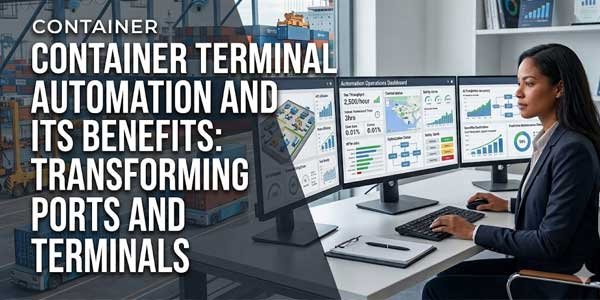
Today, 40 container terminals around the world are semi-automated or fully automated. A lot of money has been spent on these terminals, over 10 billion dollars. More money, another 10 to 15 billion dollars, will probably be spent on them in the next five years. Some examples of these container terminals are:
- Victoria International Container Terminal, Canada: The world’s first fully-automated container terminal, handling over 1 million TEUs annually.
- Port of Rotterdam, Netherlands: Early adopter of automated Rail Mounted Gantry Cranes (RMGs) and AGVs since the 1990s.
- Shanghai Yangshan Deep Water Port, China: The world’s largest fully-automated terminal, targeting a capacity of 6.3 million TEUs at full build.
Despite these advancements, automation in existing terminals faces challenges, including technology compatibility, capital availability, and labor union resistance.
The Benefits of Automation in Ports:
Implementing terminal automation solutions offers multiple advantages:
- Increased Productivity: With automation, things get done faster and on schedule. This means we can handle work.
- Reduced Costs: We save money on wages, managing equipment, and storing things.
- Enhanced Safety: When machines do more of the work, there are fewer accidents in the workplace.
- Environmental Efficiency: By planning the routes and handling things efficiently, we cut down on carbon emissions.
- Future-Ready Workforce: Places like the port authorities in Los Angeles offer training to help workers adapt to automation.
The Future of Ports and Terminals Automation:
The future of container port automation goes way beyond the stacking yard and those big quay cranes. INTECH Creative Services sees a port where everything is connected and automated, including:
- Terminal gates
- Yards and container storage
- Quay cranes
- Integrated port management software for real-time data-driven decisions
Terminals can really make things easier for themselves by using automation solutions for ports and terminals. This way, ports and terminals can work smoothly. Get things done quickly. Ports and terminals will also be better for the environment. At the time, ports and terminals can keep people with good skills who can handle new things in maritime logistics.
Conclusion:
Automation is no longer optional; it’s a critical step toward smarter, safer, and more sustainable container terminals. With INTECH Creative Services’ terminal automation solutions, ports can optimize operations, reduce costs, and stay competitive in the era of mega ships and global trade.
 About the Author:
Ankit Desai is the President of Global Sales and Marketing at INTECH Creative Services, specialising in terminal automation solutions, port management software, and container terminal optimization. He helps ports adopt smart automation technologies to improve efficiency, reduce costs, and enable data-driven operations.













Be the first to write a comment.