
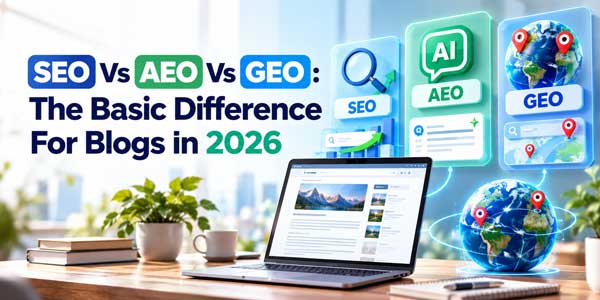
Search optimization has become more confusing because users no longer discover information through only one type of search result. Traditional Google listings still matter, but users can now also receive featured answers, AI-generated summaries, conversational responses, cited sources, and multi-step generative search results.
This shift has created three popular terms: SEO, AEO, and GEO. They sound like separate disciplines, but for bloggers the reality is more connected.
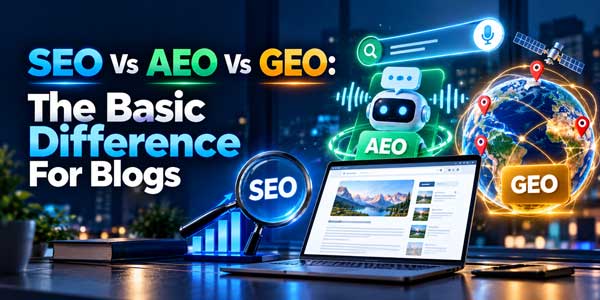
SEO focuses on making content discoverable, understandable, indexable, relevant, and competitive in search engines. AEO focuses on making content easy to use as a direct answer to a question. GEO focuses on making content useful enough for generative AI systems to retrieve, reference, cite, or use as evidence when producing synthesized answers.
In practical terms, a strong blog post should increasingly be designed to perform across all three environments rather than choosing only one.
The Simplest Difference: SEO Helps Your Page Become Discoverable And Competitive In Search. AEO Helps Your Content Become The Answer. GEO Helps Your Content Become A Source That Generative AI Systems Can Retrieve, Reference, And Cite.
This guide explains the basic difference between SEO, AEO, and GEO for bloggers in 2026, how they overlap, what Google currently says about generative AI optimization, how AI search changes content strategy, which optimization myths should be ignored, and how to create blog posts that work across traditional search and generative search environments.
Table of Contents
What Is SEO?
SEO stands for Search Engine Optimization. It is the process of helping search engines discover, crawl, understand, index, and appropriately rank your website content.
Traditional SEO covers a broad range of activities, including:
- Search intent research.
- Keyword research.
- On-page SEO.
- Technical SEO.
- Internal linking.
- Content optimization.
- Image SEO.
- Structured data.
- Page experience.
- Authority and backlink earning.
The primary SEO question is usually:
How Can This Page Become A Relevant And Useful Search Result For The Right Query?
For a blog, successful SEO may produce:
- Organic impressions.
- Blue-link rankings.
- Image visibility.
- Featured search appearances.
- Discover visibility.
- Organic clicks.
What Is AEO?
AEO stands for Answer Engine Optimization. It is an industry term used to describe the practice of making content easy for search and answer systems to understand and use when responding directly to a question.
AEO became popular as search engines increasingly began answering queries directly rather than showing only ten traditional links.
Answer-oriented experiences can include:
- Featured snippets.
- Direct answer boxes.
- Voice-assistant responses.
- Conversational search answers.
- AI-generated summaries.
- Question-based search experiences.
The primary AEO question is:
Can A System Quickly Understand The Question This Page Answers And Identify A Clear, Accurate Response?
This often encourages bloggers to write:
- Clear definitions.
- Short direct answers.
- Step-by-step instructions.
- Comparison tables.
- Question-based subheadings.
However, AEO should not be confused with a separate Google ranking algorithm that has its own secret technical requirements.
What Is GEO?
GEO stands for Generative Engine Optimization. It is an increasingly common industry term for improving the likelihood that content will be discovered, retrieved, referenced, or cited in AI-generated answers.
Generative search systems do more than select one webpage.
They may retrieve information from multiple sources, compare evidence, reason across subtopics, and synthesize a new answer for the user.
GEO therefore asks a slightly different question:
Is This Page Valuable And Trustworthy Enough To Become Supporting Evidence For A Generative Answer?
Potential generative environments include:
- Google AI Overviews.
- Google AI Mode.
- Microsoft Copilot.
- Bing AI-generated answers.
- ChatGPT search experiences.
- Other AI assistants using web retrieval.
SEO Vs AEO Vs GEO At A Glance
| Area | SEO | AEO | GEO |
|---|---|---|---|
| Main Goal | Rank And Earn Search Visibility | Become A Clear Direct Answer | Become A Useful Source For Generative Answers |
| Main Environment | Search Results | Answer-Oriented Results | AI-Generated Search And Assistants |
| Core Asset | Relevant Webpage | Clear Answer | Source-Worthy Evidence |
| Important Content Trait | Relevance And Usefulness | Clarity And Directness | Originality, Trust, Evidence, And Retrievability |
| Typical Outcome | Organic Click | Answer Visibility | Citation Or Supporting Source Visibility |
This table is useful conceptually, but the three areas overlap significantly.
A page that performs well in GEO generally still needs strong SEO foundations. A page that provides excellent direct answers can improve both traditional SEO usefulness and generative retrieval potential.
SEO Is The Foundation For Both AEO And GEO
This is the most important strategic point.
Google currently states that the same foundational SEO practices remain relevant for generative AI features such as AI Overviews and AI Mode.
Pages still need to be:
- Crawlable.
- Indexable.
- Eligible to appear in Search.
- Useful to users.
- Supported by strong internal links.
- Technically accessible.
That means a blogger should not abandon traditional SEO because generative search is growing.
If an AI system retrieves information through a search index, being properly discoverable and indexable remains fundamental.
AEO Is Primarily About Answer Clarity
AEO improves how easily systems and users can identify the answer inside the content.
Consider this question:
What Is A Canonical URL?
A weak article might begin with five paragraphs discussing the history of websites before eventually explaining canonicalization.
A stronger answer-first version could begin:
A canonical URL is the URL a site owner signals as the preferred version among duplicate or very similar pages.
The article can then explain:
- How canonical tags work.
- When to use them.
- Common mistakes.
- Examples.
This structure benefits humans, traditional search, answer engines, and AI retrieval simultaneously.
GEO Is Primarily About Source-Worthiness
A generative engine can already produce generic explanations of many common topics.
If your article simply rewrites information available on hundreds of websites, it may provide little unique reason to be selected as supporting evidence.
GEO therefore places strong emphasis on content that adds something distinctive.
Examples include:
- Original research.
- First-hand experience.
- Unique data.
- Expert interpretation.
- Current facts.
- Case studies.
- Product testing.
- Original comparisons.
The goal is not to make text sound more robotic or “AI-friendly.”
The goal is to make the information itself more useful as evidence.
Google Does Not Require Special GEO Optimization
This is one of the most important corrections to modern SEO discussions.
Google’s current generative AI guidance explicitly says there are no additional technical requirements for appearing as a supporting link in AI Overviews or AI Mode beyond the normal Search eligibility requirements.
Google also says you do not need:
- Special AI schema.
- Special machine-readable AI files.
- A special GEO markup standard.
- A special AEO schema.
This means bloggers should be skeptical of anyone selling a mysterious Google GEO code snippet that supposedly guarantees AI visibility.
LLMS.txt Is Not A Google GEO Requirement
The llms.txt proposal has received substantial attention in the AI SEO community.
However, Google’s current guidance says Google Search does not require or use llms.txt for visibility or rankings.
Maintaining such a file for another service is not necessarily harmful, but it should not be presented as a Google ranking advantage.
For Google, foundational SEO remains more important.
Do You Need To Break Content Into Tiny AI Chunks?
No.
Some GEO advice suggests every paragraph should be converted into tiny standalone chunks because AI systems supposedly cannot understand larger sections.
Google currently says there is no requirement to artificially break content into small pieces for its generative Search systems.
Use sections and paragraphs because they improve readability and organization.
Do not destroy natural writing simply to create imaginary AI chunks.
Question-Based Headings Are Useful, But Not Mandatory
AEO strategies frequently encourage headings such as:
- What Is SEO?
- How Does SEO Work?
- Does SEO Still Matter?
These can work extremely well when users actually ask those questions.
However, not every heading needs to be a question.
For example:
SEO Vs GEO Content Strategy
may be clearer than:
What Is The Difference Between The Way SEO Content Strategy And GEO Content Strategy Work?
Optimize for readability first.
Direct Answers Help SEO, AEO, And GEO At The Same Time
A short direct answer can make content easier to understand.
That helps:
- Users scanning the page.
- Traditional search systems.
- Answer-oriented experiences.
- Generative retrieval systems.
Use an answer-first, depth-second structure when it suits the topic.
For example:
- Give The Direct Answer.
- Explain Why.
- Add Examples.
- Add Evidence.
- Cover Exceptions.
This avoids forcing users to search elsewhere for the missing explanation.
Original Information Is Increasingly Important For GEO
Generative AI makes commodity content extremely easy to create.
A model can quickly explain:
- What SEO is.
- What a backlink is.
- What a CDN does.
- What WordPress is.
If your blog contributes only another generic definition, it is competing with information that can be reproduced almost instantly.
Source-worthy content should add something more.
Examples Of High-Value Blog Information
- A benchmark from your own data.
- A real implementation case study.
- A test involving several tools.
- An expert workflow.
- Original screenshots.
- A proprietary dataset.
- A new comparison.
This strengthens classic SEO quality as well as generative visibility potential.
E-E-A-T Matters Across SEO, AEO, And GEO
Google uses the concept of Experience, Expertise, Authoritativeness, and Trustworthiness as part of its quality framework.
E-E-A-T itself is not one single ranking score.
However, content that demonstrates real experience, strong expertise, external recognition, and trust can be easier for users and systems to rely on.
For blogs, useful trust signals include:
- Real author names.
- Accurate author bios.
- First-hand evidence.
- Source citations.
- Clear editorial processes.
- Accurate updated dates.
Never fabricate authors, testing, credentials, or first-hand experience to make content look more authoritative.
Who, How, And Why Strengthen Modern Blog Content
Google recommends thinking about content in terms of Who, How, and Why.
Who Created The Content?
Use real authorship where readers would reasonably expect it.
How Was The Content Created?
If an article involves testing, explain:
- What was tested.
- How it was tested.
- What data was collected.
Why Was The Content Created?
The primary purpose should be helping the audience, not generating another keyword-targeted URL simply because a tool found search volume.
This framework helps SEO, AEO, and GEO simultaneously because it improves trust and originality.
AEO Does Not Mean Adding Hundreds Of FAQs
FAQ content can be useful when it addresses genuine reader questions.
However, adding fifty shallow questions merely to target answer engines usually weakens the page.
Use FAQ sections when:
- Users actually ask the questions.
- The answers add information not already covered clearly.
- The questions fit the primary topic.
Do not turn every article into an endless question database.
FAQ Schema Is Not A Current Google Visibility Shortcut
Historically, FAQ structured data could produce enhanced FAQ appearances in Google Search.
That should no longer be the reason for adding FAQ sections.
Google discontinued the general FAQ rich-result feature in May 2026.
FAQ sections can still be valuable for readers and content structure, but they should not be sold as a guaranteed rich-result tactic.
Structured Data Helps SEO But Is Not Special GEO Markup
Structured data can help search engines understand entities and page information.
Useful blog markup can include:
- Article.
- BlogPosting.
- Breadcrumb.
- Organization.
- Person.
However, Google specifically says no special schema.org markup is required for AI Overviews or AI Mode.
Continue using valid structured data where it accurately represents visible content.
Do not invent properties such as:
"geoOptimizationScore": "100"
and expect Google to use them.
GEO Includes Generative Search Beyond Google
This is where GEO becomes broader than Google’s AI features alone.
Different AI platforms use different crawling, retrieval, indexing, and citation systems.
For example, OpenAI provides OAI-SearchBot for ChatGPT search visibility.
Website owners can manage access through robots.txt.
A site that blocks the search crawler may remove itself from normal ChatGPT search-source eligibility, although inclusion is never guaranteed simply by allowing crawling.
AI Search Crawlers And Training Crawlers Can Be Different
This distinction matters for publishers.
OpenAI currently separates its search crawler from GPTBot controls.
That means a publisher can make one policy decision about search visibility and a different decision about use for model training.
Do not assume every AI crawler performs the same function.
Review the documentation for each platform you intentionally want to support.
Generative Visibility Can Now Be Measured More Directly
One major development in 2026 is improved reporting for AI search visibility.
Google Search Console now provides dedicated generative AI performance reporting for supported Google Search experiences.
This can help publishers understand visibility associated with features such as:
- AI Overviews.
- AI Mode.
- Generative Search experiences.
This makes GEO less speculative than it was in earlier years.
Bing Also Reports AI Citations
Bing Webmaster Tools introduced AI Performance reporting that can show how content is referenced across supported Microsoft AI experiences.
Available insights can include:
- Citation activity.
- Cited URLs.
- Grounding query phrases.
- Visibility trends.
This is important because GEO success is not always represented by a conventional search ranking.
A page may become valuable because an AI system repeatedly uses it as evidence.
SEO Success And GEO Success Can Look Different
Traditional SEO performance commonly looks like:
- Ranking position.
- Impressions.
- Clicks.
- Organic traffic.
- Conversions.
GEO performance may additionally involve:
- AI citations.
- Supporting-source appearances.
- Generative impressions.
- Brand mentions in AI answers.
- Referral traffic from AI assistants.
These metrics should complement—not replace—business KPIs.
AEO Success Can Be More Difficult To Attribute
An answer engine may satisfy the user’s question without creating a click.
This means answer visibility can produce:
- Brand awareness.
- Trust.
- Zero-click exposure.
- Later branded searches.
Bloggers should therefore avoid measuring every optimization effort exclusively by immediate sessions.
At the same time, visibility that produces no meaningful business value should not automatically be celebrated.
SEO Focuses Heavily On Search Demand
Keyword research remains useful because it reveals:
- What people search for.
- How they describe problems.
- Which topics have demand.
- What search intent may exist.
For SEO, a blogger may build content clusters around recurring search demand.
However, do not let search volume become the only editorial filter.
AEO Focuses More On Questions And Tasks
Answer optimization often begins with questions such as:
- What Is X?
- How Does X Work?
- Why Does X Matter?
- X Vs Y?
- How Do I Fix X?
These patterns help writers create clear informational architecture.
But AEO should still serve the real reader rather than artificially creating hundreds of question variations.
GEO Focuses More On Evidence And Retrieval
Generative systems often need sources that can support a claim.
A GEO-focused article should therefore make useful facts easy to identify and verify.
This does not mean writing for robots.
It means clearly presenting:
- Evidence.
- Methodology.
- Statistics.
- Definitions.
- Comparisons.
- Sources.
Clean content benefits human readers too.
Entity Clarity Can Help All Three Strategies
Search and AI systems need to understand what people, brands, products, places, and concepts are being discussed.
Use clear names instead of vague references.
For example, write:
Google Search Console
rather than repeatedly writing:
the tool
when ambiguity could arise.
This improves clarity without requiring artificial entity stuffing.
Internal Linking Remains Important For SEO, AEO, And GEO
Internal links help search engines discover related pages and understand site structure.
For a blog, create logical topic relationships.
An article about:
SEO Vs AEO Vs GEO
might naturally link to detailed guides about:
- Technical SEO.
- AI Overviews.
- E-E-A-T.
- Structured data.
- Content optimization.
Do not create hundreds of mechanical internal links simply to distribute keywords.
Link when the destination genuinely helps the reader.
Backlinks Still Matter In The AI Search Era
Generative search has not made external authority irrelevant.
Editorial links can help with:
- Discovery.
- Authority.
- Brand recognition.
- Referral traffic.
- Traditional search visibility.
However, GEO should not become another excuse for buying artificial backlinks or mentions.
Google’s current generative AI guidance specifically warns against seeking inauthentic mentions as a shortcut.
Brand Mentions Can Have Broader Value Than Links Alone
A respected industry publication may mention your company or research even without linking.
That can still contribute to:
- Brand discovery.
- Reputation.
- Journalist awareness.
- Future references.
Do not reduce every off-page activity to a dofollow backlink.
SEO Titles Still Matter For GEO
Page titles help both users and systems understand a page.
A vague title such as:
Everything You Need To Know
is less descriptive than:
SEO Vs AEO Vs GEO: Key Differences For Bloggers
The second title communicates entities, topic, and comparison intent immediately.
Good traditional SEO titles remain useful in generative search.
Meta Descriptions Are Primarily Traditional Search Assets
Meta descriptions can help communicate page value in traditional search snippets.
They should not be treated as special GEO metadata.
Generative systems can retrieve information from the actual page content.
Continue writing strong descriptions because they improve normal search presentation—not because they are secret AI prompts.
Images And Video Can Strengthen Modern Search Visibility
Google’s AI Search guidance still recommends high-quality images and videos when they are useful.
Visual content can add:
- Evidence.
- First-hand experience.
- Explanation.
- Unique value.
For example, an original screenshot demonstrating a software workflow can be more useful than a generic AI illustration.
Freshness Matters When The Topic Changes
AI and search products evolve quickly.
A blog about:
- AI search.
- SEO policies.
- Software pricing.
- AI tools.
should be reviewed regularly.
Do not update the year in the title without checking whether the actual information is still correct.
SEO, AEO, And GEO Do Not Require Three Separate Articles
A common mistake is creating three nearly identical articles:
- Best SEO Guide.
- Best AEO Guide.
- Best GEO Guide.
when the information substantially overlaps.
Instead, decide whether the search intents are genuinely distinct.
A single comprehensive article may provide more value than three thin pages created only to target different terminology.
One Strong Blog Post Can Satisfy SEO, AEO, And GEO Together
Consider an article about:
How To Reduce WordPress Server Response Time
For SEO, you optimize:
- Search intent.
- Title.
- Content depth.
- Internal links.
- Technical accessibility.
For AEO, you provide a concise answer:
Reduce WordPress server response time by improving hosting resources, enabling full-page caching, optimizing PHP and database queries, and using persistent object caching where appropriate.
For GEO, you strengthen the article with:
- Real benchmark data.
- Test methodology.
- Before-and-after TTFB measurements.
- Current technical documentation.
- Original screenshots.
That one article can support all three goals.
SEO Vs AEO Vs GEO Content Checklist
| Content Task | SEO | AEO | GEO |
|---|---|---|---|
| Search Intent | Essential | Essential | Essential |
| Crawlability | Essential | Important | Essential For Search-Based Retrieval |
| Direct Answers | Useful | Core | Very Useful |
| Original Research | Strong Advantage | Strong Advantage | Especially Valuable |
| First-Hand Experience | Valuable | Valuable | Highly Source-Worthy |
| Internal Linking | Important | Useful | Useful |
| Structured Data | Useful Where Supported | Useful Where Relevant | No Special GEO Schema Required |
| Author Information | Trust Signal | Trust Signal | Source Credibility |
| Citations And Sources | Useful | Useful | Especially Important For Verifiability |
A Practical SEO, AEO, And GEO Workflow For Bloggers
- Choose A Topic Your Audience Actually Needs.
- Analyze Search Intent.
- Research Current Primary Sources.
- Create A Clear Page Structure.
- Answer The Main Question Early.
- Add Original Experience, Data, Or Analysis.
- Use Descriptive Headings.
- Add Internal Links To Relevant Pages.
- Add High-Quality Images Or Video Where Useful.
- Use Accurate Structured Data Where Appropriate.
- Make The Page Crawlable And Indexable.
- Verify Important Facts And Sources.
- Publish And Monitor Traditional Search Performance.
- Monitor AI Search Visibility Where Reporting Exists.
- Update The Article When The Topic Changes.
Common SEO, AEO, And GEO Mistakes
- Treating GEO As A Replacement For SEO: SEO remains foundational to major search-based generative systems.
- Creating Artificial AI Content Chunks: Write naturally for readers.
- Installing Fake AI Schema: Google requires no special GEO schema.
- Assuming llms.txt Improves Google Rankings: Google currently says it does not use the file for Search visibility.
- Creating Hundreds Of FAQ Questions: Answer real user questions rather than manufacturing query variations.
- Publishing Generic AI Summaries: Add original information or experience.
- Ignoring Traditional Technical SEO: Crawlability and indexability still matter.
- Chasing AI Citations Without Business Value: Measure useful outcomes.
- Buying Artificial Mentions: Build genuine authority.
- Ignoring Content Freshness: Generative systems need accurate, current information.
Which Strategy Should Bloggers Prioritize?
The practical answer is SEO first, then integrate AEO and GEO principles into the same content workflow.
Do not create separate editorial departments for all three unless your publishing operation is extremely large.
For most blogs:
- Build Strong SEO Foundations.
- Make Answers Clear And Direct.
- Add Source-Worthy Original Value.
This gives one article the best chance of performing across multiple discovery environments.
Should New Blogs Focus On GEO Immediately?
A new blog should understand generative search, but it should not neglect foundational work.
Prioritize:
- Crawlable site architecture.
- Useful topic-focused content.
- Internal linking.
- Technical health.
- Author credibility.
- Original value.
These same investments support GEO later.
Do not delay publishing because you do not have a special AI optimization plugin.
How To Measure SEO Performance
Traditional SEO metrics include:
- Search impressions.
- Organic clicks.
- Ranking visibility.
- Organic sessions.
- Conversions.
- Revenue.
Google Search Console remains a core source for query and page-level visibility.
How To Measure AEO Performance
AEO is harder to isolate because direct-answer visibility can occur without a click.
Possible indicators include:
- Featured answer appearances.
- Branded search growth.
- Question-query visibility.
- Search impressions.
- Voice or assistant referrals where measurable.
Do not invent an “AEO score” unless you clearly explain what the metric actually measures.
How To Measure GEO Performance
Generative visibility is becoming more measurable.
Potential metrics include:
- Generative Search impressions.
- AI citations.
- Cited URLs.
- Grounding queries.
- AI referral traffic.
- Conversions from AI discovery.
Google and Bing now provide increasingly useful reporting for generative search visibility.
Use these metrics alongside traditional SEO—not instead of them.
What The Future Of Blog Search Optimization Looks Like
Search is becoming more conversational, multimodal, and generative.
Users increasingly expect search systems to:
- Compare options.
- Summarize information.
- Answer follow-up questions.
- Reason across several sources.
- Provide supporting links.
This changes the value proposition of blogging.
Simply publishing information that already exists everywhere becomes less competitive.
Strong blogs will increasingly win through:
- Originality.
- Experience.
- Research.
- Evidence.
- Trust.
- Distinct expertise.
Final Verdict On SEO Vs AEO Vs GEO For Blogs
SEO, AEO, and GEO describe different optimization perspectives, but they should not be treated as three isolated systems.
SEO remains the foundation.
Your blog still needs to be crawlable, indexable, relevant, technically sound, internally connected, and genuinely useful.
AEO adds answer clarity.
Make it easy for users and systems to identify direct answers, definitions, steps, comparisons, and explanations.
GEO adds source-worthiness.
Make your content valuable enough that generative systems have a reason to retrieve, reference, or cite it while synthesizing answers.
The strongest GEO content usually contains something a model cannot simply reproduce from generic public knowledge: original data, first-hand experience, current evidence, expert interpretation, or proprietary insight.
Google’s current guidance reinforces that SEO best practices still apply to AI Overviews and AI Mode.
There is no special Google GEO schema. There is no requirement to create artificial AI text files. There is no need to rewrite your entire website into tiny content chunks.
Instead, focus on high-quality information and strong technical fundamentals.
Other generative platforms have their own crawler and retrieval controls. For example, OpenAI allows publishers to manage search access through OAI-SearchBot independently from training-related crawler preferences.
Measurement is also improving.
Traditional SEO can be measured through impressions, clicks, rankings, and conversions. Generative search increasingly adds citation activity, AI visibility, grounding queries, and AI referral traffic.
For bloggers, the most efficient workflow is therefore:
SEO Foundation + AEO Clarity + GEO Originality And Evidence
Do not write three versions of the same article for three acronyms.
Create one excellent article that search engines can discover, readers can understand, answer systems can interpret, and generative systems can trust as a useful source.
The Future Of Blog Optimization Is Not About Choosing SEO, AEO, Or GEO. It Is About Creating Content That Is Discoverable Enough For SEO, Clear Enough For AEO, And Valuable Enough To Be Cited Through GEO.
Everyday Reader Frequently Asked Questions
What Is The Difference Between SEO, AEO, And GEO?
SEO focuses on improving website visibility in search engines. AEO focuses on making content easy to use as a direct answer to user questions. GEO focuses on making content useful, trustworthy, and source-worthy enough to be retrieved or cited in generative AI responses.
Is GEO Replacing SEO?
No. SEO remains foundational because major generative search experiences still rely heavily on crawling, indexing, retrieval, relevance, and established Search systems. GEO extends SEO toward generative visibility rather than replacing traditional search optimization.
What Is AEO In Blogging?
AEO, or Answer Engine Optimization, means structuring useful content so questions receive clear, accurate, direct answers. Bloggers can support AEO with concise definitions, question-focused sections, step-by-step instructions, tables, and well-organized explanations without sacrificing depth.
Do Blogs Need Special GEO Schema To Appear In AI Search?
No. Google currently states that no special schema.org markup or additional technical requirement is needed specifically for AI Overviews or AI Mode. Continue using valid structured data where appropriate, but do not expect invented AI-specific schema to create generative visibility.
How Can Bloggers Optimize For SEO, AEO, And GEO Together?
Start with solid SEO fundamentals, match search intent, answer the main question clearly, add original research or first-hand experience, cite reliable sources, use descriptive headings, maintain strong internal linking, keep content crawlable, and monitor both traditional and generative search performance.













Be the first to write a comment.