
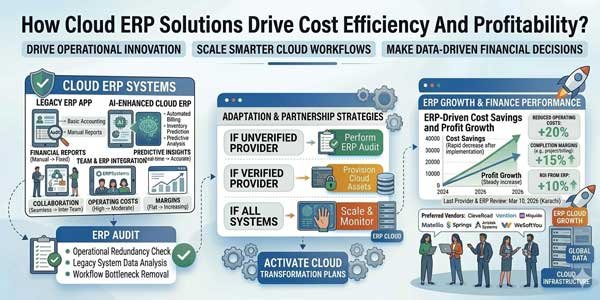
In this AI ERA Most of the enterprise’s IT leaders and experts will admit that a significant portion of their annual budget only goes toward keeping existing systems functional rather than making the business better. Maintenance of contracts, ageing hardware refresh cycles, integration patches, and the hidden cost of unplanned downtime, none of this creates value. It simply prevents collapse.
That is the uncomfortable baseline from which any honest conversation about Cloud ERP must begin.
Cloud ERP was supposed to fix this. And for organisations that have approached the transition with genuine strategic intent, it largely has. The problem is that the business case for Cloud ERP is routinely buried under vendor marketing that leans heavily on “digital transformation” and “enterprise agility” language that resonates in boardrooms but gives IT finance committees very little to work with when building an actual investment case.
This article is written for technology and operations leaders who need substance. Specifically, where Cloud ERP systems are creating measurable cost efficiency from a budget perspective, how those savings can compound over time, and why the financial case is considerably stronger than most organisations realise before they start looking closely.
Table of Contents
The Real Cost of the Status Quo:
Before evaluating any new platform, it is worth calculating what the current one actually costs, fully loaded, not just the licence renewal.
On-premise ERP infrastructure carries huge costs that are easy to cut down if optimized in the correct way. Server hardware depreciates and requires replacement on a three-to-five-year cycle. Internal IT staff whose primary function is system maintenance, patching, and break-fix support represent a significant and often growing overhead. Custom integrations built over years of accumulated workarounds are fragile; they break during upgrades and consume disproportionate engineering time to maintain. Version upgrades, when they finally happen, can consume six to twelve months of internal IT resources and still miss deadlines.
Then there is the operational cost that rarely appears in IT budget reviews: the cost of delayed information. When finance teams spend several days each month manually consolidating data across systems before producing management reports, that is not a process inefficiency; it is a strategic liability. Decisions get made on information that is already stale, or they get deferred until better data is available. Either outcome has a commercial cost that, while difficult to quantify precisely, is very real.
The organisations that make the strongest cases for Cloud ERP investment are typically the ones that took the time to quantify the status quo honestly before evaluating the alternative.
Infrastructure Cost Restructuring: CapEx to OpEx:
The financial model shift that Cloud ERP enables from capital expenditure to operational expenditure is sometimes dismissed as an accounting technicality. It is not.
Under a traditional on-premise deployment, ERP infrastructure is a capital asset. Hardware is procured, depreciated, and eventually replaced, creating spending patterns that are lumpy, politically charged, and difficult to align with actual business performance. The organisation owns the infrastructure, which means it absorbs all the risk, all the maintenance burden, and all the replacement cost.
Cloud ERP transfers that burden to the vendor. The hardware, redundancy architecture, security infrastructure, and disaster recovery capability are the provider’s responsibility. The organisation pays a predictable subscription fee and directs capital elsewhere.
For IT leaders making internal investment cases, the immediate benefit is budget predictability. For CFOs evaluating the total cost of ownership over a five-year horizon for organizations with plan of linear growth, the elimination of hardware refresh cycles and the reduction in infrastructure-dedicated headcount typically make the numbers compelling. The capital freed through this model can be redeployed toward revenue-generating technology investment rather than sitting in depreciating server infrastructure.
Elastic Scalability Without Infrastructure Risk:
Enterprise IT teams that are just managing on-premise ERP environments are also permanently stuck between two uncomfortable positions: over-provisioned and wasteful during normal operations, or under-provisioned and exposed during demand peaks.
Cloud ERP resolves this through elastic infrastructure. Capacity adjusts automatically in response to actual transaction volumes. A manufacturing business running quarterly financial consolidations, a retailer processing peak seasonal demand, or a logistics company managing unexpected volume surges all of these scenarios are handled by the platform without manual intervention or emergency procurement.
The billing model adjusts accordingly, meaning organisations pay in proportion to usage rather than maintaining fixed overhead for worst-case scenarios.
Companies looking for international expansion are equally significant in terms of implications. Historically, extending ERP coverage to a new country or business unit required establishing local infrastructure, engaging local IT support, and managing a separate implementation project. Cloud ERP eliminates most of this friction. New entities and users are provisioned on the same platform, often within days, without any material change to the infrastructure cost base. For organisations with a good level of growth agendas, that capability changes the economics of expansion in ways that extend well beyond the IT department.
Reducing the Cost of IT Operations:
There is a version of the enterprise IT function that most CIOs aspire to be strategic, commercially oriented, and focused on using technology to create competitive differentiation. The reality in many organisations is different. A substantial proportion of IT capacity is consumed by reactive maintenance work: patching, monitoring, troubleshooting integrations, and managing the consequences of deferred upgrades.
Cloud ERP changes this dynamic materially. System maintenance, security patching, platform monitoring, and version management are the vendor’s responsibility. Internal IT teams are released from this reactive workload and can be redirected toward higher-value activity.
The continuous update model that Cloud ERP vendors operate deserves specific attention. Legacy ERP upgrades are one of the most resource-intensive and disruptive activities an enterprise IT organisation undertakes.
Unified Data as a Financial Asset:
The financial case for data consolidation is well understood in principle but frequently underestimated in practice.
Fragmented ERP environments create data silos that impose real operating costs. Finance teams spend significant time each period manually reconciling figures across systems. Operations teams work from inventory data that may be hours or days old. Senior leadership makes resource allocation decisions based on reports that reflect last week’s reality rather than today’s.
Cloud ERP creates a single, continuously updated data environment shared across all business functions. Finance sees real-time inventory positions. Procurement sees live demand signals. Leadership accesses performance dashboards that reflect the current operational reality.
The downstream financial impact is concrete. Inventory carrying costs fall when replenishment decisions are made on accurate data. Cash flow forecasting improves when the inputs are current and reliable. Underperforming business units are identified and addressed earlier, before losses compound. The finance team’s capacity shifts from data assembly to data analysis, which is where genuine commercial value is created.
Process Automation and Labour Efficiency:
Cloud ERP-based platforms are built with robust automation as a core architectural principle, not as an add-on feature.
Transactional business processes that consume a significant amount of finance and operations headcount, such as accounts payable and receivable processing, purchase order management, payroll execution, bank reconciliation, and regulatory reporting, can be automated within a well-configured Cloud ERP environment. Human involvement is reserved for exceptions, approvals, and judgment-intensive work.
The labour efficiency gains are measurable. Organisations that have implemented Cloud ERP with serious attention to process automation consistently report the ability to scale transaction volumes without proportional headcount increases. The cost per transaction falls. The error rate falls with it, since automated processes built on consistent rules do not introduce the variability that manual processing creates.
 About the Author:
Jagdish Mali is the Co-Founder and Director of ERP Peers, a recognized NetSuite support services provider that helps businesses scale with confidence. He leads business strategy, growth initiatives, and client engagement, bringing deep insight into client needs and the practical challenges organizations face when adopting ERP solutions and integrating business systems.













Be the first to write a comment.