

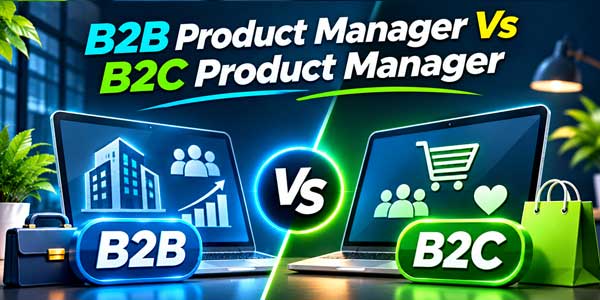
At first glance, a B2B Product Manager and a B2C Product Manager appear to do the same job. Both define product strategy, understand customers, prioritize problems, work with design and engineering, launch features, measure outcomes, and decide what should happen next.
But the operating environment can be dramatically different. A B2B Product Manager may need to balance the needs of end users, administrators, department heads, procurement teams, sales representatives, customer success managers, and an executive buyer inside the same customer account.
A B2C Product Manager may instead manage millions of relatively independent users whose behavior can be observed through activation funnels, retention cohorts, purchases, searches, content consumption, sessions, and experiments.
The Simplest Difference Is This: B2B Product Managers Often Optimize A Product Across Accounts, Buyers, Users, Contracts, And Business Workflows, While B2C Product Managers More Often Optimize Individual User Behavior, Engagement, Conversion, Retention, And Scale.
That difference affects almost everything: research methods, roadmap pressure, metrics, pricing, onboarding, experimentation, stakeholder management, user experience, go-to-market strategy, and even what the word customer means.
This guide explains the practical differences between B2B and B2C product management, where the roles overlap, which skills matter most in each environment, and how to decide which product-management career is better suited to you.
Table of Contents
What Is A B2B Product Manager?
A B2B Product Manager manages a product that is primarily sold to businesses or organizations rather than directly to individual consumers.
Common B2B products include:
- CRM systems.
- Accounting software.
- HR platforms.
- Cybersecurity products.
- Enterprise analytics.
- Project management tools.
- Infrastructure platforms.
- Vertical SaaS products.
- Business automation software.
The defining characteristic is not merely that a company pays the invoice. The deeper difference is that the buying process and product usage often involve multiple stakeholders with different motivations.
The person approving a $100,000 software contract may never use the application personally.
What Is A B2C Product Manager?
A B2C Product Manager manages products primarily designed for individual consumers.
Examples include:
- Social applications.
- Consumer marketplaces.
- Streaming platforms.
- Mobile games.
- Fitness applications.
- Personal finance products.
- Food delivery applications.
- Travel applications.
- Consumer e-commerce experiences.
In many B2C businesses, the user and the person making the purchase are the same person.
That simplifies some aspects of product management while introducing different challenges around acquisition, engagement, habit formation, competition, pricing sensitivity, and large-scale retention.
The Buyer And User Relationship Is The Biggest B2B Difference
In a typical consumer product, the person experiencing the product may also be the person deciding whether it is worth using or paying for.
B2B products frequently separate those roles.
A single business account may contain:
- Economic Buyer: Controls budget or approves the purchase.
- Decision Maker: Selects or recommends the solution.
- Administrator: Configures users, roles, policies, and integrations.
- End User: Uses the product in daily work.
- IT Or Security Team: Reviews infrastructure and risk.
- Procurement: Handles commercial approval.
This creates a product-management challenge that is easy to underestimate.
The product must create enough value for daily users while simultaneously satisfying the people who approve, administer, govern, and renew it.
B2C Product Managers Often Work Closer To Individual Behavior
Consumer products typically have fewer organizational layers between the PM and the user’s behavior.
If a consumer cannot understand onboarding, they may abandon the app.
If checkout is frustrating, they may not purchase.
If the product does not repeatedly create value, they may simply stop returning.
This gives B2C PMs strong incentives to understand:
- Acquisition funnels.
- First-session experience.
- Activation.
- Feature discovery.
- Engagement frequency.
- Conversion.
- Retention.
The product experience itself can have a particularly direct influence on business performance.
Customer Discovery Works Differently In B2B
B2B PMs can often speak directly with customers because the company knows who those customers are.
Discovery sources may include:
- Customer interviews.
- Sales calls.
- Implementation meetings.
- Support conversations.
- Customer success reviews.
- Win-loss analysis.
- Renewal conversations.
This access can be incredibly useful, but it introduces bias.
Your largest customer may have a loud opinion that does not represent the broader market.
A B2B PM must therefore separate:
“An Important Customer Requested This”
from:
“This Is A Valuable Product Problem For Our Target Market.”
B2C Discovery Depends More Heavily On Behavioral Scale
A B2C company may have millions of users, making direct interviews with a representative percentage impossible.
Consumer PMs therefore frequently combine qualitative research with quantitative behavior.
Useful inputs include:
- Product analytics.
- Funnel analysis.
- User research.
- Surveys.
- Reviews.
- Support tickets.
- Session patterns.
- Experiment results.
The challenge is different.
B2B PMs may struggle with a small number of extremely influential customers. B2C PMs may struggle with enormous amounts of behavioral data that explain what happened but not automatically why.
B2B Roadmaps Face Stronger Sales Pressure
Sales plays a major role in many B2B organizations.
A sales representative may say:
“If We Build SSO, This Enterprise Customer Will Sign.”
Another may say:
“This Prospect Needs A Custom Approval Workflow Before They Can Move Forward.”
Both requests may represent real revenue opportunities.
The PM must decide whether the feature:
- Supports the target segment.
- Solves a repeatable problem.
- Creates strategic differentiation.
- Unlocks enough revenue.
- Adds long-term complexity.
Strong B2B PMs learn to work closely with sales without turning the roadmap into a list of promises made during sales conversations.
B2C Roadmaps Face Stronger Growth And Engagement Pressure
Consumer-product roadmaps frequently face pressure from growth metrics rather than individual sales deals.
Questions may include:
- How can signup conversion improve?
- Why are users dropping during onboarding?
- How can repeat purchase increase?
- What drives weekly engagement?
- Which experience improves retention?
The roadmap may therefore contain more experimentation around user behavior.
Instead of one enterprise customer asking for a particular feature, the product team may see that 38% of a large user segment fails at a specific step in the funnel.
B2B Product Management Is Often Account-Centric
One of the most important analytical differences is the unit you measure.
In B2B SaaS, analyzing individual users alone can produce a misleading picture.
Imagine a customer account with 100 licensed employees.
If five power users are extremely active but 95 employees never adopt the product, the account may still be at renewal risk.
B2B PMs frequently need metrics at both:
- User Level.
- Account Level.
Account-level product health may include seat activation, feature penetration, active teams, administrative setup, workflow completion, and persistent use of high-value capabilities.
B2C Product Management Is Often User-Centric
In consumer products, the individual user is often the primary analytical unit.
The team may study:
- Signup conversion.
- Day 1 retention.
- Day 7 retention.
- Day 30 retention.
- Sessions per user.
- Purchase frequency.
- Average revenue per user.
This makes behavioral cohorts especially powerful.
The PM can compare whether users who experience a particular feature or onboarding path retain better than users who do not.
B2B Metrics Often Connect Product Usage To Revenue Retention
Common B2B product metrics may include:
- Account activation.
- Feature adoption.
- Seat utilization.
- Time to value.
- Renewal rate.
- Logo retention.
- Expansion revenue.
- Net revenue retention.
- Customer health.
The key question is often:
Is The Customer Organization Receiving Enough Persistent Value To Continue, Renew, And Expand?
A feature can have relatively low usage while still being extremely important if it solves a mission-critical problem for high-value accounts.
B2C Metrics Often Focus On Engagement And Retention At Scale
B2C PMs frequently monitor:
- Activation rate.
- DAU, WAU, Or MAU.
- Retention cohorts.
- Purchase conversion.
- Average order value.
- Subscription conversion.
- Churn.
- Session frequency.
The exact metrics should reflect the product’s value proposition.
A meditation application should not optimize screen time simply because another consumer product does.
The best metric represents the behavior that indicates the user received meaningful product value.
Experimentation Is Usually Faster In B2C
B2C products often have enough traffic to run controlled experiments relatively quickly.
A product team may test:
- Signup flows.
- Pricing screens.
- Recommendation logic.
- Navigation.
- Checkout.
- Notifications.
Large sample sizes can make statistically meaningful experiments possible within reasonable timeframes.
This creates a culture where PMs may make many smaller product decisions through experimentation.
B2B Experimentation Can Be More Difficult
A B2B product may have 300 customers rather than 30 million users.
That makes classic A/B experimentation more difficult.
Some enterprise features also cannot easily be randomized.
Instead, B2B PMs may rely more on:
- Design-partner programs.
- Beta releases.
- Pilot customers.
- Prototype testing.
- Before-and-after analysis.
- Cohort comparisons.
- Customer interviews.
This requires judgment.
“We cannot run a statistically powered A/B test” does not mean “we cannot validate anything.”
B2B Onboarding Can Be An Organizational Workflow
Consumer onboarding may take minutes.
Enterprise onboarding can take weeks or months.
It may require:
- Data migration.
- Administrator setup.
- Role configuration.
- Security review.
- Integrations.
- Training.
- Workflow configuration.
A B2B PM must understand that customer onboarding is often not simply a sequence of UI screens.
It can be an operational process involving customer success, implementation teams, administrators, and end users.
B2C Onboarding Must Often Create Value Immediately
A consumer usually has little contractual commitment to continue using a new product.
If the first experience is confusing, there may be nothing preventing immediate abandonment.
B2C PMs therefore often focus heavily on:
- Reducing signup friction.
- Demonstrating value quickly.
- Progressive permission requests.
- Personalization.
- First-session success.
The user should ideally understand why the product deserves another session.
B2B Products Require More Permission And Administration Complexity
Many enterprise products need functionality consumers rarely see.
Examples include:
- Role-based access control.
- Team permissions.
- Audit logs.
- SSO.
- SCIM provisioning.
- Workspace administration.
- Approval workflows.
These capabilities may not look exciting in a marketing screenshot, but they can determine whether an enterprise can adopt the product at all.
A B2B PM therefore learns to distinguish between user delight and organizational readiness.
B2C Products Often Demand Greater Consumer Simplicity
Consumers usually do not receive implementation training.
They expect the product to explain itself.
Every unnecessary field, unclear label, or confusing step increases abandonment risk.
B2C PMs therefore tend to work deeply with:
- Information architecture.
- Interaction design.
- Behavioral psychology.
- Progressive disclosure.
- Friction reduction.
The product may need to serve first-time users with almost no external assistance.
B2B Pricing Is Often More Complex
B2B pricing models can involve:
- Per-seat pricing.
- Usage pricing.
- Platform fees.
- Enterprise contracts.
- Annual commitments.
- Volume discounts.
- Custom packages.
The product itself may need to support different plan entitlements and negotiated capabilities.
Pricing decisions therefore affect product architecture as well as commercial strategy.
B2C Pricing Usually Has Less Negotiation
Consumer pricing is often standardized.
Examples include:
- Free.
- Freemium.
- Monthly subscription.
- Annual subscription.
- In-app purchase.
- Transaction fee.
The PM can often test packaging and price presentation across large user cohorts.
Individual consumers rarely negotiate a custom contract with the product team.
B2B Product Managers Work More Closely With Sales
Sales can be one of the most influential stakeholders in B2B product organizations.
Product managers may participate in:
- Enterprise demos.
- Strategic sales calls.
- RFP responses.
- Feature-gap discussions.
- Win-loss reviews.
This can provide excellent market intelligence.
But the PM needs enough strategic discipline to avoid prioritizing every revenue opportunity independently.
Customer Success Has More Influence In B2B
Customer success teams often understand how customers behave after purchase.
They can reveal:
- Adoption barriers.
- Renewal risk.
- Training problems.
- Feature gaps.
- Expansion opportunities.
A B2B PM who ignores customer success may understand why prospects buy but fail to understand why customers remain or leave.
B2C Product Managers Often Work Closely With Growth And Marketing
For consumer products, acquisition and product experience can be tightly connected.
A PM may collaborate heavily with:
- Growth teams.
- Lifecycle marketing.
- Performance marketing.
- SEO teams.
- CRM teams.
- Brand teams.
The challenge is ensuring acquisition promises align with the actual product experience.
Enterprise Security Can Become A Product Requirement
B2B PMs may spend meaningful time working on concerns such as:
- Access controls.
- Auditability.
- Data isolation.
- Security reviews.
- Compliance requirements.
- Data residency.
These may directly influence sales and renewal.
A buyer can love the product and still be unable to purchase it because the organization cannot approve the security model.
B2C Products Have Different Trust Risks
Consumer products also face privacy, security, and regulatory requirements.
But the trust experience often appears more directly through:
- Permission requests.
- Privacy messaging.
- Payment security.
- Account recovery.
- Data controls.
One serious trust failure can cause users to leave immediately and damage reputation at scale.
B2B Release Cycles Can Be Constrained By Customer Operations
An enterprise product cannot always change behavior overnight.
A major workflow redesign may require:
- Administrator communication.
- Training.
- Migration.
- Documentation.
- Customer-success preparation.
Backward compatibility can become a major product requirement.
The PM may need to think not only about whether the new experience is better, but also about how existing organizations transition safely.
B2C Products Can Often Iterate More Continuously
Consumer products may deploy interface changes frequently.
Large-scale telemetry then shows how users respond.
This can create a faster learning cycle:
Hypothesis
    ↓
Experiment
    ↓
Behavioral Data
    ↓
Learning
    ↓
Iteration
However, faster experimentation does not automatically mean better product management.
Teams can become addicted to local metric optimization and lose sight of long-term product strategy.
B2B Roadmaps Need Strong Segmentation
Not every customer request deserves equal weight.
A B2B PM should understand which segment the company is strategically trying to win.
Segments may differ by:
- Company size.
- Industry.
- Geography.
- Use case.
- Revenue potential.
- Product maturity.
A feature valuable to very large enterprises may make the product unnecessarily complicated for small businesses.
Segmentation protects the roadmap from becoming a compromise that serves nobody particularly well.
B2C Segmentation Often Uses Behavioral Cohorts
Consumer segmentation may include demographics, but behavioral segmentation is particularly useful.
Examples include:
- New users.
- Power users.
- Dormant users.
- Subscribers.
- High-value purchasers.
- Users who completed a key action.
This lets teams understand how product experiences differ by behavior rather than treating every consumer as identical.
B2B Feature Requests Need Problem Discovery
Enterprise customers often propose solutions directly.
A customer may request:
“Add A New Dashboard With 14 Filters.”
The PM should investigate the underlying job:
- What decision are they trying to make?
- Who needs the information?
- How frequently?
- What do they do today?
- Which other customers share the problem?
The right solution might be a saved report, automated alert, export, API, or dashboard.
Customer requests are evidence, not ready-made roadmap specifications.
B2C Feedback Also Needs Interpretation
Consumer PMs face a different version of the same problem.
App reviews and social comments may contain extreme opinions from a small subset of users.
A PM should combine stated feedback with observed behavior.
What users say they want and what improves their long-term behavior are not always identical.
The Definition Of Product-Market Fit Can Look Different
In B2B, strong product-market fit may appear through:
- Customers renewing consistently.
- Accounts expanding usage.
- Sales cycles becoming easier.
- Referenceable customers.
- Strong adoption of core workflows.
In B2C, product-market fit may appear through:
- Strong retention curves.
- Repeat usage.
- Organic acquisition.
- High engagement.
- Word of mouth.
Neither is defined by downloads, signups, or signed contracts alone.
Long-term value delivery matters.
B2B Product Managers Need Strong Commercial Understanding
A B2B PM benefits from understanding:
- Sales cycles.
- Contract values.
- Renewals.
- Customer expansion.
- Procurement.
- Implementation cost.
A feature that increases enterprise win rate may justify significant engineering investment even if relatively few users interact with it.
Product decisions therefore need commercial context.
B2C Product Managers Need Strong Behavioral Understanding
Consumer PMs benefit from understanding:
- Motivation.
- Habits.
- Choice architecture.
- Friction.
- Social behavior.
- Attention.
Small interface decisions can affect millions of user journeys.
This makes behavioral design and product analytics especially valuable skills.
B2B Product Managers May Have Fewer But Deeper Customer Relationships
A B2B PM might know twenty strategic customers extremely well.
They may understand:
- The customer’s organization.
- Workflow.
- Business model.
- Implementation.
- Renewal concerns.
This depth can lead to exceptional product insight.
The risk is assuming those known accounts represent the entire market.
B2C Product Managers May Have Millions Of Anonymous Users
A B2C PM may never personally meet 99.99% of users.
This makes analytics essential but also dangerous if teams reduce human experiences to dashboards.
Strong B2C product teams combine:
Quantitative Scale + Qualitative Understanding.
Analytics identifies patterns. Research helps explain those patterns.
B2B Products Often Have Higher Switching Costs
Once an enterprise has migrated data, trained staff, configured workflows, and integrated systems, replacing the product can be expensive.
This can improve retention.
But it can also hide product problems.
A customer may renew because migration is painful rather than because users love the product.
B2B PMs should therefore monitor product adoption and customer outcomes, not only contract renewal.
B2C Switching Costs Can Be Extremely Low
A consumer may replace one application with another in minutes.
This increases pressure on:
- Usability.
- Performance.
- Trust.
- Value.
- Differentiation.
Retention can therefore provide brutally honest feedback about whether the product deserves continued attention.
B2B Product Managers Need Strong Stakeholder Management
Both PM roles require influence without authority.
B2B PMs often operate within a particularly dense stakeholder environment that can include:
- Engineering.
- Design.
- Sales.
- Customer success.
- Solutions engineering.
- Implementation.
- Support.
- Security.
- Leadership.
Each group sees different evidence and different customer problems.
The PM must synthesize these signals without allowing any single stakeholder group to own the roadmap.
B2C Product Managers Often Need Strong Experimentation Discipline
Consumer environments can make experimentation easy enough that teams run too many tests.
A good experiment needs:
- A hypothesis.
- A primary success metric.
- Guardrail metrics.
- A meaningful sample.
- A decision rule.
Do not change UI elements randomly until a number moves.
Experiments should help answer meaningful product questions.
B2B Product Management Is Not Automatically Slower
A common stereotype says B2B is slow and B2C is fast.
That is too simplistic.
A product-led B2B SaaS platform may iterate rapidly, while a regulated consumer fintech company may have extensive release controls.
The more useful distinction is the environment:
- Customer concentration.
- Contract structure.
- Risk.
- Traffic.
- Compliance.
- Workflow complexity.
These factors affect product velocity more than the B2B or B2C label alone.
B2C Product Management Is Not Automatically More Data Driven
Consumer products often have more behavioral data, but more data does not automatically create better decisions.
B2B PMs can also be highly quantitative through:
- Account analytics.
- Feature adoption.
- Renewal data.
- Expansion behavior.
- Sales conversion.
The difference is often sample size and unit of analysis, not whether data matters.
Modern Product-Led Businesses Blur The Difference
Many products no longer fit neatly into one category.
A collaboration tool may let individuals sign up independently and later spread through their company.
A developer tool might have a self-serve free tier but sell enterprise contracts.
This produces a hybrid model:
Individual User
      ↓
Team Adoption
      ↓
Organization Usage
      ↓
Enterprise Contract
The PM must understand both consumer-like activation and enterprise-like monetization.
Prosumer Products Also Blur B2B And B2C
Products for creators, freelancers, developers, and professionals may be purchased personally but used for work.
The buyer and user are still the same person, yet the willingness to pay may depend on business ROI.
These products often combine:
- B2C onboarding.
- B2C self-service.
- B2B-style value propositions.
- Professional workflows.
Do not force every product into a binary classification when the business model is genuinely hybrid.
B2B Vs B2C Product Manager Comparison
| Area | B2B Product Manager | B2C Product Manager |
|---|---|---|
| Primary Customer | Businesses And Organizations | Individual Consumers |
| Buyer Vs User | Often Different People | Often The Same Person |
| Discovery | Customer Interviews, Sales, Success, Account Data | Research, Analytics, Reviews, Experiments |
| Primary Analysis Unit | User And Account | Individual User |
| Roadmap Pressure | Sales, Enterprise Customers, Renewals | Growth, Engagement, Retention |
| Experimentation | Often Smaller Samples | Often Larger Samples |
| Onboarding | May Include Organization Setup | Usually Self-Service |
| Pricing | Often Complex Or Negotiated | Usually Standardized |
| Key Partners | Sales And Customer Success | Growth And Marketing |
| Retention | Renewal, Adoption, Expansion | Repeat Behavior And Churn |
Skills Every B2B Product Manager Should Build
Strong B2B PM skills include:
- Customer Discovery: Separate requests from underlying problems.
- Commercial Awareness: Understand revenue, contracts, and sales cycles.
- Segmentation: Know which customers the product is designed to win.
- Stakeholder Management: Align sales, success, engineering, and leadership.
- Enterprise UX: Understand roles, workflows, permissions, and administration.
- Account Analytics: Measure value across organizations, not only users.
The PM needs to understand both product value and business value.
Skills Every B2C Product Manager Should Build
Strong B2C PM skills include:
- Product Analytics: Understand behavior at scale.
- Experimentation: Design valid product tests.
- Consumer Psychology: Understand motivation and friction.
- Growth: Connect acquisition, activation, retention, and monetization.
- UX Judgment: Deliver simple self-service experiences.
- Cohort Analysis: Understand which users retain and why.
B2C PMs often need to make small product decisions that have very large aggregate effects.
Which Role Is Better For A UX Or Product Designer?
Someone with a strong UX background can succeed in either environment.
B2B may be especially attractive if you enjoy:
- Complex workflows.
- Dashboards.
- Role-based systems.
- Business processes.
- Stakeholder interviews.
B2C may be especially attractive if you enjoy:
- Behavioral psychology.
- Growth funnels.
- Interaction simplicity.
- Large-scale analytics.
- Rapid experimentation.
Neither path is inherently more strategic.
The type of strategic problem simply changes.
Which Role Is Better For Your Career?
Choose B2B if you enjoy understanding organizations, complex workflows, enterprise buying, commercial strategy, and deeper customer relationships.
Choose B2C if you enjoy consumer psychology, high-volume behavior, experimentation, engagement, and fast feedback loops.
If you enjoy both, look for product-led SaaS, marketplaces, professional tools, or prosumer products that combine the two environments.
How To Move From B2C Product Management To B2B
A B2C PM moving into B2B should strengthen knowledge of:
- Enterprise Buyers And Users.
- Sales And Procurement.
- Customer Success.
- Roles And Permissions.
- Account-Level Analytics.
- Renewals And Expansion.
Your consumer analytics and experimentation skills remain valuable.
The major shift is understanding organizational complexity around the product.
How To Move From B2B Product Management To B2C
A B2B PM moving into consumer products should strengthen:
- Behavioral Analytics.
- Retention Cohorts.
- A/B Experimentation.
- Consumer UX.
- Growth Funnels.
- High-Volume Segmentation.
Your stakeholder management and customer-discovery experience will transfer well.
The shift is toward faster behavioral feedback and less dependence on direct account relationships.
Common B2B Product Management Mistakes
- Building Every Customer Request: Discover the underlying problem first.
- Letting Sales Own The Roadmap: Use sales evidence without losing strategy.
- Measuring Only Individual Users: Analyze account health too.
- Ignoring Customer Success: Renewal insight matters.
- Overbuilding For One Enterprise: Protect the target market.
- Measuring Only Renewals: High switching costs can hide weak adoption.
Common B2C Product Management Mistakes
- Optimizing Vanity Engagement: Measure product value.
- Running Experiments Without Hypotheses: Test meaningful questions.
- Ignoring Qualitative Research: Analytics explains behavior, not always motivation.
- Adding Friction To Monetize Too Early: Protect long-term value.
- Copying Competitor Features: Understand your own users.
- Optimizing Local Metrics: Watch long-term retention and guardrails.
A Practical Product Manager Decision Framework
Whether you work in B2B or B2C, strong product decisions still follow the same core logic.
- Understand The Customer Problem.
- Identify The Strategic Segment.
- Define The Desired Outcome.
- Generate And Test Solutions.
- Prioritize Against Other Opportunities.
- Ship And Measure Real Behavior.
- Learn And Iterate.
The surrounding context differs, but product management remains fundamentally about creating customer and business value.
Final Verdict On B2B Vs B2C Product Management
B2B and B2C Product Managers share the same foundational responsibility: understand important customer problems, define product strategy, align cross-functional teams, prioritize opportunities, ship useful solutions, and measure whether those solutions create meaningful outcomes.
The difference is the system in which that responsibility operates.
B2B Product Managers typically work in a more organizationally complex environment.
The buyer, administrator, end user, decision maker, procurement team, and security team may all be different people.
This makes product discovery, prioritization, onboarding, permissions, pricing, and roadmap communication more complicated.
A B2B PM must often understand both users and accounts.
Individual feature usage matters, but so does adoption across teams, seat utilization, renewal risk, account expansion, and persistent business value.
Sales and customer success become especially important partners because they provide information about prospects, objections, implementation, adoption, renewal, and customer outcomes.
This creates roadmap pressure.
High-value prospects and strategic customers may request features directly. The PM’s responsibility is not to reject sales input, but to transform it into product evidence.
The question becomes:
Is This A One-Off Request Or Evidence Of A Repeatable Market Problem?
B2C Product Managers operate closer to large-scale individual behavior.
They often have more users, faster feedback, lower switching costs, and stronger opportunities for controlled experimentation.
Activation, engagement, conversion, retention, purchasing, and repeat usage can therefore become central product signals.
Consumer PMs often work closely with growth, marketing, lifecycle, and analytics teams.
Small interface changes can affect millions of sessions, which makes analytical discipline and UX judgment extremely important.
But consumer data has its own weakness.
Analytics can reveal that users abandon a screen without explaining the emotional, cognitive, or contextual reason behind the behavior.
Strong B2C PMs therefore combine large-scale quantitative evidence with qualitative user research.
The experimentation difference is also important.
Consumer products with large traffic volumes may run statistically meaningful A/B tests quickly.
B2B products with smaller customer populations may need pilots, prototypes, design partners, beta programs, interviews, and account cohorts instead.
Neither approach is inherently more rigorous.
They simply operate with different evidence.
The user experience requirements also differ.
B2B products frequently need complex role systems, permissions, reporting, auditability, configuration, integrations, and administrative capabilities.
B2C products more often need to create immediate value with almost no training or implementation support.
This does not mean B2B UX should be complicated.
It means the underlying domain often contains more complexity that the product must manage intelligently.
The line between B2B and B2C is also becoming less rigid.
Product-led SaaS businesses can acquire an individual user through a consumer-like self-service funnel, spread across a team, and eventually become an enterprise contract.
Professional and prosumer products may behave similarly.
This means some of the strongest modern Product Managers need to understand both operating models.
From a career perspective, neither B2B nor B2C is universally better.
B2B is a strong fit for people who enjoy complex systems, business workflows, stakeholder management, customer relationships, commercial strategy, and enterprise UX.
B2C is a strong fit for people who enjoy behavioral psychology, consumer UX, experimentation, growth, retention, analytics, and high-volume feedback.
Skills also transfer between them.
A B2B PM can become stronger by learning consumer-grade UX and experimentation.
A B2C PM can become stronger by learning enterprise segmentation, account economics, stakeholder complexity, and commercial strategy.
The Core Difference Is Therefore Not That B2B Product Managers Build Serious Products While B2C Product Managers Build Simple Ones, Or That One Role Is More Strategic Than The Other. B2B Product Management Optimizes Value Across Organizations, Buyers, Users, Workflows, And Revenue Relationships, While B2C Product Management More Often Optimizes Individual User Experience, Behavior, Engagement, Conversion, And Retention At Scale.
Everyday Reader Frequently Asked Questions
What Is The Main Difference Between A B2B And B2C Product Manager?
The main difference is the customer and decision-making environment. B2B Product Managers often serve organizations containing buyers, administrators, users, procurement teams, and other stakeholders, while B2C Product Managers usually optimize experiences for individual consumers. This affects discovery, roadmaps, onboarding, pricing, analytics, and success metrics.
Is B2B Product Management Harder Than B2C Product Management?
Neither is universally harder. B2B products often involve greater organizational complexity, longer buying processes, integrations, permissions, and stakeholder pressure. B2C products often face stronger competition for user attention, lower switching costs, high-volume experimentation, and demanding retention challenges. The difficulty depends on the product and market.
What Metrics Do B2B Product Managers Track?
B2B Product Managers commonly track account activation, feature adoption, seat utilization, time to value, renewal, churn, expansion, and account-level product health. The exact metrics should connect product behavior to the value customers receive and the business outcomes the product is expected to create.
What Metrics Do B2C Product Managers Track?
B2C Product Managers often track acquisition, activation, conversion, daily or monthly active users, engagement frequency, retention cohorts, subscription conversion, purchasing behavior, and churn. Strong teams select metrics that represent the product’s actual value rather than optimizing generic engagement numbers.
Can A Product Manager Move From B2B To B2C Or B2C To B2B?
Yes. Core skills such as customer discovery, strategy, prioritization, UX collaboration, analytics, and stakeholder management transfer between both environments. B2B-to-B2C transitions usually require stronger behavioral analytics and experimentation skills, while B2C-to-B2B transitions require greater understanding of account-level economics, enterprise stakeholders, sales, and customer success.












Be the first to write a comment.