
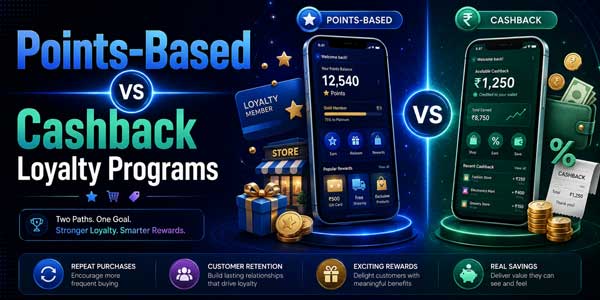
Customer acquisition cost is higher than customer retention cost. Retaining customers is the best investment any small business can make. A well-designed loyalty program helps small businesses retain customers by rewarding repeat purchases.
Two models dominate this market: the points-based loyalty program and the cashback loyalty program. Choosing the right one directly affects customer engagement, basket size, and long-term profitability. This article compares both models so small business owners can make informed decisions.
Table of Contents
What Is a Points-Based Loyalty Program?
A points-based loyalty program rewards customers with points for every purchase they make. These points accumulate over time and can be redeemed for discounts or free products. Earning more points with more purchases and getting discounts in the future encourages them to buy regularly.
Why Businesses Like Points Programs
Points programs give small businesses a flexible retention tool that rewards engagement at every level.
- Encourages Repeat Visits: Customers return frequently to accumulate points with each purchase, which increases frequency and consistent purchasing.
- Makes Customers Work Toward Rewards: Working toward a reward gives customers a reason to keep coming back, motivating customers to reach a redemption threshold rather than making one-off purchases.
- Creates a Sense of Achievement: Reaching a reward milestone and getting a discount generates a positive emotional response, associating satisfaction with the store.
- Easier to Customize Promotions: Points multipliers, bonus point events, and category-specific extra points offer businesses precise control over which behaviors and products they want to incentivize.
What Is a Cashback Loyalty Program?
A cashback loyalty program returns a fixed percentage of the customer’s total spend back to them in the form of cash credit, account balance, or store credit, which applies automatically at checkout on the total bill or is credited to their account for future use.
Businesses That Commonly Use Cashback:
The loyalty program cashback model is widely adopted across various retail categories where price sensitivity and purchase frequency require immediate rewards for high satisfaction:
- Supermarkets use cashback to reward consistent grocery shoppers who make high-volume purchases across multiple product categories.
- Fuel stations offer cashback per liter or gallon to retain price-sensitive drivers who actively compare fuel costs between nearby competitors.
- Pharmacies apply cashback on prescriptions and over-the-counter products to build repeat visit habits among health-conscious, frequent buyers.
- Large retail chains use cashback to attract customers of various categories, with easy-to-understand reward structures.
- Ecommerce stores issue cashback as store credit on completed orders, incentivizing the next purchases, reducing cart abandonment, and encouraging repeated visits.
Points-Based vs Cashback Loyalty Programs: Key Differences
Both models serve the same retention goal, but they work through fundamentally different customer psychology and deliver different outcomes for the business.
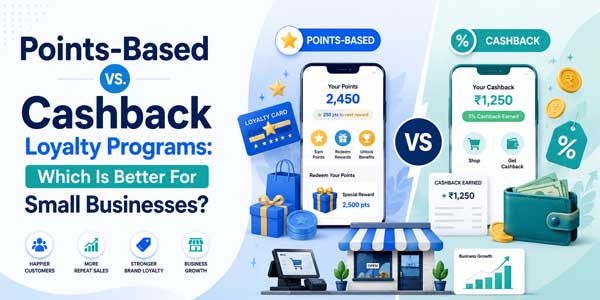
Here is a direct side-by-side comparison across ten parameters:
| Parameter | Points-Based Loyalty Program | Cashback Loyalty Program |
| Reward Type | Points/tokens | Cash or credit |
| Easy to Understand | Moderate | High |
| Customer Excitement | High | Moderate |
| Flexibility | High | Low |
| Custom Promotions | Yes | Limited |
| Gamification | Strong | Weak |
| Redemption Options | Multiple | Fixed |
| Best For | Engagement-focused retailers | Price-sensitive shoppers |
| Profit Margin Control | Strong | Limited |
| Customer Engagement | High | Moderate |
Advantages & Drawbacks of Points-Based Loyalty Program:
A points-based loyalty program delivers strong engagement for small businesses, but it carries operational trade-offs that need to be planned.
Advantages of Points-Based Loyalty Programs:
Points programs create behavioral incentives that go beyond simple discounting, rewarding the engagement patterns that build long-term customer value.
- Encourages Frequent Purchases: Customers return more often to accumulate points toward a reward threshold, and hence, such a loyalty program for small businesses turns occasional buyers into regular customers.
- Builds Long-Term Customer Loyalty: Points accumulate over time, and customers don’t like to lose them. Customers with accumulated points may be more motivated to continue shopping with a business so they can redeem their rewards.
- Creates Gamification: Milestone rewards, point multipliers, and bonus events make earnings feel like progress toward a goal, adding an engagement layer that a flat cashback loyalty program cannot replicate.
- Supports Tiered Rewards: Loyalty programs allow small businesses to configure tiered reward structures, offering increasingly valuable redemption options to higher-spending members, which drives average transaction value upward.
- Promotes Higher Spending: When customers know a higher transaction value earns more points, they naturally add items to reach the next earning threshold, increasing basket size per visit in a way that pure cashback mechanics do not.
Drawbacks of Points-Based Loyalty Programs:
Points-based programs sometimes take a long time to reach the goal, and this time-consuming process may create some disinterest over time, risking the failure of the program.
Here are some drawbacks of the points-based program:
- Complex Reward Structure: If the rules of earning points and redemption are not clear, customers disengage. A poorly explained points-based loyalty program creates confusion rather than motivation.
- Delayed Customer Gratification: Points are credited with purchases over time before they are accessible, which is slow, creating gaps for customers who like immediate rewards. A loyalty program cashback model has a clear advantage in this.
- Low Redemption Rates: Some customers earn and gather points without redeeming them, which reduces the behavioral impact that is the base of this program, which can reduce the program’s impact on retention.
- Reward Liability Accumulation: Unredeemed points are future obligations in the accounts of the business. Some customer loyalty programs for small business operations require a carefully structured design.
- Higher Administrative Effort: Configuring point multipliers, managing expiry rules, and tracking redemption behavior requires more ongoing management than a straightforward loyalty program cashback structure.
Advantages & Drawbacks of Cashback Loyalty Program:
A cashback loyalty program offers simplicity, appealing strongly to price-sensitive shoppers, but offers less flexibility for businesses that wish to shape buying behavior.
Advantages of Cashback Loyalty Programs:
Cashback programs remove uncertainty and doubts, making them among the easiest customer loyalty programs for small business owners to launch and explain.
- Easy for Customers to Understand: A cashback loyalty program is easy to understand: spend this amount and receive this credit back. There is no difficult math for converting points or redemption thresholds to explain at the register.
- Instant Value: Some cashback loyalty program structures return value immediately or within a short window, satisfying the customer’s desire for a tangible, immediate benefit from every purchase.
- Faster Customer Adoption: Since it’s a transparent mechanism and benefits are clear, the cashback programs typically see faster sign-up rates and quicker participation from new members than equivalent points programs.
- Strong Appeal for Price-Sensitive Customers: In categories where customers actively compare prices, a visible cashback percentage offers an important reason to choose your store.
Drawbacks of Cashback Loyalty Programs:
Cashback loyalty programs are transparent and attractive, yet they hold some potential drawbacks that need to be considered:
- Reduced Profit Margins: Every cashback reward issued is a direct cost. A loyalty program cashback model requires careful margin analysis before setting reward rates.
- Higher Reward Costs: High cashback rates driving purchasing behavior can quickly affect the margin on the very transactions, making budgeting a constant challenge.
- Limited Customer Excitement: Cashback is practical but rarely memorable. A cashback loyalty program does not create milestone satisfaction or a sense of achievement, as a points-based loyalty program generates over time.
- Lower Emotional Engagement: Cashback rewards feel transactional, which doesn’t build direct brand connection or make switching difficult. Customers in a loyalty program cashback model are often equally happy to take a competitor’s cashback offer instead.
- Easy for Competitors to Replicate: Any competitor can match or exceed the cashback rate without meaningful effort, making a cashback loyalty program a weak strategy compared to a gamified points experience.
Which Loyalty Program Is More Profitable for Small Businesses?
Profitability depends on how each model impacts the business’s margin structure, customer behavior, and reward budget, where each model affects costs and customer behavior differently.
Points Programs:
Points-based customer loyalty programs for small business operations give operators better scope to protect and grow margin over time.
- Lower Redemption Cost: Points can be structured with redemption values that protect margin, unlike cashback, where the cost per reward is fixed and immediately deducted from revenue.
- Flexible Reward Value: Businesses can configure point values, bonus multipliers, and redemption thresholds, giving operators control over the actual financial cost.
- Encouraging Larger Basket Size: Point multipliers on specific product categories or minimum spend thresholds drive customers to add items, directly increasing average transaction value that flat cashback structures do not.
- Easier Promotional Campaign: Bonus point events, category-specific earn rates, and limited-time multipliers give small businesses a cost-effective promotional boost, driving short-term traffic without permanently adjusting pricing.
Cashback Programs:
Loyalty program cashback structures offer financial predictability but with less flexibility to manage costs as the program scales.
- Direct Financial Incentive: Cashback provides a clear, tangible benefit, resonating with price-sensitive customers, and is easy to communicate at the point of sale (POS).
- Easier Budgeting: The cost per reward is fixed and predictable, making it straightforward to model the financial impact of the program before launching and forecast redemption costs against revenue.
- Predictable Customer Value: Because every enrolled customer earns the same rate, the revenue impact of a cashback loyalty program is relatively consistent and easier to track.
- Margin Considerations: For small businesses with thin margins, even a 2-3% cashback rate on high-volume stock keeping units (SKUs) can meaningfully compress profitability, making the points-based loyalty program model a structurally safer choice for most loyalty programs for small business applications.
Factors to Consider Before Choosing a Loyalty Program:
Selecting between a points-based loyalty program and a cashback loyalty program requires evaluating six operational and strategic factors specific to each business.
Business Goals:
If the primary goal is building long-term behavioral engagement and increasing average transaction value, a points-based loyalty program supports that objective better. If the goal is simply driving initial sign-ups and immediate repeat purchases from price-sensitive buyers, a loyalty program cashback model may deliver faster early results.
Profit Margins:
A cashback loyalty program is a fixed cost on every eligible transaction, which may be unsustainable in low-margin retail categories. A points-based loyalty program allows businesses to set redemption values that reflect actual margin available, making it a safer model for businesses with tight profit margins.
Customer Behavior:
Review existing purchase data before choosing a model. High-frequency, lower-basket shoppers typically respond better to immediate cashback rewards. Customers with higher average transaction values and longer purchase cycles are better candidates for point accumulation mechanics, rewarding total spend over time.
Reward Budget:
Establish a maximum monthly reward liability before configuring either program. A loyalty program for small businesses that issues more in rewards than it recovers incremental revenue is not a retention strategy anymore; it is a cost. Ensure that you track reward issuance against revenue growth in real-time.
POS Integration:
Both program types require direct POS integration to function reliably at the register, which allows you to sync transaction data, apply rewards automatically, and update customer profiles in real-time, eliminating the manual processes that create errors and staff friction at checkout.
Ease of Management:
A cashback loyalty program requires less ongoing configuration than a points-based loyalty program with multipliers and tiered structures. Small businesses with limited staff bandwidth should evaluate how much time the program will require to manage monthly and choose a platform that automates campaign triggers, coupon delivery, and reporting without manual intervention.
Best Practices for Running a Successful Loyalty Program:
A well-chosen program model only delivers results if it is executed consistently. These six practices apply to both points-based loyalty programs and cashback loyalty programs.
- Keep Earning Rules Simple. If customers cannot explain how they earn rewards in one sentence, the program is too complex. A simple, clear mechanism drives higher enrollment and sustained participation in any loyalty program for a small business structure.
- Make Rewards Attainable. A redemption threshold that takes twelve months to reach does not motivate behavior. Configure the program so members can earn a meaningful first reward within three to five visits, creating early positive reinforcement.
- Integrate with Your POS System. A direct platform to POS integration ensures rewards apply automatically at checkout, removing the manual steps that slow transactions and create staff errors at the register.
- Promote the Program at Checkout. The point of sale is the highest-conversion enrollment moment in retail. Train staff to mention the loyalty program at every transaction and display program signage at eye level near the register.
- Send Personalized Offers. A marketing automation tool integration allows businesses to trigger personalized email, short message service (SMS), and push notifications based on individual purchase history, making every campaign feel relevant rather than generic.
- Train Staff to Explain the Program. Staff who understand the cashback loyalty program or points-based loyalty program mechanics can answer customer questions confidently and promote enrollment naturally during the checkout conversation without a script.
Conclusion:
Both the points-based loyalty program and the cashback loyalty program are beneficial for a small business retention strategy, and both can drive measurable improvements in repeat purchases and customer lifetime value when designed well. Points programs offer greater flexibility, stronger engagement, and better margin control. Cashback programs offer simplicity and fast adoption among price-sensitive shoppers.
The right loyalty program for small businesses comes down to your margin structure, your customers’ buying behavior, and how much program complexity your team can manage. Evaluate those three factors before launching and choose the model built to serve the business you are running, not just the one that sounds the most appealing.
 About the Author:
James Kelly is a Content Strategist at Loyal N Save, specializing in customer engagement, retail technology, and loyalty strategies. He has expertise in executive communication, crisis messaging, and developing effective loyalty programs for small business solutions. James focuses on transforming complex technology challenges into clear, business-focused insights that help brands improve customer retention, strengthen customer relationships, and build successful loyalty programs.











Be the first to write a comment.