
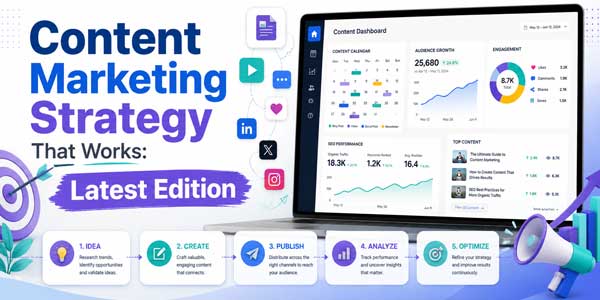
Content marketing in 2026 is no longer about publishing as many blog posts as possible and hoping Google sends traffic. Search algorithms, generative AI, social platforms, video consumption, changing buyer behavior, and increasingly crowded digital channels have forced marketers to become far more strategic.
A successful content marketing strategy in 2026 must connect audience research, SEO, subject-matter expertise, content creation, distribution, conversion, repurposing, and performance measurement into one coordinated system.
The companies winning with content are not necessarily publishing the most. They are creating the right content for the right audience at the right stage of the customer journey, then distributing and improving that content consistently.
This distinction matters because producing content has become dramatically easier. Generative AI can help marketers research, outline, summarize, brainstorm, repurpose, and accelerate production, which means simply producing more content is no longer a competitive advantage.
The Core Content Marketing Principle For 2026: Do Not Compete On Content Volume. Compete On Relevance, Expertise, Originality, Distribution, Trust, And Your Ability To Turn Attention Into Business Results.
This comprehensive guide explains how to build a content marketing strategy that actually works in 2026, including audience research, content planning, SEO, AI-assisted workflows, social distribution, email marketing, video content, conversion optimization, analytics, and long-term content growth.
Table of Contents
Why Content Marketing Changed So Much In 2026
The fundamental purpose of content marketing has not changed. Businesses still create useful information to attract, educate, influence, and convert audiences.
What has changed is the environment in which that content competes.
Audiences are surrounded by enormous volumes of articles, newsletters, social posts, podcasts, videos, AI-generated answers, advertisements, influencers, and branded content. At the same time, search engines and social platforms have become increasingly capable of filtering low-value material.
Several forces shaped content marketing strategy during 2026:
- Generative AI: Content production became faster and cheaper.
- Google Search Changes: Search quality systems increasingly emphasized useful, original, people-first content.
- Scaled Content Concerns: Publishing large quantities of low-value pages became a riskier SEO strategy.
- Short-Form Video Growth: Video remained central to social discovery and audience engagement.
- Zero-Click Search Behavior: Users increasingly found answers without necessarily visiting every source website.
- First-Party Audience Building: Email lists and communities became more important as businesses sought channels they could control.
- Measurement Pressure: Marketing teams faced stronger expectations to connect content with leads, pipeline, sales, and revenue.
This creates a simple strategic reality: content must now earn attention rather than merely occupy search-result space.
Start With Business Goals Instead Of Content Ideas
One of the most common content marketing mistakes is beginning with a list of article topics. A better strategy begins with the business outcome.
Ask what the content program is expected to achieve.
Possible goals include:
- Increase qualified organic traffic.
- Generate sales leads.
- Build brand awareness.
- Increase product trials.
- Grow email subscribers.
- Educate prospects.
- Shorten the sales cycle.
- Reduce customer-support pressure.
- Increase product adoption.
- Develop category authority.
- Improve customer retention.
- Support account-based marketing.
Each objective should produce a different content strategy.
A SaaS company trying to generate qualified demos should not measure success primarily through social-media impressions. An e-commerce brand focused on repeat purchases should not build its entire content program around broad informational keywords that rarely influence buying behavior.
Your content metrics should reflect your business objective.
Turn Business Objectives Into Content Goals
Suppose your business wants to generate 500 additional qualified leads during the year. Your content goal can then be broken into measurable components.
- Increase relevant search visibility.
- Grow qualified landing-page traffic.
- Create lead-generation assets.
- Improve calls to action.
- Build email nurture sequences.
- Track lead sources and conversions.
- Improve high-performing content quarterly.
This gives the content team a measurable system rather than an abstract instruction to create more content.
Understand Your Audience Before Choosing Keywords
SEO tools can tell you what people search for, but they cannot fully explain why a particular customer buys from you.
A strong content strategy starts with audience intelligence.
Understand:
- Who your ideal customers are.
- What problems they experience.
- What triggers them to search for a solution.
- What alternatives they currently use.
- What prevents them from buying.
- Which questions they ask before purchasing.
- Who influences the buying decision.
- What outcomes they actually want.
- Which terminology they use.
- Which channels they trust.
Where To Find Real Audience Insights
Do not rely entirely on imagined customer personas. Use real behavioral and qualitative data wherever possible.
Useful sources include:
- Customer interviews.
- Sales-call recordings.
- Support tickets.
- Live chat conversations.
- Customer reviews.
- Competitor reviews.
- Reddit discussions.
- Quora questions.
- YouTube comments.
- Search Console queries.
- Internal site-search data.
- CRM notes.
- Product analytics.
- Social-media conversations.
Your strongest content ideas are often hidden inside recurring customer questions.
If prospects repeatedly ask your sales team the same question, that question probably deserves a dedicated article, comparison page, video, FAQ, case study, or product guide.
Build Content Around The Customer Journey
Not every visitor is ready to purchase. Content should help prospects progress from awareness to evaluation and eventually conversion.
A practical content funnel can be divided into three broad stages.
Top Of Funnel Content
At the awareness stage, customers are researching a problem rather than actively comparing vendors.
Useful formats include:
- Educational blog posts.
- Beginner guides.
- Industry reports.
- Checklists.
- Short-form videos.
- Educational social posts.
- Podcasts.
- Templates.
- Glossaries.
The objective is primarily attention, education, and audience acquisition.
Middle Of Funnel Content
At this stage, prospects understand the problem and are comparing possible approaches.
Useful formats include:
- Detailed solution guides.
- Webinars.
- Case studies.
- Comparison content.
- Buyer guides.
- Research reports.
- Email courses.
- Calculators.
- Product demonstrations.
The objective is to establish trust, expertise, and solution preference.
Bottom Of Funnel Content
Bottom-of-funnel content helps prospects make a purchasing decision.
Examples include:
- Product comparison pages.
- Alternative pages.
- Pricing explanations.
- Customer success stories.
- ROI calculators.
- Implementation guides.
- Product demos.
- Free trials.
- Consultation pages.
Many content strategies fail because almost every article targets informational traffic while very little content supports commercial intent.
Traffic without a path toward conversion is media activity, not necessarily effective marketing.
Create A Topic Cluster Strategy Instead Of Random Blog Posts
One of the strongest ways to build topical authority is to organize content around meaningful subject areas.
Instead of publishing unrelated articles based on individual keyword opportunities, create topic clusters.
For example, a company selling project-management software could build a cluster around:
- Project management.
- Project planning.
- Task management.
- Team collaboration.
- Project reporting.
- Agile workflows.
- Resource planning.
- Project-management templates.
Each major subject can contain a pillar page supported by more specific articles.
Example Topic Cluster
A pillar guide titled Complete Guide To Project Management might link to supporting content covering:
- How To Create A Project Plan.
- Best Project Management Methodologies.
- Project Management Templates.
- How To Estimate Project Costs.
- How To Track Project Risks.
- Project Management KPIs.
- Best Project Management Tools.
Those pages should also link contextually back to the primary pillar and to each other where relevant.
This architecture improves navigation, creates stronger internal linking, and gives visitors a logical learning path through your expertise.
SEO In 2026 Requires People-First Content
Search engine optimization remains one of the most valuable content distribution channels, but the strategy has evolved.
Google’s major 2026 search changes placed even greater emphasis on content that provides meaningful value rather than material created primarily to capture search rankings.
This means marketers should stop treating SEO as a mechanical checklist based entirely on keyword repetition.
High-quality SEO content should demonstrate:
- Search Intent Alignment: Answer what the user actually wants.
- Original Value: Add information beyond what already ranks.
- Experience: Show evidence of genuine use, testing, analysis, or expertise.
- Depth: Cover the topic sufficiently without unnecessary filler.
- Clarity: Make important information easy to understand.
- Trust: Support important claims and identify authorship where appropriate.
- Usability: Deliver a strong mobile and page experience.
Search Intent Matters More Than Keyword Density
Consider someone searching for “best email marketing software.” That user probably wants comparisons, advantages, disadvantages, pricing, use cases, and recommendations.
A 4,000-word history of email marketing would technically contain relevant keywords but fail the actual intent.
Before writing any search-focused page, analyze:
- What is the searcher trying to accomplish?
- What type of page currently satisfies that query?
- What questions remain unanswered?
- What unique evidence can your brand contribute?
- What should the visitor do after reading?
Original Research And Experience Create A Content Moat
Generative AI can summarize information that already exists. That makes original information more strategically valuable.
Brands should increasingly create content AI systems cannot simply reconstruct from existing public material.
Examples include:
- Original surveys.
- Internal platform data.
- Customer benchmarks.
- Experiments.
- Product testing.
- Expert interviews.
- Case studies.
- Industry analysis.
- Original frameworks.
- First-hand experience.
Instead of publishing “10 Social Media Tips” based on generic advice, a marketing platform might analyze 100,000 social posts and report what actually correlates with engagement.
That information can then power articles, videos, LinkedIn posts, newsletters, webinars, PR outreach, downloadable reports, and sales collateral.
One strong proprietary insight can create dozens of differentiated content assets.
Use Generative AI As An Accelerator, Not A Content Factory
Generative AI became one of the biggest changes to content workflows entering 2026. It can dramatically improve productivity when used correctly.
Useful applications include:
- Topic brainstorming.
- Keyword clustering.
- Research assistance.
- Outline generation.
- Content gap analysis.
- Headline variations.
- Meta descriptions.
- Content repurposing.
- Transcript summarization.
- Email variations.
- Social-media drafts.
- Editing assistance.
The mistake is using AI as a system for publishing hundreds of nearly identical articles without meaningful editorial input.
In 2026, search engines increasingly emphasized a simple distinction: the problem is not automatically whether AI was involved. The problem is publishing scaled, low-value material primarily designed to manipulate visibility.
A Better AI-Assisted Content Workflow
- Human Defines The Strategy. Determine audience, intent, goal, angle, and positioning.
- AI Assists Research. Gather questions, concepts, terminology, and potential gaps.
- Human Verifies Sources. Validate factual claims using reliable information.
- AI Helps Structure. Generate potential outlines and content organization.
- Subject-Matter Expert Adds Insight. Include experience, examples, opinions, data, and original thinking.
- Human Editor Improves Quality. Remove repetition, generic phrasing, unsupported claims, and unnecessary text.
- SEO Review Aligns Intent. Optimize headings, entities, internal links, metadata, and discoverability.
- Final Review Protects Brand Quality. Verify accuracy and consistency before publication.
This approach uses AI to reduce production friction while keeping the content genuinely useful.
Short-Form Video Should Be Part Of Your Content Strategy
Written content remains valuable, particularly for search, education, and deep research. However, a 2026 strategy should not depend exclusively on articles.
Video has become essential for discovery, education, trust, product demonstration, and social-media engagement.
A single long-form article can generate:
- A YouTube video.
- Several YouTube Shorts.
- Instagram Reels.
- TikTok clips.
- LinkedIn video posts.
- Quote graphics.
- Carousel posts.
- Email content.
The key is not creating completely separate content for every platform. Build a content repurposing engine.
Use One Core Idea Across Multiple Formats
Suppose your company produces a research article titled “10 Conversion Trends From 5,000 E-Commerce Stores.”
That one research asset can become:
- A long-form SEO article.
- A downloadable PDF report.
- A webinar.
- A YouTube summary.
- Ten short videos.
- Several LinkedIn posts.
- An infographic.
- A newsletter sequence.
- A sales presentation.
- PR outreach.
This improves content economics because research and expertise are reused rather than recreated repeatedly.

Email Marketing Remains A Critical Content Distribution Channel
Search engines and social platforms are rented distribution. Algorithms determine how much of your audience sees your content.
Email provides a much more direct relationship.
A strong content marketing strategy should therefore convert a percentage of visitors into subscribers, leads, customers, or community members.
Useful email acquisition assets include:
- Newsletters.
- Templates.
- Checklists.
- Industry reports.
- Free tools.
- Email courses.
- Webinars.
- Calculators.
- Resource libraries.
Do Not Treat The Newsletter As A Link Dump
A weak newsletter simply announces newly published content. A strong newsletter becomes a product itself.
Give subscribers a reason to open it even when they have no intention of visiting your website.
Include original insights, curated resources, expert opinions, data, customer stories, practical frameworks, and meaningful recommendations.
The goal is not simply growing an email database. It is building an audience that expects value from your brand.
Distribution Must Be Planned Before Content Is Published
One of the biggest content marketing myths is that good content naturally gets discovered.
It usually does not.
Every important piece should have a distribution plan covering the channels where the intended audience already spends time.
Potential channels include:
- Google Search.
- Email newsletters.
- LinkedIn.
- YouTube.
- TikTok.
- Instagram.
- Facebook.
- Reddit.
- Communities.
- Influencer partnerships.
- Industry newsletters.
- Paid social media.
- Paid search.
- Webinars.
- Podcasts.
- Partner marketing.
Use A Distribution Checklist
For every major asset, determine:
- Which search queries should discover it?
- Which email segment should receive it?
- Which social platforms fit the topic?
- Which experts can contribute or share it?
- Which communities would genuinely benefit?
- Can partners help distribute it?
- Should paid promotion amplify it?
- Can it support sales outreach?
Create once, distribute repeatedly.
Create Content That Converts Without Becoming Overly Promotional
Content marketing should create business outcomes, but aggressively inserting product promotions into every paragraph damages credibility.
The better approach is contextual conversion.
If someone reads an article about improving website conversion rates, an appropriate CTA might offer a conversion checklist, audit, calculator, related product feature, or consultation.
Useful calls to action include:
- Download the guide.
- Subscribe to the newsletter.
- Use the calculator.
- View the template.
- Start a free trial.
- Book a demo.
- Compare plans.
- Read the case study.
- Watch the product demo.
Match The CTA To Buyer Intent
A visitor reading a beginner-level educational article may not be ready to book a sales call.
An email signup or downloadable resource may be a better next step.
A visitor reading “Your Product Vs Competitor” is much closer to a purchasing decision and may respond well to a demo or trial CTA.
Conversion architecture should reflect the maturity of the buyer.
Case Studies And Customer Stories Build Trust
Marketers often publish claims such as our product saves time, our software increases conversions, or our service improves performance.
A case study provides evidence.
Strong case studies include:
- Customer background.
- The original problem.
- Why previous approaches failed.
- The selected solution.
- Implementation process.
- Measurable results.
- Customer quotations.
- Lessons learned.
Avoid turning case studies into disguised advertisements.
The more specific the challenge and results, the more believable the story becomes.
Customer success stories can also be repurposed into sales presentations, social proof, landing pages, email campaigns, videos, and retargeting ads.
Update Existing Content Instead Of Always Creating New Pages
Content teams frequently underestimate the value of their existing library.
A website with hundreds of articles may gain more by improving its strongest existing pages than by publishing another hundred weak ones.
Conduct regular content audits and categorize pages into:
- Keep: Performing well and still accurate.
- Update: Valuable but outdated.
- Expand: Ranking but not fully satisfying search intent.
- Merge: Multiple pages compete for the same topic.
- Redirect: Page no longer deserves a separate URL.
- Remove: Thin or irrelevant content provides little value.
Look For Content Refresh Opportunities
Refresh pages when:
- Rankings begin declining.
- Statistics become outdated.
- Products or screenshots change.
- Search intent evolves.
- Competitors publish stronger resources.
- New questions emerge.
- Internal links can be improved.
Updating proven pages can produce a faster return than continuously creating content from zero.
Measure Content Performance Across The Entire Funnel
Website traffic alone is an incomplete content marketing metric.
A page can generate 100,000 visits while contributing almost nothing to revenue. Another page might receive 2,000 visits and influence hundreds of valuable sales opportunities.
Measure content at several levels.
Awareness Metrics
- Organic impressions.
- Search visibility.
- Website traffic.
- Video views.
- Social reach.
- New visitors.
Engagement Metrics
- Engaged sessions.
- Scroll depth.
- Time spent consuming content.
- Newsletter engagement.
- Video watch time.
- Social comments and shares.
Conversion Metrics
- Newsletter subscriptions.
- Lead magnet downloads.
- Trial signups.
- Demo requests.
- Qualified leads.
- Purchases.
Revenue Metrics
- Pipeline influenced by content.
- Revenue influenced by content.
- Customer acquisition cost.
- Lead quality.
- Conversion rate.
- Revenue per visitor.
The best KPI is the one aligned with the purpose of the asset.
Build A Sustainable Content Production System
A content strategy fails when it depends on individual heroics.
Create a repeatable process covering:
- Audience research.
- Topic selection.
- Keyword research.
- Content brief.
- Subject-matter expert input.
- Drafting.
- Fact checking.
- Editing.
- SEO optimization.
- Design.
- Publication.
- Distribution.
- Measurement.
- Content refresh.
Define who owns every stage and what quality standard must be met before the content moves forward.
Create A Practical Editorial Calendar
Your editorial calendar should contain more than titles and publication dates.
Track:
- Audience segment.
- Funnel stage.
- Primary topic.
- Search intent.
- Primary keyword.
- Content format.
- Author.
- Subject-matter expert.
- CTA.
- Distribution channels.
- Status.
- Publication date.
- Refresh date.
This transforms content marketing from a publishing activity into an operational system.
Use The 70-20-10 Content Investment Model
Teams need consistency, but they also need experimentation.
A practical content portfolio can allocate resources approximately as follows:
- 70% Proven Content: Formats, topics, and channels already known to perform.
- 20% Expansion Content: New variations on promising formats or adjacent audiences.
- 10% Experiments: New channels, formats, AI workflows, interactive content, or unconventional campaigns.
The percentages do not need to be exact. The purpose is to protect the core strategy while maintaining room for discovery.
If every campaign is experimental, the marketing engine becomes unpredictable. If nothing is experimental, the strategy eventually becomes outdated.
Common Content Marketing Mistakes To Avoid In 2026
- Publishing For Algorithms Instead Of People: Search optimization cannot rescue unhelpful content indefinitely.
- Using AI Without Editorial Oversight: Fast production is worthless if the result is generic or inaccurate.
- Creating Content Without Distribution: Publishing is only the beginning.
- Targeting Only High-Volume Keywords: Smaller commercial-intent queries can create greater business value.
- Ignoring Existing Content: Refreshing proven assets often produces strong returns.
- Measuring Only Traffic: Connect content performance with conversions and business outcomes.
- Writing Without Expert Input: Original expertise creates differentiation.
- Using The Same Content On Every Channel: Adapt the message to platform behavior.
- Ignoring Email: Build first-party audience relationships instead of depending entirely on algorithms.
- Overproducing: More content is not automatically better content.
A Step-By-Step Content Marketing Strategy For 2026
If you are building a strategy from scratch, follow this sequence.
- Define Business Goals. Determine whether content should generate awareness, leads, pipeline, sales, retention, or another outcome.
- Research Your Audience. Understand their problems, objections, terminology, behaviors, and decision process.
- Map The Customer Journey. Identify awareness, consideration, and purchase-stage questions.
- Conduct Keyword And Topic Research. Find demand that aligns with genuine audience needs.
- Build Topic Clusters. Organize content around subjects where the business can develop meaningful authority.
- Create A Content Calendar. Prioritize based on business value rather than publishing volume.
- Build Originality Into Production. Add experts, proprietary data, examples, experiments, and first-hand experience.
- Use AI Selectively. Automate low-value production tasks while keeping humans responsible for quality.
- Optimize For Search Intent. Create the page users actually need.
- Repurpose Strategically. Turn major ideas into articles, video, social posts, email, and sales assets.
- Distribute Aggressively. Use search, email, social media, communities, partners, and paid promotion where appropriate.
- Add Conversion Paths. Give every important content asset a logical next action.
- Measure Business Impact. Track visibility, engagement, conversions, leads, and revenue.
- Refresh Winners. Continuously improve content already demonstrating demand.
Final Content Marketing Strategy For 2026
A content marketing strategy that works in 2026 is not primarily a publishing calendar. It is a business growth system built around useful information and audience trust.
The strongest strategy starts with a specific audience and a measurable business goal. Content should then address real problems throughout the customer journey while building authority around topics directly connected to the company’s expertise.
SEO remains essential, but the objective should be satisfying search intent rather than manipulating ranking signals. Google’s 2026 direction reinforced the value of original, useful, people-first content and increased the risk of relying on scaled low-value publishing tactics.
Generative AI should improve research, ideation, production, and repurposing, but it should not replace expertise, original thinking, verification, or editorial judgment.
Brands should also stop thinking of blog posts as isolated assets. One strong idea can become a search article, newsletter, YouTube video, social-media series, webinar, lead magnet, presentation, and sales resource.
Distribution should receive as much planning as creation. Search, email, video, social platforms, partnerships, communities, and paid amplification should work together rather than operating as separate marketing activities.
Finally, measure the outcome that actually matters.
Traffic is useful. Rankings are useful. Engagement is useful. But successful content marketing ultimately needs to contribute to brand growth, audience growth, leads, customer acquisition, retention, pipeline, or revenue.
The winning content strategy for 2026 is simple in principle: understand your audience better, create something genuinely worth consuming, distribute it intelligently, connect it to business outcomes, and continuously improve what already works.
Everyday Reader Frequently Asked Questions
What Is A Content Marketing Strategy?
A content marketing strategy is a structured plan for creating, distributing, and measuring useful content designed to attract a defined audience and achieve specific business goals. It typically includes audience research, SEO, content formats, distribution channels, conversion paths, and performance measurement.
What Is The Best Content Marketing Strategy For 2026?
The strongest strategy in 2026 combines people-first SEO content, original expertise, generative AI-assisted workflows, video, email audience building, multi-channel distribution, content repurposing, and measurement tied to real business outcomes rather than publication volume alone.
Does Content Marketing Still Work In 2026?
Yes. Content marketing remains highly valuable when it solves real audience problems and supports measurable business objectives. However, generic articles created only to attract search traffic are increasingly less effective than original, expert-led, well-distributed content.
How Can AI Be Used In Content Marketing?
AI can support research, brainstorming, keyword clustering, outlines, editing, repurposing, social-media variations, summarization, and workflow automation. Human experts should still verify facts, contribute original insight, define strategy, and maintain editorial quality.
How Do You Measure Content Marketing Success?
Measure content according to its purpose. Useful metrics include organic visibility, website engagement, newsletter growth, qualified leads, trial signups, conversion rate, pipeline influence, customer acquisition, and revenue attributed or influenced by content.













Be the first to write a comment.