
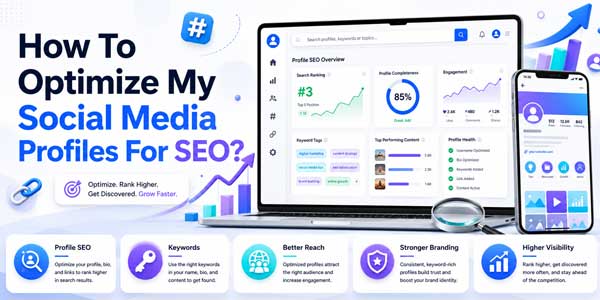
Social media profiles are no longer just places to publish updates and collect followers. A well-optimized profile can help people discover your brand through Google, Bing, LinkedIn, YouTube, TikTok, Instagram, Facebook, Pinterest, and other search-driven platforms.
This matters because modern search behavior is fragmented. Someone researching you, your business, or a service may search Google first, while another potential customer may search directly inside TikTok, YouTube, LinkedIn, Instagram, or another social platform.
A strong social media SEO strategy therefore needs to optimize for two different environments at the same time: traditional search engines and the search systems built into individual social networks.
The goal is not to stuff every profile with keywords. The goal is to make it extremely clear who you are, what you do, who you help, what topics you are associated with, and where users should go next.
Quick SEO Principle: Your Social Profiles Should Use Consistent Branding, Relevant Keywords, Clear Expertise Signals, Crawlable Public Information, And Strong Links Back To Your Website While Remaining Useful To Real People.
This guide explains how to optimize social media profiles for SEO step by step, including usernames, names, bios, descriptions, profile URLs, links, platform-specific keywords, branding, content, schema markup, and methods for increasing your visibility across both social search and Google.
Table of Contents
What Social Media SEO Actually Means
Social media SEO is the process of optimizing profiles and social content so they are easier to discover through search.
There are two major forms of social SEO:
- External Search SEO: Helping profiles appear when people search Google, Bing, or another search engine.
- Internal Platform SEO: Improving discoverability when people search directly inside LinkedIn, TikTok, YouTube, Instagram, Facebook, Pinterest, or other platforms.
These systems do not work identically.
Google may evaluate a public social profile as a crawlable webpage, while a social network may use its own combination of profile information, content relevance, user behavior, connections, popularity, personalization, and search intent.
This means optimizing only your bio is not enough. Your profile, content, links, brand consistency, authority, and activity should work together.
Can Social Media Profiles Rank On Google?
Yes. Public social profiles can appear in Google and other search engines, particularly for brand names, personal names, company names, creators, executives, products, and professional searches.
LinkedIn, for example, explicitly allows public profiles to be visible to search engines such as Google and Bing when appropriate visibility settings are enabled.
YouTube channels and videos can also appear prominently in Google search results, especially for branded queries, tutorials, reviews, demonstrations, interviews, and informational searches.
Google also supports structured information related to profile pages and provides mechanisms such as sameAs properties that websites can use to connect an organization or person with external profile URLs.
This creates an important brand SEO opportunity.
If someone searches your company name, an ideal search results page might contain:
- Your official website.
- Your LinkedIn profile or company page.
- Your YouTube channel.
- Your Instagram profile.
- Your Facebook page.
- Your X profile.
- Your other trusted brand properties.
This is sometimes called SERP ownership because your legitimate brand assets occupy more of the search results surrounding your name.
Start With One Primary Keyword Theme Per Profile
Before editing your profiles, decide what you want people to associate with you.
A common mistake is trying to target every service and keyword in a tiny profile description.
Instead, define a primary keyword theme.
For example, a product designer might target:
- Product Designer.
- SaaS UX Designer.
- UX Consultant.
- AI Product Designer.
- Conversion Optimization Expert.
A digital agency might target:
- Digital Marketing Agency.
- SEO Agency.
- Web Development Company.
- AI Development Agency.
- E-Commerce Marketing Agency.
You can then build secondary semantic terms around that core positioning.
If your primary keyword is SaaS Product Design, related phrases might include UX strategy, SaaS UX, dashboard design, user experience, product strategy, onboarding optimization, and conversion design.
The result should read naturally. Keyword relevance helps discovery, but repetitive keyword stuffing makes a profile look unprofessional.
Optimize Your Username And Social Media Handle
Your username or handle is one of the strongest identity signals across social platforms because it appears repeatedly in profile URLs, mentions, comments, shares, and search results.
Whenever practical, use a handle that is:
- Short.
- Easy to spell.
- Easy to remember.
- Consistent across platforms.
- Closely connected to your real name or brand.
- Free from unnecessary numbers and punctuation.
For example:
Better: @AdeelDesign
Weaker: @AdeelDesign98743Official
Brand consistency is particularly important when people move between Google and social networks.
If your Instagram account is @GrowthFoundry, your YouTube account is @GrowthFoundryAgency, your LinkedIn company is Growth Foundry, and your domain is growthfoundry.com, the connection between those entities is relatively easy for users to understand.
Should You Put Keywords In Your Username?
Use keywords only when they fit your real brand identity.
Changing a clean company name like PixelNova to PixelNovaBestWebDesignSEOAgency is not an SEO improvement.
For personal brands, however, adding a profession can sometimes create useful context when a simple name is unavailable. A handle such as @SaraUXDesign may be more descriptive than a random numeric variation.
Optimize Your Profile Name Or Display Name
Your username and display name are usually separate fields, and both can contribute to discoverability depending on the platform.
Your display name should immediately identify either your real identity, company, or specialty.
Examples include:
- Adeel Khan | Product Designer
- Nova Labs | AI Development
- Sarah Malik | Fitness Coach
- GrowthHub | SEO Agency
Do not force keywords into every available character.
A professional format combines brand recognition with search relevance.
Write An SEO-Friendly Social Media Bio
Your bio is one of the most important profile optimization areas because it explains what your account represents.
A high-performing social bio should answer four questions quickly:
- Who Are You?
- What Do You Do?
- Who Do You Help?
- What Should The Visitor Do Next?
A weak bio might say:
“Helping dreams become reality. Think big. Work hard.”
It sounds inspirational but provides almost no search or business context.
A more useful version would be:
“SaaS Product Designer Helping Startups Improve UX, Onboarding, Conversion And Retention. View Product Design Case Studies Below.”
This naturally contains semantic terms such as SaaS, product designer, UX, onboarding, conversion, and retention without looking like a search engine manipulation tactic.
A Simple Social Bio Formula
Use this structure:
[Primary Role Or Business] + [Target Audience] + [Main Outcome] + [Proof Or Differentiator] + [CTA]
Example:
“SEO Consultant Helping SaaS Companies Grow Qualified Organic Traffic Through Technical SEO And Content Strategy. Explore My SEO Case Studies.”
Keep Your Brand Information Consistent Everywhere
One of the most underrated social SEO practices is entity consistency.
Your profiles should present the same fundamental identity across platforms.
Keep the following information consistent where appropriate:
- Brand name.
- Personal name.
- Username.
- Logo.
- Profile photo.
- Main description.
- Website URL.
- Business category.
- Location.
- Contact information.
- Primary services.
Consistency helps users immediately recognize the official account and reduces confusion with duplicates or impersonators.
It can also strengthen the relationship between your website and external brand properties when search systems evaluate public information about your business.
Use A Clean And Consistent Profile URL
Where platforms permit custom URLs, claim a clean URL that reflects your brand or personal identity.
LinkedIn specifically allows members to create custom public profile URLs and recommends using a variation of a name or professional brand.
A clean URL looks more trustworthy when it appears in:
- Google search results.
- Email signatures.
- Business cards.
- CVs.
- Guest articles.
- Press releases.
- Speaker profiles.
- Author bios.
Compare:
Better: linkedin.com/in/adeelkhan
Weaker: linkedin.com/in/adeel-khan-98462b738
A custom URL is not a magic ranking factor, but it improves identity consistency, usability, memorability, and professional presentation.
Make Sure Important Profiles Are Public And Indexable
You cannot expect search engines to surface information they cannot access.
Review the privacy and public visibility settings for profiles you want people to discover.
LinkedIn, for example, allows users to control whether their public profile and individual profile sections can appear outside LinkedIn, including in search engines.
Facebook also provides settings related to whether external search engines can link to profiles.
That does not mean every personal account should become public. Privacy should always come first.
Important: Only Make Information Public If You Intentionally Want Customers, Recruiters, Partners, Search Engines, And The Wider Internet To Discover It.
For businesses, creators, consultants, public professionals, and commercial brands, maintaining clearly accessible official profiles usually makes strategic sense.
Link Your Website And Social Profiles Together
Your website and social accounts should form a connected ecosystem.
Add your official website to relevant social profiles, and link from your website back to your primary social properties.
Good locations for social links on a website include:
- Footer.
- Contact page.
- About page.
- Author pages.
- Team pages.
- Press page.
Avoid adding dozens of low-priority social icons simply because accounts exist.
Link to profiles that are actively maintained and genuinely represent your brand.
Use Schema Markup To Connect Your Brand Profiles
If you control your own website, structured data can provide additional machine-readable context.
Google’s Organization structured data documentation supports the sameAs property for external pages containing information about an organization, including social or review profiles.
A simplified implementation could look like:
<script type="application/ld+json">
{
  "@context": "https://schema.org",
  "@type": "Organization",
  "name": "Example Company",
  "url": "https://www.example.com",
  "sameAs": [
    "https://www.linkedin.com/company/example",
    "https://www.instagram.com/example",
    "https://www.youtube.com/@example"
  ]
}
</script>
For a personal website or author profile, Person or ProfilePage structured data may also be appropriate depending on the page.
Structured data should accurately describe visible, legitimate relationships. Do not add unrelated or unofficial profiles.
How To Optimize LinkedIn For SEO
LinkedIn deserves special attention because it functions as both a social network and a professional search database.
Public LinkedIn profiles can also appear in Google and Bing results.
Optimize the following areas:
- Custom Profile URL: Use your name or professional brand.
- Name: Use your authentic professional identity.
- Headline: Clearly describe your expertise and target value.
- About Section: Naturally include relevant services, industries, and expertise.
- Experience: Explain what you actually achieved instead of listing only job titles.
- Skills: Add relevant professional capabilities.
- Featured Section: Showcase case studies, portfolio work, articles, or projects.
- Public Visibility: Ensure appropriate sections are accessible if Google visibility matters.
How To Write A Better LinkedIn Headline
A weak headline:
Founder At Example Company
A stronger search-oriented version:
Founder At Example Company | SaaS Product Strategy | UX Design | AI Product Development
The second version gives recruiters, clients, users, LinkedIn search, and external searchers far more context.
LinkedIn also measures profile appearances, including appearances in LinkedIn search, feeds, comments, and recommendations. Tracking profile appearances after optimization can help determine whether visibility is improving.
How To Optimize Instagram For SEO
Instagram increasingly behaves like a discovery engine, particularly for products, creators, locations, services, visual inspiration, restaurants, travel, fitness, fashion, beauty, and lifestyle topics.
Start with the profile itself.
- Username: Keep it recognizable and consistent.
- Name Field: Use your real name, brand, or relevant specialty naturally.
- Bio: Clearly explain your niche, audience, and offer.
- Category: Choose an accurate professional category where available.
- Website Link: Send users to the most relevant destination.
- Profile Photo: Use consistent visual branding.
- Public Visibility: Public professional accounts have stronger discovery opportunities than private accounts.
Your content also influences Instagram discovery.
Use descriptive language in captions, naturally mention the topic being discussed, add relevant location information when meaningful, and use focused hashtags rather than unrelated high-volume tags.
For example, a Karachi fitness studio posting about personal training might naturally include phrases related to personal training, strength training, fitness coaching, Karachi gym, and workout programs within useful content.
Do not turn every caption into a keyword list.
How To Optimize YouTube For SEO
YouTube is one of the most important search-driven social platforms because users actively search for tutorials, reviews, comparisons, explanations, entertainment, products, and solutions.
YouTube also integrates strongly with Google search.
Optimize your channel profile through:
- Channel Name: Keep it aligned with your brand.
- Handle: Choose a recognizable @handle.
- Channel Description: Clearly explain the topics and audience.
- Profile Picture: Use recognizable branding.
- Banner: Communicate your value proposition visually.
- Links: Add your website and important destinations.
- Channel Sections: Organize content around major topics.
- Playlists: Group related videos into searchable content clusters.
YouTube confirms that handles can be searched directly using the @ symbol and that each handle creates a corresponding YouTube channel URL.
Optimize Your Videos As Well As Your Channel
A perfectly optimized profile will not compensate for unclear video topics.
YouTube recommends focusing particularly on:
- Titles.
- Descriptions.
- Thumbnails.
Your video title should make the content immediately understandable.
Instead of:
“You Need To See This!”
Use:
“How To Improve SaaS User Onboarding: 7 UX Strategies”
The second title is clearer for both humans and search-driven discovery.
How To Optimize TikTok For SEO
TikTok is no longer only a feed-driven entertainment platform. Search plays a meaningful role in how users discover tutorials, places, products, trends, answers, reviews, recipes, services, and educational content.
TikTok itself has introduced Creator Search Insights, a tool designed to show creators topics people are actively searching for.
Optimize your profile by keeping your:
- Username recognizable.
- Display name clear.
- Bio focused on your niche.
- Profile photo consistent.
- Main website link relevant where available.
Then create content around actual search demand.
If you are a fitness coach, a video titled and spoken around “How To Fix Your Squat Form” has a much clearer search purpose than an abstract caption such as “Today’s Motivation.”
Use natural keywords in:
- Spoken content.
- On-screen text.
- Captions.
- Relevant hashtags.
The objective is not to repeat the same phrase constantly. It is to make the content topic unmistakable.
How To Optimize Facebook Profiles And Pages For SEO
Facebook remains important for businesses, local services, organizations, communities, events, and branded searches.
For business visibility, optimize your Facebook Page rather than relying only on a personal account.
Review:
- Page name.
- Username.
- Category.
- About information.
- Business description.
- Website.
- Phone number.
- Address.
- Opening hours.
- Services.
Facebook usernames also create customized profile or Page URLs, making a clean brand username useful for consistency.
Local businesses should keep their core business details aligned across Facebook, their website, Google Business Profile, directories, and other major platforms.
How To Optimize Pinterest For SEO
Pinterest behaves much more like a visual search and discovery engine than a traditional social feed.
Businesses in niches such as interior design, food, fashion, beauty, travel, DIY, weddings, fitness, e-commerce, and education can benefit significantly from keyword-focused optimization.
Optimize:
- Profile name.
- Username.
- Profile description.
- Website connection.
- Board names.
- Board descriptions.
- Pin titles.
- Pin descriptions.
Create boards based on real topic clusters instead of vague names.
For example:
Better: SaaS Dashboard Design Inspiration
Weaker: Cool Stuff
Descriptive organization helps users immediately understand your content themes.
How To Optimize X Profiles For Search Visibility
An X profile can become important for founders, technology companies, journalists, developers, investors, creators, and industry experts.
Optimize the fundamentals:
- Use a recognizable handle.
- Use your real name or official brand name.
- Explain your expertise in the bio.
- Add your website.
- Use an accurate location where useful.
- Pin a high-value post that introduces your expertise, product, or strongest resource.
A good pinned post acts like an extended landing page for people discovering your account for the first time.
Publish Content Around Consistent Topic Clusters
Profile optimization is only the foundation.
If your bio says you are an expert in SaaS UX but every post discusses unrelated news, memes, cryptocurrency, gym workouts, and travel, the topical identity of your account becomes unclear.
Choose three to five primary content pillars.
A product designer might use:
- SaaS UX.
- AI Product Design.
- User Onboarding.
- Conversion Optimization.
- Product Strategy.
Consistently publishing useful content within those clusters helps audiences associate your profile with specific expertise.
Use Social Content To Support Website SEO
Social media is not a substitute for website SEO, but the two channels can reinforce each other.
When you publish a strong article, guide, tool, report, or case study:
- Publish The Main Resource On Your Website.
- Create A LinkedIn Post Explaining The Main Insight.
- Create A YouTube Video Around The Topic.
- Create Short TikTok And Instagram Videos.
- Share Visual Insights On Pinterest Where Relevant.
- Link Users Back To The Most Useful Website Resource.
This creates multiple discovery points around one core topic.
It also increases the chance that journalists, bloggers, customers, or industry professionals discover and reference your original work.
Do Social Signals Directly Improve Google Rankings?
This is one of the most misunderstood areas of social SEO.
You should not assume that simply gaining more likes, followers, shares, or comments directly increases the Google ranking of your website.
There is no official Google guidance establishing follower count as a straightforward ranking factor for normal web pages.
However, social media can influence SEO indirectly in several meaningful ways.
- More people discover your content.
- Journalists can find your research.
- Bloggers may reference your resources.
- Branded searches can increase as awareness grows.
- Social profiles can occupy branded search results.
- Content distribution can create backlink opportunities.
- Strong creators can build recognized expertise around specific topics.
The right way to think about social media is therefore distribution, discovery, reputation, and brand reinforcement, not as a shortcut for manipulating Google rankings.
Create A Social Profile SEO Checklist
Use this checklist across every important platform.
- Claim A Consistent Username.
- Use A Clear Brand Or Professional Name.
- Add One Primary Keyword Theme.
- Write A Clear Keyword-Relevant Bio.
- Use A Consistent Profile Image Or Logo.
- Add Your Official Website.
- Complete All Important Profile Fields.
- Enable Appropriate Public Visibility.
- Use A Clean Custom URL Where Available.
- Link Your Website Back To Your Profiles.
- Add Legitimate Social URLs To Relevant Schema Markup.
- Publish Around Consistent Topic Clusters.
- Use Search-Oriented Content Titles And Captions.
- Keep Business Information Updated.
- Track Search And Profile Visibility.
Measure Whether Your Social SEO Is Working
Profile optimization should produce measurable improvements over time.
Track:
- Profile views.
- Profile appearances.
- Search impressions where platforms provide them.
- Website clicks from social profiles.
- Branded Google searches.
- Search traffic to social profiles.
- Follower quality.
- Direct inquiries.
- Lead generation.
- Video search traffic.
- Social referral traffic.
Use analytics parameters such as UTM tags when appropriate so you can identify which profiles and campaigns send valuable traffic.
Do not evaluate social SEO only by follower count.
A profile with 8,000 highly relevant followers and consistent qualified inquiries can be commercially far more valuable than one with 100,000 unrelated followers.
Common Social Media SEO Mistakes To Avoid
- Keyword Stuffing: Bios should be readable and persuasive.
- Different Branding Everywhere: Inconsistency weakens recognition.
- Random Usernames: Use memorable, professional handles.
- Incomplete Profiles: Fill out relevant public fields.
- Ignoring Public Visibility: Search engines cannot surface information they cannot access.
- Using Only Hashtags: Social SEO involves much more than hashtags.
- Posting Unrelated Topics Constantly: Build recognizable content expertise.
- Ignoring Your Website: Social profiles should support assets you own.
- Buying Followers: Artificial follower numbers provide weak business value.
- Using Clickbait Without Topic Clarity: Search discovery requires understandable content.
- Never Updating Profiles: Old services, titles, and broken links damage trust.
Advanced Strategy For Dominating Branded Search Results
If your objective is to control more of the first Google results page for your brand or personal name, optimize your entire digital entity rather than one profile at a time.
A strong strategy looks like this:
- Build A Strong Official Website.
- Create A Detailed About Or Author Page.
- Maintain Major Social Profiles.
- Use The Same Brand Identity Across Platforms.
- Link Official Profiles From Your Website.
- Use Accurate Organization Or Person Structured Data.
- Publish Original Content Consistently.
- Earn Mentions From Trusted External Websites.
- Keep Profiles Active And Current.
This produces something much more valuable than a few extra social impressions.
It creates a recognizable search presence around your identity.
Final Strategy For Optimizing Social Media Profiles For SEO
Optimizing social media profiles for SEO starts with clarity.
Search engines and users should quickly understand your identity, expertise, business category, main topics, website, and relationship with your other official digital properties.
Start by choosing consistent usernames, profile names, images, and URLs. Write concise bios containing relevant keywords naturally, complete important profile fields, and ensure commercial profiles have the appropriate public visibility settings.
Then connect your social profiles with your website. Use official website links in social bios, link back to active profiles from your website, and implement appropriate Organization, Person, or ProfilePage structured data where relevant.
Platform-specific optimization matters too. LinkedIn benefits from a strong headline, About section, professional expertise, and public visibility. YouTube requires clear channel positioning plus searchable titles and descriptions. TikTok increasingly rewards content aligned with real search demand. Instagram benefits from strong identity, topical consistency, descriptive captions, and clear profile positioning.
Finally, remember that social SEO is not about tricking algorithms.
The strongest profile is the one that communicates expertise clearly, publishes consistently around relevant topics, builds legitimate authority, and makes it easy for users to move between search engines, social platforms, and your owned website.
Optimize For Discovery First, But Always Design The Profile For The Human Who Actually Finds You.
Everyday Reader Frequently Asked Questions
How Do I Optimize My Social Media Profile For SEO?
Use a consistent username, clear profile name, relevant keywords in your bio, a professional profile image, your official website URL, complete profile information, and appropriate public visibility settings. Publish consistently around a small number of relevant topic clusters so both users and platform search systems can understand your expertise.
Do Social Media Profiles Help Google SEO?
Social profiles can help with branded search visibility, content discovery, reputation, referral traffic, and opportunities for mentions and backlinks. However, you should not assume that followers or likes directly increase normal Google rankings.
Can Social Media Profiles Rank On Google?
Yes. Public profiles from platforms such as LinkedIn, YouTube, Facebook, Instagram, X, and other major networks can appear in Google search results, particularly for personal names and branded searches. Visibility depends on the platform, privacy settings, query, and search engine indexing.
What Keywords Should I Put In My Social Media Bio?
Use keywords that describe your real profession, business, services, niche, target audience, or expertise. For example, a SaaS designer might naturally use terms such as SaaS Product Design, UX Strategy, User Onboarding, Dashboard Design, and Conversion Optimization.
Should I Use The Same Username On Every Social Media Platform?
Using the same or very similar username across platforms is recommended when possible because it improves brand consistency, recognition, memorability, and trust. If your exact username is unavailable, choose a simple professional variation rather than adding random characters or numbers.




![Facebook-Your-Page-Is-Not-Recommendable-[SOLVED]](https://www.exeideas.com/wp-content/uploads/2023/06/Facebook-Your-Page-Is-Not-Recommendable-SOLVED-300x150.jpg)








Be the first to write a comment.