

It’s quite typical for software bugs to be spotted by the developers in the initial stages of application development. But sometimes these issues only occur even after deployment.
In addition, software defects or bugs are not always a problem for the product developer. Rather, customers usually do not even see the product. And then there’s some other problem which has nothing to do with the defects. The actual issue for a company is finding a solution quickly without compromising its release schedule or customer experience, or overburdening its internal development team.
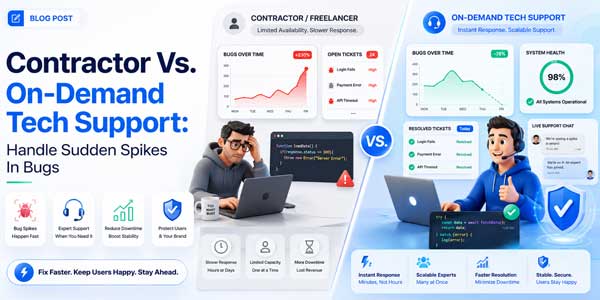
When additional technical expertise is required, organizations generally consider two options: hiring contractors or using on-demand tech support. Both of these methods can get a team to a problem pretty instantly. Yet if you look at the pros and cons of each one, like availability, flexibility, and team makeup, you’ll see differences.
By getting familiar, any organization is better equipped to decide on support models that fit the project’s scope, urgency, and other operational factors in the long run.
Table of Contents
Why Do Bug Spikes Occur?
Nearly all software applications nowadays get built utilizing different technologies with cloud platforms, APIs, external resources, payment gateways, analytics tools, and numerous other integrations. Troubleshooting bugs becomes more complicated when applications are increasingly interlinked. Because it is hard to determine which part of the system is faulty, and it also takes more effort to fix all the interconnected parts.
Many times, bug spikes happen not because of one coding error but because several components of the system have been changed. Some such instances are:
- Launching new features of a product
- Upgrading a platform or setup
- Changes to an external provider’s API
- Heavy advertising campaign periods
- Spikes in the number of users visiting the website
- Transferring data to a database
- Implementing a security update
- Scaling of the hardware
There are situations where even the engineering department can look after regular updates and fixes, but when there is a flood of technical problems within a short time.
Understanding Different Technical Support Models:
In order to keep up with fluctuating workloads for software development, companies have resorted to various workforce models.
Each of these has its unique pros, and the right one depends on the project’s life cycle, technical complexity, and key areas of interest.
The major ones are:
- Full-time staff employed by the company
- Freelancers with their own practice
- Staff augmentation
- Outsourced IT support
Contrary to the assumption that they replace each other, these models are more likely to coexist and support each other at various stages of software development:
What Is an IT Contractor?
An IT contractor is a technology expert working for a limited time only or a specific project. Companies employ such a person mostly when they lack in-house specialists with the necessary skills and need to address the problem quickly.
Here are the kinds of things that a contractor might do
- Create backend code
- Let the systems grow with new infrastructure
- Implement better security measures
- Optimize databases
- Migrate to the cloud
- Update platforms
Since contractors work on their own most of the time, a host organization still needs to ensure they set the right goals for the project. It ensures that everything is documented and helps the contractor understand how the company does business.
What Is On-Demand Tech Support?
Unlike individual contracting, on-demand tech support gives you a team of technical professionals available whenever you need more resources.
To get the support you’re asking for, you might have to work your way through several different kinds of professionals – developers, quality assurance engineers, DevOps specialists, cloud engineers, frontend developers, backend developers, or platform-specific experts – all of whom will depend on your business requirements.
If it was not necessary to hire a whole new staff with each occurrence, the solution was a great way to gain quick access to a range of experienced professionals who were ready to tackle different challenges at the same time.
The model is typically applied during what comes next instances:
- Rollouts or launches of new products
- Major shopping events with heavy traffic
- Unexpected production issues
- Coding periods when a new version of code is released
- Major upgrades of hardware or system components of a network
If there is any sudden overload of work that only lasts for a certain period of time.
Contractor vs On-Demand Tech Support:
When it comes to contractor versus on-site tech support, factors that really help in such a discussion are the type of work being done and not so much the inherent superiority of one model over the other.
Contractors typically provide services as individual specialists working on a single assigned project. A Contractor’s specialized skills will be extremely helpful when dealing with project types that require long-lasting technical expertise.
On-call support is more about ensuring operational flexibility through offering ready access to many different technical skill sets at short notice when business demands spike.
On-Demand Tech Support vs. IT Contractor:
When comparing on-demand tech support vs IT contractor, businesses typically evaluate four areas:
Availability:
Contractors usually require sourcing, interviews, contractual agreements, and onboarding before contributing to a project.
On-demand support teams are generally structured for quicker deployment when immediate technical assistance is required.
Team Structure:
A contractor normally works as an individual contributor.
On-demand support may include multiple specialists working together across development, testing, infrastructure, and support functions.
Flexibility:
Contractor engagements are generally fixed for a defined period.
On-demand services can often expand or reduce resources based on changing project needs.
Knowledge Coverage:
One contractor brings expertise in a particular discipline.
Technical support teams can provide broader knowledge across several technologies simultaneously.
Staff Augmentation vs On Demand Hiring:
Many organizations also compare staff augmentation vs. on-demand hiring when planning resource expansion.
Even though they both result in a rise in the level of technical capabilities, there is a different operational context for which each one is used.
Staff augmentation is a way of adding skilled personnel externally to the already functioning internal teams, and the collaboration lasts in a moderate- or long-term manner. The developers will normally join in the daily stand-ups, help plan the work at the beginning of each sprint, and be a part of the product development.
The essence of on-demand hiring is to give technical help only in cases when more capacity is urgently required. Without getting into long-term commitments, resources can be easily adjusted based on project workloads.
Temporary Developer vs. On-Demand QA:
During software incidents, businesses often focus primarily on adding developers.
However, comparing temporary developer vs. on-demand QA highlights an important distinction.
Developers mostly focus on fixing bugs and making code changes.
Rather than testing the code themselves, QA testers make sure the changes work as expected through many testing practices: regression, compatibility, automation, performance & release verification.
Organizing a proper workflow in which the developers and the QA team coordinate is essential for any organization.
Choosing the Right Support Model:
There is no universal solution that fits every business.
Organizations should evaluate several factors before selecting a support model, including:
- Expected project duration
- Required technical expertise
- Time available for recruitment
- Internal management capacity
- Application complexity
- Budget flexibility
- Frequency of production incidents
Some companies keep permanent engineering teams running, with them adding in temporary specialists at the time of major releases or peak seasonal demands. Whereas others go for resource models which are flexible enough so that their response time can be increased without their getting stuck with long-term hiring plans.
Quite often, even organizations hire developers on demand only when they need a particular skill for a very short period, which enables them to resolve the technical issues quickly and without the overheads of expanding their permanent staff.
The Hidden Cost of Delaying Bug Fixes:
Unresolved software defects that accumulate over long periods of time result in consequences much more severe than just the technical aspect. A bug may not look serious from one perspective, but after some time, it will start affecting customer satisfaction, employee productivity, and generally the whole business performance.
An e-commerce company, for instance, with a non-working checkout button or a system that miscalculates the item price might lead to shopping cart abandonment and the consequent loss of revenue.
A SaaS software organization can lose customers due to frequent login glitches or application crashes. In fact, postponing bug fixing leads to growing technical debt. As developers keep introducing new features on top of unresolved bug-ridden code, it becomes a nightmare to maintain that piece of software. Also, future updates will take lots of additional test efforts.
Companies need to understand that managing software bugs is an essential part of their product strategy instead of just treating it as another maintenance task only for the developers.
When Does On-Demand Tech Support Make the Most Sense?
Although every business has different operational requirements, there are several situations where flexible technical support becomes particularly valuable.
Product Launches:
Launching a new feature or application often places additional pressure on development teams. Unexpected compatibility issues, deployment failures, or customer-reported bugs may appear immediately after release. Having additional specialists available allows teams to investigate and resolve issues without delaying future development.
Seasonal Business Peaks:
Retailers frequently experience traffic spikes during Black Friday, holiday campaigns, or limited-time promotions. Higher transaction volumes increase the likelihood of performance issues that require immediate technical attention. Flexible support enables businesses to maintain application stability throughout these critical periods.
Cloud Migration Projects:
Migrating infrastructure introduces numerous technical dependencies involving databases, APIs, networking, and application architecture. Temporary technical experts can assist internal teams throughout migration while reducing operational risk.
Enterprise Software Upgrades:
Major platform upgrades often introduce compatibility issues between existing systems, plugins, and third-party integrations. Additional support resources help organizations identify problems early and accelerate testing before production deployment.
Key Factors to Evaluate Before Choosing a Support Model:
Selecting between contractors and on-demand technical support should not depend solely on project cost. Several operational factors influence which approach delivers better business outcomes.
Response Time Requirements:
Some software issues require immediate attention because they directly affect customers or revenue. Businesses should evaluate how quickly additional resources can become available during production incidents.
Internal Team Capacity:
Organizations with experienced engineering managers may comfortably coordinate external contractors. Smaller businesses without dedicated technical leadership may benefit from structured support teams that require less day-to-day supervision.
Technical Complexity:
Projects involving multiple technologies often require expertise across frontend development, backend systems, cloud infrastructure, databases, APIs, cybersecurity, and quality assurance. A broader support model may provide better coverage than relying on individual specialists.
Scalability:
Business priorities change quickly. A support model that allows resources to expand or reduce based on workload provides greater operational flexibility compared with fixed staffing arrangements.
Best Practices for Managing External Technical Resources:
Regardless of which workforce model a business selects, effective collaboration is essential for achieving successful outcomes. Organizations that establish clear communication processes generally experience faster issue resolution and smoother project execution.
Some practical best practices include:
- Clearly define project objectives before work begins.
- Maintain centralized documentation for architecture, APIs, and deployment processes.
- Provide secure but limited access to development environments.
- Use project management tools to prioritize bugs based on business impact.
- Schedule regular progress reviews to identify blockers early.
- Document all code changes and testing results for future maintenance.
These practices improve transparency, reduce onboarding time, and help internal and external teams collaborate more effectively.
Building a Long-Term Bug Management Strategy:
Some companies fix software bugs once customers report the issues to them. In reality, reactive troubleshooting may at times be inevitable, but advanced engineering organizations take a proactive way of doing things.
Also, development teams have to decide which bugs to work on, mostly based not only on when they are reported but on their effects on the business, such as payment disruptions, customer data loss, or platform availability issues. These kinds of emergencies require immediate solutions, whereas, for example, a UI enhancement can be left to the next release.
Eventually, having a well-defined set of procedures around bug management not only eliminates last-minute changes but also enhances the overall product quality and gives engineering teams more headspace when it comes to coming up with new features and products since they will not be consumed by rework of the same problems over and over again.
Conclusion:
The ability to solve software bugs quickly often has to do not only with technical skills but also with the ability to locate and retrieve those resources that can be the solution to problems that arise suddenly. Both the hiring of contractors and the availability of technical support on demand are beneficial aspects of the delivery of modern software.
In contrast to contractors, who offer specific expertise for fixed-time periods, on-demand support gives a degree of liberty during fluctuating workloads or when unforeseen production problems come up.
 About the Author:
Ramandeep Arya is a Content Writer at QuickHire, specializing in software development, AI, cloud computing, DevOps, and emerging technology trends. With extensive experience creating SEO-focused, business-driven content, she helps startups and enterprises simplify complex technical topics into actionable insights for decision-makers. Her work focuses on helping businesses understand modern hiring models, technology adoption, and digital transformation strategies, including how to hire developers on demand to accelerate product development and scale engineering teams efficiently.













Be the first to write a comment.