
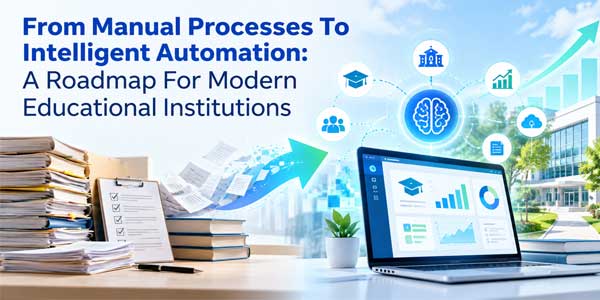
Educational institutions have traditionally relied on paperwork, spreadsheets, emails, physical registers, and disconnected software to manage everyday operations. While these methods may be manageable at a smaller scale, they become increasingly difficult to sustain as schools, colleges, and universities grow.
Today, institutions handle large volumes of information related to admissions, student records, academic activities, examinations, attendance, communication, finance, faculty operations, and administration. Managing these processes manually can consume valuable time while increasing the risk of delays, duplicate data, and human error.
This is where intelligent automation is becoming an important part of digital transformation in education.
The objective is not simply to replace paper with software. Modern institutions need to rethink how their processes work, connect information across departments, and use technology to create more efficient, transparent, and data-driven operations.
Table of Contents
Why Manual Processes Are Becoming a Challenge
One of the biggest limitations of manual processes is the creation of information silos. A student’s information may be stored in one spreadsheet, attendance records in another system, examination details somewhere else, and communication history across emails or messaging platforms.
When information is distributed across multiple locations, employees often have to collect, verify, and enter the same information repeatedly. This can create several operational challenges:
- Repetitive administrative work
- Duplicate data entry
- Delayed access to information
- Increased risk of human errors
- Difficulty generating accurate reports
- Limited visibility across departments
- Inefficient communication
- Higher dependence on individual employees
These challenges become more significant as the number of students, courses, departments, and administrative activities increases.
A well-planned education management system can help address these challenges by bringing important processes and information into a more structured digital environment.
What Does Intelligent Automation Mean in Education?
Automation in education does not mean that every process should operate without human involvement. Instead, intelligent automation combines software, workflows, integrations, data, and analytics to reduce repetitive work while allowing people to focus on activities that require professional judgment and interaction.
For example, when a student submits an online application, an automated workflow can capture the information, organize documents, notify the appropriate department, and update the relevant records.
Similarly, institutions can automate notifications related to attendance, assignments, examinations, fees, admissions, or important academic events.
The result is a connected workflow in which technology handles repetitive administrative steps while staff members remain responsible for decisions, exceptions, and student support.
Step 1: Identify Processes That Need Improvement
Before implementing new technology, institutions should understand their existing processes. Not every manual activity needs to be automated immediately.
A practical approach is to identify processes that:
- Consume significant administrative time
- Involve repetitive data entry
- Create frequent errors
- Require coordination between departments
- Depend heavily on spreadsheets or paper records
- Make reporting difficult
Common areas for improvement include:
- Student admissions
- Student registration
- Attendance management
- Examination workflows
- Fee management
- Academic scheduling
- Document management
- Student communication
- Faculty administration
- Reporting and analytics
Mapping these processes helps institutions understand where automation can deliver measurable operational value.
Step 2: Move From Disconnected Data to Centralized Information
A reliable and accessible information structure is one of the foundations of digital transformation.
Instead of maintaining multiple disconnected spreadsheets and applications, institutions can use centralized platforms to organize student, academic, administrative, and operational information.
A student management system can provide a structured environment for maintaining student profiles, academic records, attendance, documents, and other relevant information. Similarly, student database management becomes more efficient when information is maintained systematically rather than across scattered files.
A centralized student management portal can also give authorized users access to relevant information based on their roles.
This does not mean every employee should have access to everything. Role-based permissions can ensure that users see only the information and functions relevant to their responsibilities.
Centralized information also makes reporting easier because decision-makers can work with data collected within a connected digital environment.
Step 3: Automate Repetitive Workflows
Once important processes have been mapped and information has been organized, institutions can begin automating repetitive workflows.
Consider the admissions process!
In a traditional environment, an applicant may submit information through one channel, documents may be reviewed manually, payment information may be maintained separately, and staff members may communicate application updates through email or phone calls.
A digital workflow can connect these stages. Applications can be captured electronically, documents can be organized within the applicant’s record, status changes can trigger notifications, and relevant information can move between departments without repeated manual entry.
The same principle can be applied to attendance, examinations, fee collection, academic scheduling, document processing, and student communication.
For universities and colleges, a university ERP or college ERP can bring multiple institutional workflows into a connected environment. For schools, a school ERP can similarly support the digitization of academic and administrative processes.
The right platform should be selected according to the institution’s operational requirements rather than simply the number of modules available.
Step 4: Connect Different Systems
Automation becomes more effective when different applications can communicate with one another.
A modern educational institution may use separate systems for admissions, student management, finance, examinations, learning management, communication, and human resources. If these platforms operate independently, staff may still have to transfer information manually.
APIs and system integrations can help create connections between these applications.
For example, information from a student management system can be connected with an LMS for institute, allowing relevant student and course information to move between systems without unnecessary duplication.
Integration can also connect academic, administrative, and operational data, creating the foundation for campus automation.
The objective is not necessarily to replace every existing application. In many cases, the greater priority is to ensure that important systems can work together effectively.
Step 5: Introduce Data-Driven Decision-Making
Automation creates another valuable institutional resource: structured data.
When processes are managed digitally, institutions can collect information about applications, attendance, academic performance, course participation, payments, resource utilization, and other activities.
This information can be transformed into dashboards and reports that help administrators understand what is happening across the institution.
For example, administrators may analyze:
- Enrollment trends
- Attendance patterns
- Course participation
- Student engagement
- Academic performance
- Operational efficiency
- Resource utilization
The objective is not to collect data simply because it is available. The real value comes from converting reliable data into meaningful insights that can support informed decisions.
Step 6: Keep People at the Center
Technology should simplify institutional processes without removing the human element from education.
Teachers still need to teach. Administrators still need to make decisions. Students still need guidance and support.
Automation should therefore handle repetitive administrative activities wherever appropriate while allowing staff to spend more time on meaningful work.
For example, automated reminders can reduce the need for staff to repeatedly send routine notifications. Automated reports can reduce manual spreadsheet preparation. Digital workflows can make information easier to locate and share.
Specialized platforms can also support areas such as faculty management software, helping institutions organize faculty-related information and administrative workflows more systematically.
The time saved through automation can then be redirected toward student support, academic planning, communication, and institutional improvement.
Step 7: Prioritize Security and Access Control
As more institutional activities become digital, protecting information becomes increasingly important.
Educational systems can contain sensitive student records, academic results, financial information, faculty information, and institutional documents.
Modern digital platforms should therefore incorporate appropriate security measures, including:
- Authentication
- Role-based access
- Secure data transmission
- Regular backups
- Controlled permissions
- Appropriate data-access policies
Institutions should also establish clear policies regarding data access, retention, and usage.
Whether an institution is implementing a university ERP, school ERP, college ERP, or integrated education management system, automation should never come at the expense of data security.
The Role of Integrated Education Management Platforms
For institutions undergoing digital transformation, an integrated education management platform can provide a foundation for connecting different operational areas.
Solutions such as university management systems, college ERP platforms, school ERP software, student management systems, and learning management systems can support digital workflows across different departments.
These platforms can help institutions create a connected environment covering areas such as:
- Admissions and enrolment
- Student records
- Academic management
- Attendance
- Examinations
- Finance
- Faculty administration
- Learning management
- Communication
- Reporting and analytics
- Alumni management
For example, alumni management can help institutions maintain structured graduate information and engagement records after students complete their academic journey.
The broader objective is to create an integrated digital ecosystem in which information can move efficiently between relevant departments and stakeholders.
However, technology should always be evaluated according to an institution’s specific requirements, existing infrastructure, integration needs, security expectations, and long-term digital strategy.
Step 8: Start Small and Scale Gradually
Digital transformation does not have to happen overnight.
Attempting to automate every institutional process simultaneously can create unnecessary complexity. A phased approach is often more practical.
An institution might begin with a high-impact process such as admissions, student management, attendance, or examination administration. Once the workflow has been implemented and evaluated, additional processes can gradually be connected.
This approach allows teams to:
- Identify implementation challenges
- Improve workflows
- Train users
- Measure results
- Gather feedback
- Expand the system progressively
A phased strategy can make digital transformation more manageable while allowing institutions to build a stronger foundation for future automation.
Measuring the Impact of Automation
A successful automation strategy should be measurable.
Institutions can track indicators such as:
- Time required to complete administrative processes
- Reduction in manual data entry
- Processing turnaround time
- Number of errors or duplicate records
- Staff productivity
- Student response and engagement
- Report-generation time
- System usage
- Overall operational efficiency
These measurements can help institutions determine whether their technology investments are actually improving processes.
They can also reveal where additional integration, training, workflow redesign, or process improvement may be required.
The Future: From Automation to Intelligent Institutions
The next stage of digital transformation will extend beyond basic workflow automation.
Artificial intelligence, predictive analytics, cloud technologies, and advanced data integration can enable institutions to develop more intelligent digital environments.
AI may assist with areas such as student support, content recommendations, document processing, data analysis, and administrative assistance. Predictive analytics may help institutions identify patterns that require attention.
At the same time, learning technologies can become increasingly connected with institutional systems. An LMS for institute, for example, can form part of a broader digital ecosystem rather than functioning as an isolated learning platform.
However, intelligent technology should complement institutional expertise rather than replace it.
The future educational institution is likely to be one where technology quietly handles routine processes in the background while educators and administrators focus on teaching, strategy, innovation, and student success.
Conclusion
Moving from manual processes to intelligent automation is not simply a technology upgrade. It represents a transformation in how educational institutions manage information, people, and everyday operations.
The journey begins by identifying inefficient processes, centralizing information, automating repetitive workflows, connecting systems, strengthening data security, and using analytics to support informed decisions.
Whether an institution is exploring a university ERP, school ERP, college ERP, LMS for institute, student management system, or broader education management system, the underlying objective should remain the same: create connected processes that make institutional operations more efficient and information more accessible.
The goal should not be to automate everything.
The goal is to automate what can be automated, integrate what should be connected, and preserve human involvement where it creates the greatest value.
That balance can help educational institutions move from fragmented manual operations toward a more connected, efficient, data-driven, and future-ready model of education management.
 About the Author:
Siddhi is a Digital Marketing Manager with 6 years of experience in digital marketing, content strategy, SEO, and technology-focused communication. She writes about emerging digital trends, education technology, enterprise software, and how technology can help organizations improve their processes and user experiences.












Be the first to write a comment.