
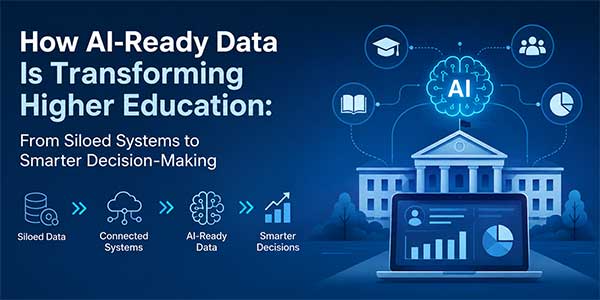
 Higher education institutions generate vast amounts of data across admissions, academics, learning, examinations, finance, student services, quality assurance, and alumni management. Yet when this information remains trapped in disconnected systems, spreadsheets, and departmental databases, its value for strategic planning is limited. AI-ready data changes this equation by making institutional information more structured, consistent, accessible, and suitable for advanced analytics and artificial intelligence.
This article explores how universities can move from siloed data environments toward integrated, decision-ready information ecosystems. It examines the role of centralized systems, data quality, interoperability, governance, analytics, and human oversight in building a reliable foundation for AI adoption. It also explains how better data can support enrollment planning, student success, academic performance, operational efficiency, quality assurance, and institutional strategy. For higher education leaders, the objective is not simply to adopt AI, but to build the data infrastructure that allows AI to produce useful, responsible, and actionable insights.
Table of Contents
Introduction:
Artificial intelligence is increasingly influencing how organizations analyze information, automate processes, identify patterns, and make decisions. Higher education is no exception. Universities and colleges now generate enormous amounts of information through admissions, student records, learning platforms, examinations, attendance systems, faculty operations, finance, research, feedback, and quality assurance.
The challenge, however, is not the lack of data. It is how data is stored, connected, interpreted, and used.
In many institutions, important information still exists across separate departmental systems, spreadsheets, legacy applications, documents, and standalone platforms. Admissions may maintain one database, academics another, the learning environment another, while quality teams rely on manually collected reports. Each system may work adequately on its own, but the institution can struggle to develop a unified view of what is happening across the campus.
This is where AI-ready data becomes important.
AI-ready data is not simply a large collection of information. It is data that is sufficiently accurate, structured, consistent, accessible, governed, and contextualized to support analytics and intelligent applications. For higher education institutions, building such a foundation can transform data from an administrative by-product into a strategic asset.
The Problem With Siloed Institutional Data:
Data silos develop naturally as institutions introduce technology over time. Different departments adopt systems according to their immediate requirements, often without a broader data architecture connecting them.
This can create several operational challenges.
First, the same information may be entered repeatedly across different systems. A student’s personal or academic information, for example, may exist in admissions, student management, examination, learning, and departmental records.
Second, definitions may vary between departments. One system may classify a student according to one status while another uses a different classification. When these datasets are combined for reporting, inconsistencies can affect the reliability of the result.
Third, fragmented information slows decision-making. Administrators may need to request reports from several departments before they can understand an institutional issue.
Finally, disconnected data makes advanced analytics more difficult. AI models depend on relevant and reliable information. If the underlying data is incomplete, duplicated, inconsistent, or poorly structured, even sophisticated AI tools can produce unreliable conclusions.
The first step toward intelligent decision-making, therefore, is not necessarily deploying another AI application. It is improving the data environment that the application will depend on.
What Makes Data AI-Ready?
AI-ready data should be viewed as an institutional capability rather than a technical buzzword. Several characteristics are particularly important.
1.) Data Accuracy:
Decisions are only as reliable as the information behind them. Institutions need processes that identify incorrect, outdated, duplicated, or incomplete records.
2.) Consistency:
Common definitions, formats, identifiers, and data standards make it easier to combine information from different systems.
3.) Accessibility:
Authorized users and applications should be able to access relevant information without depending entirely on manual extraction and spreadsheet-based consolidation.
4.) Context:
A number without context has limited value. AI systems need to understand what a particular data point represents, when it was generated, and how it relates to other institutional information.
5.) Governance:
Institutions must establish clear rules for ownership, access, security, retention, quality, and responsible use of data.
Together, these characteristics create a foundation on which analytics and AI applications can operate more effectively.
From Data Integration to Institutional Intelligence:
The transition from siloed systems to smarter decision-making does not necessarily mean replacing every existing application.
A more practical approach is to create an integrated information environment in which relevant systems can exchange data through appropriate interfaces, common standards, and centralized reporting mechanisms.
For example, an institution could bring together information from admissions, student management, learning systems, examinations, attendance, and institutional quality processes. This creates a broader view of the student and the institution without requiring every function to be managed by the same application.
Modern campus management and university management platforms increasingly follow this integrated approach. A centralized environment can connect academic and administrative processes while providing reporting capabilities that help decision-makers work from a more consistent information base.
The objective is not simply to collect more data. It is to make existing data more useful.
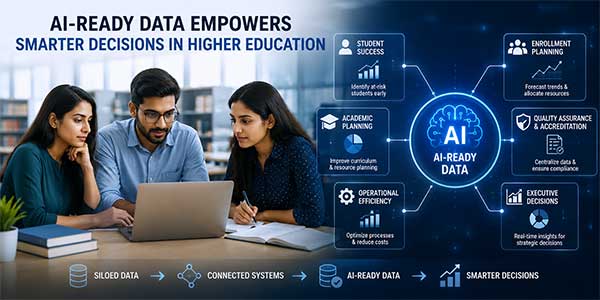
Where AI-Ready Data Can Improve Higher Education Decisions?
Once institutional information becomes more reliable and connected, AI and analytics can support a wide range of decisions.
Student Success and Early Intervention:
Universities can analyze patterns involving attendance, academic performance, learning activity, assessment results, and engagement to identify students who may require additional support.
Such systems should not replace academic judgment. Instead, they can help staff identify patterns earlier and prioritize attention where it may have the greatest value.
Enrollment and Admission Planning:
Historical admission data can help institutions identify application trends, understand demand patterns, and evaluate the performance of different recruitment channels.
When combined with other institutional information, these insights can support more informed enrollment planning and resource allocation.
Academic Planning:
Course participation, assessment performance, completion patterns, and learning activity can provide useful information for academic leaders.
Institutions can use these insights to identify courses that may require additional academic support, evaluate curriculum performance, and understand changing student needs.
Operational Efficiency:
AI-ready data can also improve non-academic decision-making.
When administrative information is connected, institutions can identify process bottlenecks, monitor workloads, analyze resource utilization, and reduce repetitive manual reporting.
This can be particularly valuable for large institutions where even small process inefficiencies can become significant when repeated across thousands of students and multiple departments.
Quality Assurance and Accreditation:
Quality assurance generates substantial amounts of institutional data and documentation.
A centralized digital approach can organize departmental information, stakeholder feedback, evidence, reports, action-taken records, and accreditation-related documentation. This creates a more structured information base for monitoring institutional performance.
For example, digital IQAC systems can centralize departmental data collection, evidence repositories, feedback management, AQAR workflows, and quality dashboards. The result is not merely easier documentation; it can provide quality teams with a more consistent view of institutional performance.
Executive Decision-Making:
Senior leadership needs information that is timely, relevant, and understandable.
Instead of waiting for manually prepared reports, decision-makers can use dashboards and analytical systems to monitor key institutional indicators and investigate emerging patterns.
This changes the role of institutional data from something reviewed periodically into something that can continuously support strategic management.
The Role of Integrated Digital Systems:
AI readiness cannot be created through an AI tool alone.
Higher education institutions need a broader digital ecosystem in which core systems can exchange information and maintain consistent records.
Enterprise resource planning, campus management systems, learning management systems, admission platforms, examination systems, CRM platforms, document management solutions, and quality management applications can each contribute different types of institutional information.
The critical question is whether these systems can work together effectively.
An integrated architecture reduces unnecessary duplication and makes it easier to establish a reliable institutional data layer. It can also provide a stronger foundation for analytics, automation, dashboards, and future AI applications.
This is particularly relevant as universities move toward more connected campus environments where academic, administrative, student-service, and quality functions increasingly depend on shared information.
Data Governance Must Come Before AI at Scale:
There is a tendency to view AI adoption as primarily a technology decision. In higher education, it is equally a governance decision.
Institutions should define who owns different categories of data, who can access them, how information is validated, how long it should be retained, and how sensitive records are protected.
Access controls should follow institutional roles and responsibilities. Data should be protected throughout its lifecycle, and processes should exist for identifying and correcting inaccurate information.
Governance also matters when AI-generated recommendations influence institutional decisions.
An AI system may identify a pattern, but administrators still need to understand the context, limitations, and potential consequences before acting on it.
The goal should therefore be AI-assisted decision-making rather than unchecked AI decision-making.
A Practical Roadmap for Becoming AI-Ready:
Higher education institutions do not need to transform everything at once. A phased approach can make the transition more manageable.
Step 1: Map Existing Data
Identify where institutional data is currently stored and which departments generate or use it.
Step 2: Identify Critical Data Gaps
Determine which information is duplicated, incomplete, inconsistent, outdated, or difficult to access.
Step 3: Establish Common Standards
Create consistent definitions, formats, identifiers, and data ownership rules across departments.
Step 4: Connect Core Systems
Prioritize integration between systems that contribute significantly to institutional reporting and decision-making.
Step 5: Centralize Reporting
Develop dashboards and reporting environments that provide authorized users with a consistent view of key institutional indicators.
Step 6: Introduce AI Where It Adds Value
Once the underlying information is reliable, institutions can introduce AI for use cases such as predictive analytics, automated reporting, intelligent search, student support, and process optimization.
Step 7: Monitor and Improve
AI readiness is not a one-time project. Data quality, governance, system integration, and model performance should be reviewed continuously.
The Future Is Not More Data, But Better Data:
Higher education institutions will continue generating more information as digital learning, connected campuses, online services, automation, and intelligent applications expand.
But volume alone will not create better decisions.
The institutions that gain the greatest value from AI are likely to be those that first establish reliable foundations for collecting, organizing, connecting, governing, and interpreting information.
AI can identify patterns at remarkable speed, but it still depends on the quality and context of the information it receives.
For universities and colleges, becoming AI-ready therefore begins with a fundamental shift in perspective: data should be treated as an institutional asset rather than a collection of departmental records.
When siloed information is transformed into connected, trusted, and actionable data, institutions can move beyond reactive reporting toward more informed planning, faster intervention, stronger quality management, and smarter strategic decisions.
The future of AI in higher education will not be determined only by which institution adopts the most advanced AI tools. It will increasingly depend on which institution builds the strongest data foundation to use those tools responsibly and effectively.
 About the Author:
Siddhi is a Digital Marketing Manager at Sonet Microsystems with over 6 years of experience in digital marketing, content strategy, SEO, and brand development. With a strong interest in technology and digital transformation, she focuses on translating complex industry trends into practical insights for businesses and organizations. Her expertise spans data-driven marketing strategies, online visibility, content development, and brand positioning, helping businesses strengthen their digital presence and achieve sustainable growth. Her content reflects a practical understanding of evolving technologies, market dynamics, and the changing digital landscape.













Be the first to write a comment.