
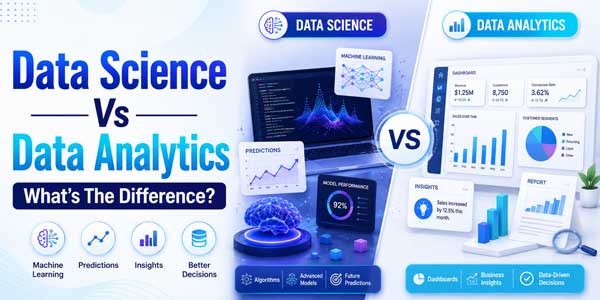
Almost every business leader I talk to says they want to be “more data-driven.” Fewer of them can tell me whether that means hiring a data analyst or a data scientist. It’s an easy mix-up; the two fields overlap enough to blur together in a job posting, but the work, the skills, and the business value they deliver are genuinely different.
Get this wrong, and you end up with a mismatch: a data scientist bored writing weekly sales reports, or a data analyst stuck trying to build a machine learning model they were never hired to build. Data science vs data analytics isn’t a semantic debate. It’s a hiring and budgeting decision that affects what your data team can actually deliver.
Table of Contents
The Short Answer:
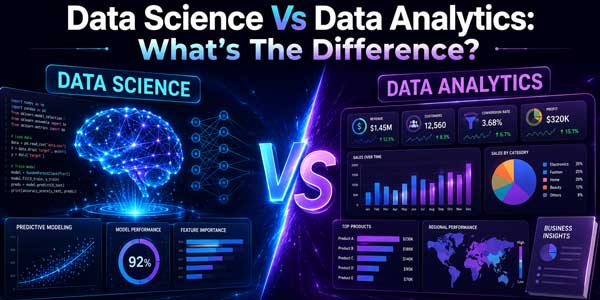
Data analytics looks at data you already have to explain what happened and why. Data science goes further; it builds models and systems that predict what’s likely to happen next, or automate a decision based on new data as it arrives. Analytics answers questions with the past. Data science builds tools that act on the future.
That’s the one-sentence version. The real difference shows up in the day-to-day work, the tools each field relies on, and what a business actually gets out of hiring one over the other.
What Data Analytics Actually Involves?
A data analyst takes existing data- sales figures, customer behavior, website traffic- and turns it into something a manager can act on. That usually means cleaning messy spreadsheets, writing SQL queries, building dashboards, and explaining in plain language why a metric moved.
The work is grounded almost entirely in explaining the past and present. A good analyst can tell you why churn spiked last quarter, or which marketing channel actually drove the signups everyone’s celebrating. What they typically don’t do is build a system that predicts churn six months before it happens. That’s a different skill set, and a different job.
Common analytics tools: SQL, Excel, Tableau, Power BI, Looker, basic Python or R for statistical analysis.
What Data Science Actually Involves?
A data scientist starts from a similar place: messy, real-world data, but the goal is different. Instead of explaining what already happened, they’re building something that predicts what will happen or automates a decision. That means training machine learning models, running experiments, and often writing production code that gets deployed into a live product.
This is where the math gets heavier, and the tooling gets more technical. A data scientist needs statistics, programming, and often some understanding of how software gets deployed and maintained once it’s live, not just how to build a model in a notebook.
Common data science tools: Python, R, SQL, machine learning frameworks like scikit-learn, TensorFlow, or PyTorch, cloud platforms for training and deploying models, and often some familiarity with software engineering practices.
Side-by-Side Comparison:
| Aspect | Data Analytics | Data Science |
| Core question | What happened, and why? | What’s likely to happen next? |
| Typical output | Dashboards, reports, recommendations | Predictive models, algorithms, automated systems |
| Data used | Mostly structured, historical data | Structured and unstructured, often real-time |
| Core skills | SQL, spreadsheets, visualization, statistics | Statistics, programming, machine learning, some software engineering |
| Time horizon | Backward-looking | Forward-looking |
| Business role | Informs decisions | Powers products and predictions |
| Typical background | Business, statistics, or analytics degree | Computer science, statistics, or applied math background |
Where the Two Actually Overlap?
Neither field lives in a clean box. Analysts increasingly use basic statistical models to go beyond simple reporting, and data scientists spend a surprising amount of their week doing the same unglamorous data cleaning and exploration that analysts do. The line between “explaining a trend” and “building a model to explain a trend” gets blurry fast, which is part of why the two job titles get confused so often.
In practice, the honest way to think about it: analytics is the foundation, and data science builds on top of it. You can’t train a useful predictive model on data nobody’s bothered to understand first.
A Real Business Scenario:
Say a subscription business notices its churn rate creeping up. A data analyst digs into the existing data and finds that churn is highest among customers who never used a specific feature in their first two weeks. That’s genuinely useful; it tells the product team exactly where to focus onboarding.
A data scientist takes it a step further: they build a model that scores every current customer’s churn risk based on early usage patterns, so the customer success team can reach out before someone actually cancels, not after. Both roles added real value here. They just answered different questions.
Which One Does Your Business Actually Need?
Most companies need analytics before they need data science, and a lot of businesses never need data science at all. If your team is still figuring out which reports to trust or struggling to explain last month’s numbers, a data scientist isn’t going to fix that. You need someone who can clean up your reporting and build dashboards leadership actually looks at.
Data science earns its cost when you have enough historical data, a clear predictive use case, and the infrastructure to actually deploy a model into a live product or workflow. Hiring a data scientist before you have solid analytics in place is a common and expensive mistake. There’s rarely clean, trustworthy data for a model to learn from.
A Quick Decision Checklist:
- Choose analytics first if: you need clearer reporting, better dashboards, or help understanding why a metric changed.
- Choose data science if: you have a specific prediction or automation problem, and the historical data to support it.
- Choose both, eventually: most mature data teams have analysts handling reporting and data scientists building on top of clean, well-understood data.
- Watch for a red flag: if you’re hiring a data scientist mainly to build dashboards, you’re paying for a skill set you don’t need yet.
Key Takeaways:
- Data analytics explains what already happened, using mostly structured, historical data.
- Data science builds models and systems that predict or automate future outcomes.
- The two fields overlap in daily tasks but differ in tools, skills, and what the business ultimately gets from the work.
- Most companies benefit from strong analytics before they’re ready for data science.
- Hiring the wrong role for your actual problem is one of the most common and costly data hiring mistakes.
Frequently Asked Questions:
Is data science just a more advanced version of data analytics?
Not exactly. Data science builds on some of the same foundations, but it’s oriented toward prediction and automation rather than explanation. The skill sets overlap, but the goals and typical outputs are different.
Do data analysts need to know machine learning?
Not usually. Most analytics roles focus on SQL, visualization, and statistical reporting. Some analysts pick up basic modeling skills, but deep machine learning expertise is generally a data scientist’s job.
Which pays more, data science or data analytics?
Data science roles typically command higher salaries because they require more specialized technical skills, including programming and machine learning, and often carry more responsibility for products that reach production.
Can one person do both jobs?
In smaller companies, yes, it’s common for one person to handle both reporting and light predictive modeling. As a company grows, the roles usually split because each one benefits from focused expertise.
What background do you need for each role?
Analysts often come from business, economics, or statistics backgrounds. Data scientists more often come from computer science, statistics, or applied math, though strong analysts sometimes transition into data science with additional training.
Should a startup hire a data scientist or a data analyst first?
Almost always an analyst first. Startups typically need clean reporting and clear insight into existing data before a predictive model has anything useful to learn from.
What tools should I expect each role to use?
Analysts typically work in SQL, Excel, Tableau, or Power BI. Data scientists typically work in Python or R, machine learning libraries, and cloud infrastructure for training and deploying models.
Is data analytics becoming obsolete because of data science?
No. If anything, demand for solid analytics has grown alongside data science, since every predictive model still depends on well-understood, well-organized data to learn from.
Conclusion:
Data science vs data analytics isn’t a question of which one is more advanced or more valuable. They solve different problems. Analytics tells you what’s happening in your business right now and why. Data science tells you what’s likely to happen next and gives you a way to act on it automatically. The businesses that get the most out of their data usually get the sequence right: solid analytics first, data science once there’s a clear predictive problem worth solving.
If you’re not sure which one your team actually needs right now, start by looking at whether your current reporting answers your questions clearly. That answer usually points you in the right direction.
 About the Author:
Raj Shah, CEO of Cephei Infotech, is a forward-thinking technology leader dedicated to helping enterprises build, scale, and transform digital products through innovation and engineering excellence. With deep expertise in Agentic AI, Data & Analytics, Custom Software Development, and Resource Augmentation, he leads the delivery of intelligent, scalable solutions that accelerate digital transformation, enhance operational efficiency, and enable organizations to achieve sustainable growth in an increasingly competitive digital economy.












Be the first to write a comment.