
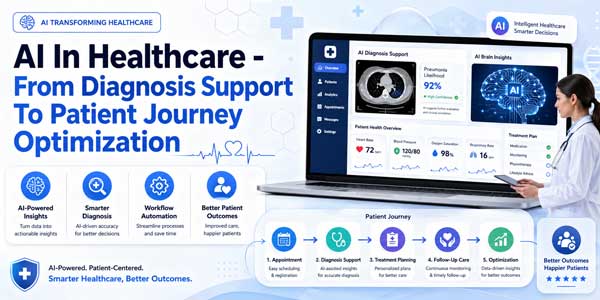
Healthcare has always relied on the expertise of medical professionals to diagnose diseases, recommend treatments, and care for patients. Today, artificial intelligence (AI) is becoming a valuable partner in that process. Instead of replacing doctors, AI is helping them make faster, more informed decisions while reducing the administrative burden that often takes time away from patient care.
The healthcare industry generates enormous volumes of data every day, from medical images and lab reports to electronic health records and wearable device data. AI makes it possible to analyze this information quickly, identify patterns, and provide actionable insights that would otherwise take hours or even days to uncover.
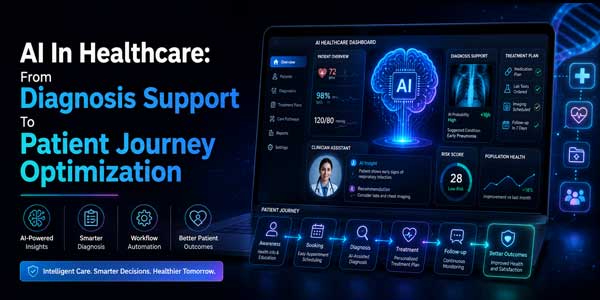
The impact extends far beyond diagnosis. AI is improving every stage of the patient journey, from scheduling appointments and supporting clinical decisions to monitoring recovery and managing chronic conditions.
According to industry research, nearly 90% of healthcare workers stay late every week to complete paperwork, and 70% say they would welcome AI tools to assist with tasks such as care coordination, patient communication, and personalized treatment planning. Yet, only 39% feel adequately prepared to work with AI technologies, highlighting both the opportunity and the need for responsible implementation.
In this article, we’ll explore how AI is transforming healthcare, its role in diagnosis support, and how it is creating a more connected, personalized patient experience.
Table of Contents
What Is AI in Healthcare?
AI in healthcare refers to the use of artificial intelligence technologies that assist healthcare professionals in making better clinical and operational decisions. Using machine learning, natural language processing (NLP), predictive analytics, and generative AI, these systems analyze large volumes of medical data to identify patterns, detect risks, and recommend appropriate actions.
Rather than replacing physicians, AI serves as a decision support system. It helps clinicians interpret complex information faster while improving accuracy and consistency. AI also automates repetitive administrative work, allowing doctors and nurses to spend more time focusing on patient care.
AI in Diagnosis Support
Early and accurate diagnosis is one of the most valuable applications of AI in healthcare. Detecting diseases at an earlier stage often leads to better treatment outcomes, reduced healthcare costs, and improved patient survival rates.
Medical Imaging Analysis:
Medical imaging is one of the areas where AI has shown remarkable success. AI algorithms can analyze X-rays, CT scans, MRIs, and mammograms to identify abnormalities such as tumors, fractures, strokes, or lung diseases.
Instead of replacing radiologists, AI highlights suspicious areas that deserve closer attention. This helps specialists review images more efficiently while reducing the likelihood of missed findings.
Predictive Disease Detection:
AI systems analyze patient histories, laboratory results, genetic information, and lifestyle factors to estimate disease risks before symptoms become severe.
For example, predictive models can identify patients who may be at higher risk of diabetes, cardiovascular disease, kidney failure, or sepsis. This allows healthcare providers to intervene earlier with preventive care and personalized treatment plans.
Clinical Decision Support:
Doctors often need to evaluate thousands of data points before making treatment decisions. AI-powered clinical decision support systems summarize relevant medical records, compare current cases with similar historical cases, and recommend evidence-based treatment options.
These recommendations help clinicians make more confident decisions while maintaining complete control over patient care.
Optimizing the Entire Patient Journey:
Healthcare extends far beyond diagnosis. Every patient experiences multiple touchpoints before, during, and after treatment. AI helps create a smoother, more connected journey across each stage.
Smarter Patient Scheduling:
Appointment scheduling has traditionally involved long wait times and manual coordination.
AI-powered scheduling systems automatically match patients with available providers, prioritize urgent cases, send reminders, and reduce missed appointments. This improves operational efficiency while providing a better patient experience.
AI-Powered Virtual Assistants:
Virtual health assistants provide patients with immediate access to basic healthcare information around the clock.
These conversational systems answer common questions, help schedule appointments, provide medication reminders, explain discharge instructions, and guide patients toward appropriate care when necessary. More complex concerns can be escalated directly to healthcare professionals.
Personalized Treatment Plans:
Every patient responds differently to treatment. AI analyzes clinical history, medications, genetic information, and lifestyle data to recommend personalized care plans tailored to individual needs.
This personalized approach supports better treatment adherence and improves long-term health outcomes.
Remote Patient Monitoring:
Wearable devices and connected health technologies continuously collect information such as heart rate, blood pressure, glucose levels, oxygen saturation, and physical activity.
AI analyzes this real-time data to detect unusual patterns and notify healthcare teams before conditions become critical. This approach is especially valuable for managing chronic diseases and supporting elderly patients at home.
Improving Healthcare Operations:
Healthcare organizations face increasing pressure to deliver quality care while managing costs and administrative complexity. AI helps improve operational efficiency across multiple functions.
Administrative tasks such as documentation, insurance verification, patient intake, and clinical note generation can be partially automated, reducing the workload on healthcare professionals.
Natural language processing also converts unstructured physician notes into structured medical records, improving documentation accuracy while saving valuable time.
AI also supports hospital resource planning by forecasting patient demand, optimizing staff schedules, and improving bed utilization. These improvements enable hospitals to deliver better care with existing resources.
Benefits of AI Across the Healthcare Ecosystem:
The adoption of AI delivers measurable benefits for patients, providers, and healthcare organizations.
Some of the most significant advantages include:
- Faster and more accurate diagnosis
- Personalized treatment recommendations
- Earlier disease detection
- Reduced administrative workload
- Better patient engagement through continuous communication
- Improved resource allocation and operational efficiency
- Lower healthcare costs over time
- Enhanced support for remote and preventive care
Together, these benefits contribute to a more efficient healthcare system while improving patient satisfaction and clinical outcomes.
Challenges That Still Need Attention:
Despite its potential, AI adoption comes with important challenges.
Data privacy remains a major concern because AI systems require access to large amounts of sensitive patient information. Healthcare organizations must implement strong cybersecurity measures while complying with regulations governing patient data.
Another challenge involves bias in AI models. If training data lacks diversity, recommendations may become less accurate for certain patient populations.
Healthcare professionals also need adequate training to understand AI recommendations and recognize their limitations. AI should always function as a support tool rather than replacing clinical expertise.
Successful implementation depends on combining advanced technology with transparent governance, continuous monitoring, and human oversight.
The Future of AI in Healthcare:
AI is rapidly evolving from an experimental technology into a core component of modern healthcare delivery.
Future innovations will include more advanced predictive analytics, AI-assisted robotic surgery, personalized precision medicine, continuous remote monitoring, and intelligent clinical documentation. As these technologies mature, healthcare organizations will be able to deliver more proactive, efficient, and patient-centered care.
The greatest value of AI will not come from replacing healthcare professionals but from empowering them with faster insights, better decision support, and more time to focus on what matters most: delivering compassionate patient care.
Conclusion:
Artificial intelligence is reshaping healthcare by supporting faster diagnosis, improving operational efficiency, and enhancing every stage of the patient journey. From identifying diseases earlier to enabling personalized treatments and continuous remote monitoring, AI is helping healthcare providers deliver better outcomes while reducing administrative burdens.
However, technology alone cannot transform healthcare. Responsible implementation, high-quality data, strong governance, and skilled medical professionals remain essential for success.
Organizations that embrace AI thoughtfully will be better positioned to provide smarter, more efficient, and patient-focused healthcare in the years ahead.
 About the Author:
Kajal Yadav is a technology content writer specializing in AI in healthcare, automation, and analytics. She explores how intelligent technologies are transforming patient care, streamlining clinical workflows, and enabling data-driven decision-making. Through her content, she helps business and technology leaders understand the practical impact of AI and automation on building more efficient, scalable, and future-ready healthcare systems.













Be the first to write a comment.