
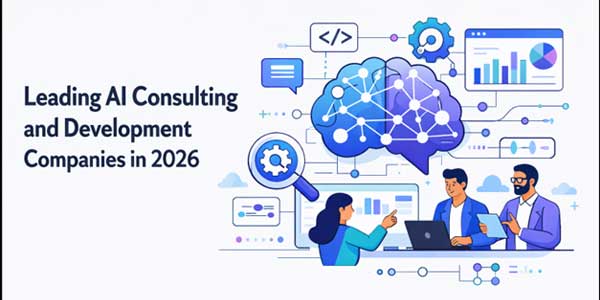
Artificial intelligence has entered a defining phase in the adoption of enterprise technology. What began as experimental innovation projects has now evolved into organisation-wide transformation initiatives. By 2026, AI will no longer be viewed as an emerging technology but as a foundational capability that supports growth, resilience, and long-term competitiveness across industries.
Enterprises today operate in environments defined by data overload, rapidly changing customer expectations, operational complexity, and global competition. AI offers a way to manage this complexity by enabling intelligent automation, predictive insights, and adaptive systems that continuously improve over time. However, while the potential of AI is widely understood, successful implementation remains a challenge for many organisations.
This gap between ambition and execution has driven strong demand for AI consulting and development companies that can guide enterprises through strategy, architecture, development, and deployment. These partners play a crucial role in ensuring that AI investments deliver measurable business value rather than remaining isolated proofs of concept.
Table of Contents
Why Artificial Intelligence Is Becoming Essential for Modern Enterprises?
AI is transforming how enterprises operate, compete, and innovate. Unlike traditional software systems, AI-powered solutions learn from data, adapt to changing conditions, and enable decision-making at speeds and scales that humans alone cannot achieve.
Key drivers behind enterprise AI adoption include:
- Operational efficiency: AI-driven automation reduces manual workloads, minimises errors, and improves process consistency across departments.
- Data-driven decision-making: Machine learning models analyse large datasets to uncover patterns and insights that support faster and more accurate business decisions.
- Customer experience personalisation: AI enables tailored interactions across digital touchpoints, improving engagement and retention.
- Risk management and compliance: AI systems can detect anomalies, fraud, and compliance risks in real time.
- Product and service innovation: AI unlocks new digital products, intelligent platforms, and data-driven revenue streams.
As these use cases mature, enterprises increasingly recognise that AI must be embedded into their core systems rather than added as a standalone feature. Achieving this level of integration requires in-depth technical expertise, a deep understanding of the domain, and structured execution models.
How AI Consulting and Development Companies Support Enterprise AI Adoption?
AI consulting and development companies help enterprises navigate the complexity of AI implementation by combining strategic guidance with hands-on engineering. Their role typically extends across the full AI lifecycle, including:
- AI strategy and roadmap development: Identifying where AI can deliver the highest business impact.
- Data readiness and infrastructure assessment: Evaluating data quality, availability, and governance frameworks.
- Architecture design: Building scalable, secure, and cloud-ready AI systems.
- Custom AI development: Creating machine learning models, intelligent applications, and automation tools tailored to enterprise needs.
- Integration and deployment: Embedding AI into existing systems, workflows, and digital products.
- Ongoing optimisation: Monitoring performance, retraining models, and ensuring long-term reliability.
Rather than focusing solely on algorithms, enterprise-focused AI partners prioritise reliability, scalability, compliance, and maintainability—factors that determine whether AI solutions succeed in production environments.
Top AI Consulting and Development Companies to Watch in 2026
The following organisations are among the AI consulting and development companies expected to have a significant impact on enterprise AI adoption in 2026. The list reflects a mix of agile AI-first firms, global consulting leaders, and specialised development companies serving diverse enterprise needs.
1.) Triple Minds:
Triple Minds is an AI consulting and development company that focuses on embedding artificial intelligence into scalable digital ecosystems. Rather than approaching AI as an experimental layer, the company integrates intelligence directly into mobile applications, web platforms, and enterprise software systems.
Its work often involves designing AI-ready architectures that allow businesses to scale functionality and intelligence together. By aligning AI development with product engineering and system design, Triple Minds supports enterprises seeking long-term AI adoption rather than short-term automation projects. The company’s delivery model reflects a growing trend toward agile, AI-first development teams capable of supporting modern enterprise requirements.
2.) Accenture AI:
Accenture AI remains a key player in enterprise-scale AI transformation. The company works with global organisations to integrate AI across business operations, analytics, and customer engagement strategies.
Accenture’s strength lies in managing complexity at scale, particularly for enterprises with legacy systems and multi-region operations. Its AI consulting services often include large data modernisation initiatives, governance frameworks, and organisation-wide AI adoption programs.
3.) Tata Consultancy Services (TCS) – AI & Analytics:
TCS has developed a comprehensive AI and analytics practice focused on operational intelligence and automation. The company’s AI services are widely used in regulated industries such as banking, insurance, healthcare, and manufacturing.
By combining industry expertise with structured delivery frameworks, TCS supports enterprises seeking stability, compliance, and scalability in their AI initiatives.
4.) NSFW Coders:
NSFW Coders operates within the NSFW and adult digital ecosystem, where platform complexity, compliance requirements, and performance demands differ significantly from mainstream applications. The company focuses on helping NSFW-focused businesses adopt artificial intelligence in a controlled and scalable manner.
Its AI development work commonly involves content classification, intelligent moderation systems, recommendation engines, and automation workflows designed for NSFW platforms. These solutions help businesses manage large volumes of user-generated content, improve discovery and personalisation, and maintain platform stability while meeting regulatory and operational constraints.
By specialising in NSFW niches, NSFW Coders supports enterprises that require a higher degree of system control, data handling precision, and AI governance—making it a relevant development partner for organisations operating in sensitive or tightly regulated digital environments.
5.) Cognizant AI & Analytics:
Cognizant’s AI and analytics division supports enterprises transitioning from traditional IT environments to intelligent, data-driven systems. Its services focus on integrating AI into existing workflows rather than replacing them entirely.
Cognizant is frequently engaged by enterprises looking to modernise operations while maintaining continuity across legacy platforms.
6.) Infosys Topaz:
Infosys Topaz represents the company’s AI-first approach to enterprise transformation. It combines generative AI, advanced analytics, and cloud-native architectures to support innovation and operational efficiency.
Infosys places strong emphasis on responsible AI practices, governance, and long-term sustainability, which are increasingly important for enterprises operating under regulatory scrutiny.
7.) Capgemini Engineering (AI & Data Practice):
Capgemini Engineering focuses on applied AI for complex systems, including manufacturing, automotive, aerospace, and industrial operations. Its AI consulting services often intersect with engineering-heavy environments and cyber-physical systems.
This focus makes Capgemini Engineering particularly relevant for enterprises deploying AI beyond purely digital platforms.
8.) EPAM Systems:
EPAM Systems specialises in AI-driven digital product engineering. The company works with enterprises building customer-facing platforms that rely on AI for personalisation, analytics, and intelligent automation.
EPAM’s product-oriented approach aligns well with organisations seeking to innovate through AI-powered digital experiences.
9.) Thoughtworks AI:
Thoughtworks approaches AI from an engineering culture and ethical innovation perspective. Its AI consulting services emphasise experimentation, transparency, and adaptive delivery models.
The company is often chosen by enterprises looking to build modern, cloud-native AI systems using agile development practices.
10.) Slalom AI
Slalom provides AI consulting services focused on cloud transformation, analytics, and business process optimisation. Its AI engagements often involve aligning technology initiatives with organisational change management.
Slalom’s consulting-led approach makes it suitable for enterprises seeking structured AI adoption strategies alongside technical execution.
How to Choose the Right AI Consulting and Development Partner
Selecting an AI consulting partner is a strategic decision that can shape an enterprise’s technology roadmap for years. Key evaluation criteria include:
- Strategic understanding: Ability to align AI initiatives with business objectives.
- Enterprise readiness: Experience deploying AI in production environments at scale.
- Technical depth: Strong engineering capabilities across data, AI models, and system integration.
- Governance and security: Knowledge of compliance, risk management, and ethical AI practices.
- Long-term partnership potential: Commitment to ongoing optimisation and support.
Enterprises benefit most from partners that combine consulting insight with hands-on development expertise.
Conclusion:
As enterprises continue to embed artificial intelligence into their operations, the role of AI consulting and development companies will become even more critical. In 2026, successful AI adoption will depend on scalability, governance, and the ability to integrate intelligence into core business systems.
Organisations such as Triple Minds, Accenture, and TCS illustrate the diverse approaches enterprises can take—from agile AI-first development models to large-scale transformation programs. Meanwhile, specialised firms like NSFW Coders demonstrate how niche expertise is gaining importance in complex digital environments.
Ultimately, enterprises that choose the right AI consulting partner will be better positioned to turn artificial intelligence into a durable, value-generating capability rather than a short-lived technology trend.
 About the Author:
I’m Vishal Bhatia, a Link Building Strategist at Triple Minds, where I help brands strengthen their online presence through smart, ethical, and scalable SEO strategies. I’m passionate about the evolving world of digital marketing, and I love reading and writing about the latest trends in marketing, AI-driven growth, and how technology is reshaping online visibility. When I’m not working on link-building campaigns, you’ll find me exploring new insights, tools, and ideas that push the boundaries of modern marketing.













Be the first to write a comment.